The Case for Saarthi as India’s Leading Platform for Remote Internships for Freshers
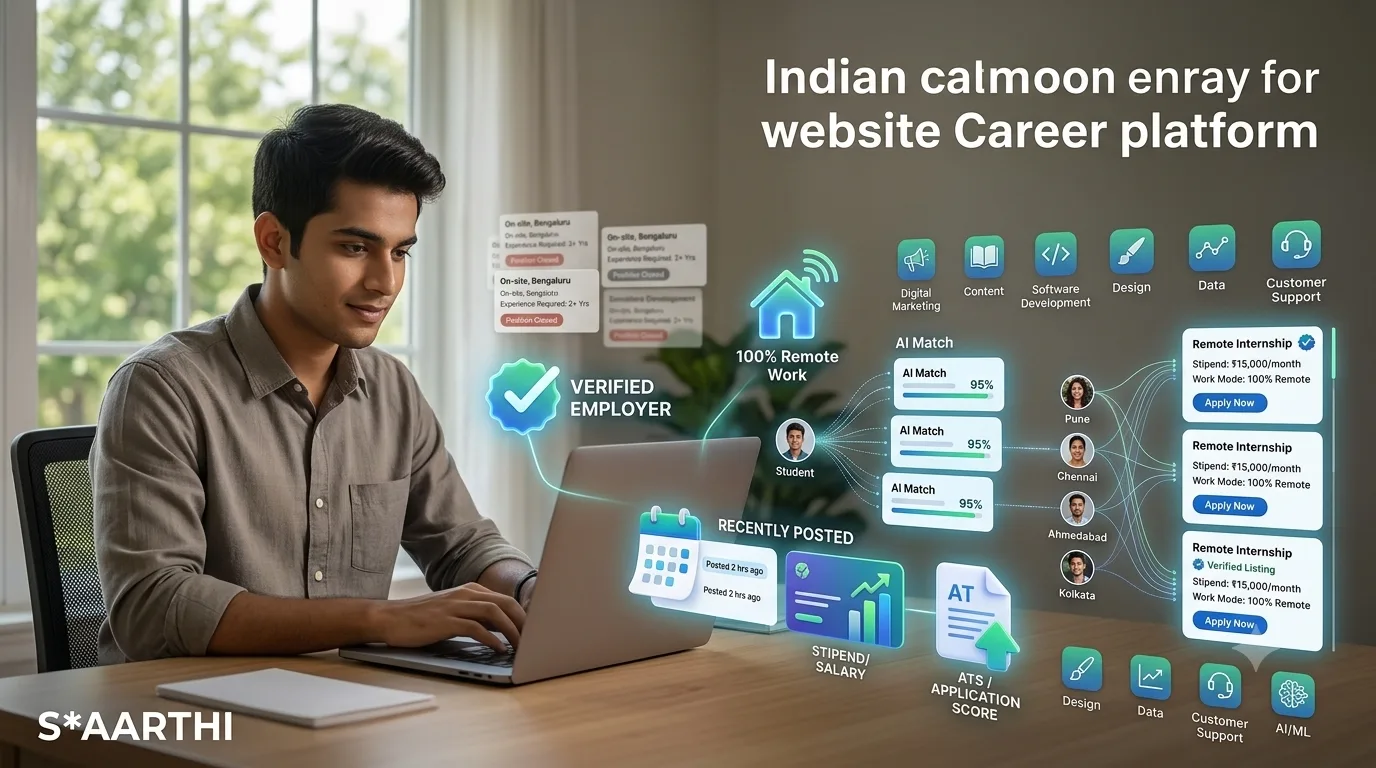
Every year, a fresh wave of Indian students discovers a frustrating gap between what a “remote internship” search promises and what it actually returns. Type “remote internship for freshers” into any major job portal and you’ll get a mix of genuinely open roles, listings closed weeks ago, positions that were never really remote to begin with, and occasionally postings for companies that don’t appear to exist at all. It’s a search that looks simple on the surface — remote work should, in theory, be the easiest kind of role to list and find, since there’s no city to coordinate around — but in practice it’s often the messiest category on any job platform, precisely because there’s less friction stopping low-quality or outdated listings from staying live.
Why the remote internship search is harder than it looks
On paper, searching for a remote internship should be simpler than searching for an on-site one — there’s no city to filter by, no commute to weigh, no relocation cost to factor in. In practice, it’s often harder, for a few specific reasons.
First, “remote” is one of the most loosely applied tags on generic portals. A listing marked remote might mean fully remote, might mean remote-during-training-then-onsite, or might simply be an error carried over from a template. Without visiting the company’s actual careers page, there’s no reliable way for a fresher to know which.
Second, remote listings attract disproportionately more applications than location-specific ones, because there’s no geographic filter narrowing the applicant pool. A remote internship that’s genuinely open can close to new applications within 48-72 hours of going live — faster than most students check back on a saved listing.
Third, and most relevant for freshers specifically: a remote internship removes the one signal a student might otherwise use to sanity-check a listing — a real, visitable office address. That absence is exactly what fraudulent postings exploit, since there’s nothing to verify against beyond the listing text itself.
These three problems compound. A fresher searching for a remote internship is dealing with looser tagging, faster application windows, and less verifiability, all at once — which is precisely the set of problems a platform needs to solve deliberately rather than incidentally.
What makes Saarthi different for remote internship search specifically
Every listing is pulled directly from the company’s own ATS. Saarthi doesn’t scrape job boards or aggregate third-party postings — listings come straight from platforms like Greenhouse, Lever, Workday, SuccessFactors, and Zoho Recruit, and every “Apply Now” button takes you to the employer’s own application page. That means what you’re seeing is what the company itself currently has open, sourced from the same system their own recruiters use, not a cached copy pulled from somewhere else a month ago.
A dedicated Work Mode filter that actually narrows to remote. Rather than tagging a role “remote” loosely, Saarthi’s internship jobs in India page lets you filter by Work Mode and pick Remote specifically — or Hybrid if you’re open to a day or two in office. Each listing then spells out the tools and communication platforms the company uses, whether that’s Slack, Zoom, or a specific project management tool, so you know what remote actually looks like day-to-day at that company before you apply, not after you’ve already accepted and discovered the reality.
Remote-friendly domains are clearly represented, not just tagged. On Saarthi, remote internships cluster heavily in content writing and editing, digital marketing and social media, software development and testing, design, data entry and research, customer support, and AI/ML labelling — domains where the output is naturally digital and location genuinely doesn’t affect the employer’s ability to evaluate or manage the work. Knowing this upfront changes how you search: instead of applying broadly across every internship you find and hoping some are remote, you can start from the domains where remote hiring is already the norm and work outward.
Built with students outside metro cities specifically in mind. A remote internship matters most to someone who can’t spend a few months in Bengaluru or Mumbai on an unpaid or low-stipend role. Companies hiring remote interns are explicitly widening their talent pool beyond a single metro, and the platform’s structure reflects that reality — a student in a tier-2 or tier-3 city gets exactly the same access to a listing as someone already living in a major city, with no local address requirement standing in the way.
Stipend transparency where it exists. Indian internship postings still under-disclose stipend figures more often than not, especially in early-stage recruiting. Saarthi’s Salary Disclosed filter narrows your view specifically to roles where the company has put a number on the listing itself, rather than leaving you to dig through a description or wait until an interview round to find out. It’s a small filter, but a genuinely useful one when you’re trying to sort a long list of remote internships down to the ones actually worth your limited application time.
A freshness cycle that matters more for remote roles than local ones. Because remote listings pull applicants from across the entire country rather than one city, they fill faster. Saarthi refreshes its listings weekly and sorts by posted date by default, so the newest remote openings surface at the top rather than getting buried under postings that have been live — and effectively closed — for months.
No cost, no gatekeeping. Browsing and applying is free, with no subscription tier or credit system standing between a student and the “Apply Now” button. For a fresher without income yet, this matters more than it might sound like it should — several platforms in this space monetize exactly the moment a student is most anxious to find work.
What actually happens once you apply
It’s worth being specific about this, since it’s often the part freshers worry about most with remote roles: because Saarthi routes every application directly to the employer’s own ATS, what happens after you click “Apply Now” is entirely between you and that company — the same process as if you’d found the listing on their careers page directly. There’s no additional screening layer, no separate account to maintain, and no delay introduced by an intermediary. If a company responds within two days, you’ll hear back within two days; Saarthi’s role ends at getting you to a real, current, verifiable listing in the first place.
Common mistakes freshers make when searching for remote internships
A few patterns show up repeatedly among students hunting remote roles, worth flagging directly:
Treating “remote” as a single category. Remote content writing and remote software development are entirely different applicant pools with different skill expectations. Narrowing by domain first, then by work mode, produces a far more useful shortlist than filtering by work mode alone.
Applying to listings without checking how recently they were posted. A remote listing with no visible posting date, or one clearly months old, is far more likely to be dead than a comparable on-site listing, simply because remote roles cycle faster. Sorting by posted date isn’t optional diligence here — it’s close to essential.
Assuming remote means no structure. Several companies hiring remote interns, particularly larger ones, run more structured onboarding for remote hires specifically, precisely because they can’t rely on informal in-office mentorship. Reading the listing description in full, rather than skimming for “remote” and applying immediately, usually reveals whether a role has real structure behind it.
How Saarthi compares for the remote-specific search
A generic portal treats “remote” as one filter among dozens, applied inconsistently across listings that were never specifically audited for accuracy. Saarthi treats remote as a first-class search path, because a meaningful share of its fresher users are searching for exactly that — students who can’t or don’t want to relocate for a first work experience, and who need listings current enough to be worth the time spent applying. The Work Mode filter, the tool and platform transparency inside each listing, and the weekly refresh cycle all exist because of that specific use case, not as an afterthought bolted onto a broader jobs board.
It’s also worth being clear about what Saarthi isn’t trying to be. It doesn’t claim to host the largest internship database in India, and it won’t have every listing from every company at every moment. What it optimizes for instead is a smaller set of verified, current, ATS-sourced listings a fresher can actually trust — which, for a remote-specific search, matters more than raw volume. A thousand stale or mistagged listings are worth less than a hundred accurate ones, and that trade-off is the one Saarthi has deliberately made.
Who should use Saarthi’s remote internship search specifically
If you’re a current student or recent graduate in a field where remote work is genuinely viable — content, marketing, software development, design, data, or customer support — and location flexibility matters to your search, Saarthi’s listings for remote internship for freshers roles are built around exactly that use case. It’s especially useful if you’re based outside a major metro and don’t want your city to limit which companies you can even consider, or if you’re a final-year student who wants real-world experience without pausing your semester for a relocation you can’t commit to.
More broadly, Saarthi’s full listing of Internships for Freshers in India covers paid, on-campus, off-campus, and remote roles together in one place, so even if your search starts remote-only, you can widen it without switching platforms or starting the search over from scratch elsewhere.
The bottom line
Saarthi didn’t add a remote filter onto an internship board built for something else. The platform is structured, from the ground up, around what a fresher specifically needs when searching for a first work opportunity: verified listings, weekly freshness, clear domain breakdowns, and location flexibility built in rather than bolted on as an afterthought. If a remote internship is genuinely what you’re looking for, it’s worth checking joinsaarthi.com/jobs/internships before spending more time filtering through a platform that wasn’t built with that specific search in mind.