Bulk Honey Sticks: A Buyer’s Checklist Before Your First Order
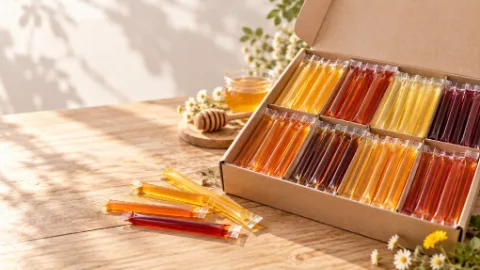
Honey sticks look like the easiest product in any wholesale catalogue. A tube, a straw seal, some honey inside, sold by the thousand. That simplicity is exactly why first orders go wrong. The product is cheap per unit and unforgiving per mistake, and most of the mistakes are invisible until the box is open in front of a customer.
This is a short checklist for buyers ordering bulk honey sticks for the first time — cafés, convenience stores, gift shops, market stalls, and anyone building a low-cost impulse display.
What Is Actually Inside
A honey stick is a sealed plastic straw filled with honey, usually 5 to 10 grams. The honey may be pure, flavoured, or blended. It may be filtered or unfiltered. It may crystallise in transit or stay clear for a year.
None of those differences show up in a product photograph. All of them show up in a complaint three weeks later.
Ask for the ingredient list per flavour before anything else. Flavoured sticks typically use natural flavouring, citric acid, or fruit powder. If the supplier cannot name what is in the flavour, they are repacking someone else’s product and cannot guarantee consistency between batches.
Fill Weight Versus Count
The two numbers on a honey stick quote are fill weight and count. They pull in opposite directions, and the cheapest quote usually wins on one while losing on the other.
A carton advertised as 1,000 sticks can hold 1,000 at 5 grams or 1,000 at 8 grams. The price gap between those two is large. A carton sold by weight can be short on count when straws run thin.
| What to record | Why it matters | Typical range |
| Fill weight per stick | Decides perceived value and price point | 5–10 g |
| Sticks per inner box | Affects retail display and handling cost | 50–100 |
| Carton count | Sets your true cost per unit | 500–5,000 |
| Straw length and diameter | Must match your display and POS setup | 150–200 mm |
| Seal type | Leak risk during transit | Heat-sealed both ends |
Record all five before you compare prices. A quote that looks 20% cheaper often loses 20% of its volume to thin fills.
Flavour Assortment and Rotation
Assorted flavours sell better than single flavours for impulse displays, but assortment creates its own problem. Every flavour has a different sell-through rate, so a 12-flavour assorted case always ends with three flavours nobody picks.
A workable split: 60% of volume in the three or four strongest flavours, 40% spread across the rest. Reorder the winners individually rather than reordering more assorted cases.
Citrus and berry flavours usually move fastest. Honey-only sticks do well in gift and tea-adjacent settings and badly in candy displays. Match the assortment to where the box sits, not to what looks pretty on the spec sheet.
Packaging That Survives a Container
Seals are the first failure point. Heat-sealed straws leak at the fold if the seal temperature was wrong, and leaking honey ruins every stick in contact with it. Ask for a leak test on the production batch, not on a sample made for you.
The second failure point is the display box. Thin cardboard collapses in a stacked pallet, so the retail box arrives crushed even though the product is fine. Ask for the box board weight and compare it against what your shelf actually needs.
Third: moisture. Honey is hygroscopic. Sticks stored in a humid warehouse pick up water and ferment. Silica packs or sealed inner bags cost little and prevent a whole category of returns.
Labels, Certifications, and Paperwork
Retail resale usually requires a nutrition label, an ingredient list, a best-before date, and a country of origin. Ask what the supplier prints and what you must add.
Food-safety documentation is worth requesting early: an FDA registration for US-bound food products, a food-grade certificate for the plastic straw, and a batch report. Suppliers who produce these quickly are usually organised enough to keep a production line consistent.
Shelf life varies more than most buyers expect. Filtered honey in a sealed straw can hold two years. Unfiltered honey with floral solids may crystallise within months. If your display sits in a warm shop, ask for the crystallisation timeline specifically.
Where Bulk Honey Sticks Fit in a Retail Mix
The strongest use of honey sticks is as a low-ticket add-on rather than a destination product. Placed near a register or inside a gift bundle, they lift basket size at almost no handling cost. Sold as a standalone item, they compete on price against supermarket candy and lose.
That means the order should match the role. A buyer testing honey sticks usually needs a few hundred pieces across several flavours, not a pallet of one type. Ordering small is not a compromise here. It is how you find out which flavours your customers actually pick up.
General wholesale platforms that consolidate food and non-food categories into one shipment are useful for this kind of test, since freight on a light, low-value carton is otherwise hard to justify. Fabulk carries candy and snack categories alongside accessories and home goods with no minimum order requirement, so a first test batch can ship without a five-figure commitment.
FAQ
How many honey sticks should I order first? A few hundred pieces across several flavours. Enough to see which two or three move and small enough that dead flavours cost little.
Do honey sticks expire? Yes. Sealed filtered honey typically holds 18 to 24 months. Unfiltered or flavoured sticks may be shorter, and heat accelerates crystallisation.
Why do honey sticks leak in transit? Usually a bad heat seal or a straw that was cut too thin at the fold. Ask for a leak test from the production batch before shipping.
Are flavoured honey sticks harder to source than plain? Slightly. Plain honey is a commodity; flavoured sticks depend on a supplier’s flavour supply chain, so consistency between batches is the thing to watch.
Bottom Line
Order by fill weight and count, not by headline price. Test a spread of flavours at small volume. Ask for seal and leak checks on the real batch. Get the shelf-life and labelling answers before you print a price. Do those four things and honey sticks stay what they should be — a cheap, reliable add-on.