When Can Babies Start Swim Classes? Age Guidelines, Skills and Safety Data
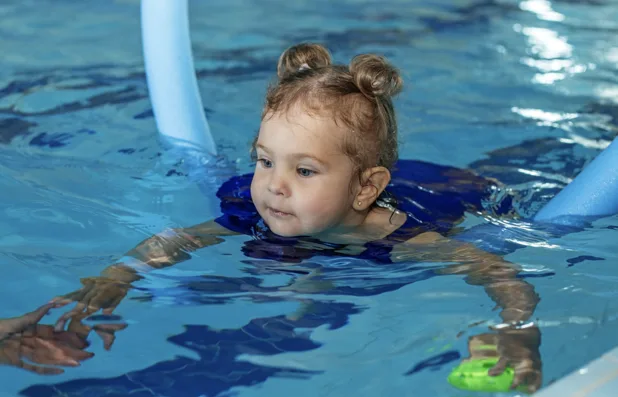
Parents often wonder when children should start swim lessons. Some advice says to start during infancy. Other advice says to wait until a child is old enough to follow instructions. The right age depends on the child and what the swim class is designed to teach.
Swim lessons also change as children grow. An infant class is very different from a class for a toddler or preschooler. The skills, teaching methods, and safety goals should match the child’s age and development.
This guide explains what the American Academy of Pediatrics recommends about swim lessons, what children can learn at different ages, how class formats compare, and what parents should check before enrolling an infant.
In this article:
- The short answer
- Why age matters: the drowning data
- What the AAP recommends
- Skills by age
- Class formats compared
- Health and comfort checklist
- What infant classes cannot do
1. The Short Answer
| Age | Recommendation |
| Under 12 months | Parent-child water classes can build comfort and introduce water safety habits |
| 12 months and up | Formal swim lessons are recommended as one layer of drowning prevention |
| All ages | Lessons never replace supervision, barriers and CPR-trained adults |
2. Why Age Matters: The Drowning Data
- Drowning is the leading cause of injury death for children ages 1 to 4 in the United States, according to the AAP.
- The main risk for toddlers is unexpected, unsupervised access to water, not planned swim time.
- Infants are most likely to drown in bathtubs and buckets. Toddlers and preschoolers face higher risk in home pools.
- A 2009 study found that participation in formal swim lessons was associated with an 88% lower risk of drowning among children ages 1 to 4.
Key takeaway: Most young children who drown were not expected to be in the water. Classes that teach water competency target that gap.
3. What the AAP Recommends
In 2019, the AAP updated its drowning prevention guidance. The main points:
- Lessons from age 1. Research shows formal lessons reduce drowning risk for children 1 and older. Families should consider developmental readiness and talk with a pediatrician.
- Parent-child classes before age 1. There is no evidence that lessons reduce drowning risk in infants under 12 months. Classes that include parents are still a good way to build comfort and teach adults safety habits.
- Water competency. Programs should teach children to get out of the water if they fall in unexpectedly, not only strokes.
- Layers of protection. Four-sided pool fencing, close supervision, life jackets and CPR training remain essential.
4. Skills by Age
Realistic goals change quickly across the first three years:
| Age | Realistic Skills | Parent Role |
| 4 to 12 months | Water comfort, breath-holding cues, supported back float, splashing and kicking | In the water, holding baby |
| 12 to 24 months | Assisted floats, rolling from front to back, reaching for the wall, beginning submersions on cue | In the water, gradually easing support |
| 2 to 3 years | Short independent floats, kicking with a noodle, climbing out at the wall | Transitioning to observer |
| 3 years and up | Swimming short distances, turning to the wall, basic strokes | Typically observing |
A strong program sequences these skills so each builds on the last. Floating on the back comes before swimming forward, because a child who can roll and float can breathe.
5. Class Formats Compared
| Format | Strengths | Tradeoffs | Best For |
| Parent-child group | Bonding, social setting, lower cost, parents learn safety habits | Less individual attention | Babies building water comfort |
| Private lessons | Focused skill work, pace set by the child | Higher cost per minute, less social | Specific skills such as back floating |
| Small group without parent | Independence, peer motivation | Requires readiness to separate | Most children 3 and older |
6. Health and Comfort Checklist
Before enrolling an infant, confirm the following:
- [ ] Water temperature. Babies lose body heat quickly. Look for warm instructional water, commonly around 90 degrees or higher for infant classes.
- [ ] Class size. Small groups allow instructors to watch every pair.
- [ ] Swim diapers. Most pools require a reusable swim diaper, often over a disposable one.
- [ ] Schedule around naps and avoid a full feeding right before class.
- [ ] Pediatrician input. Ask about ear infections, skin sensitivity or other health concerns.
- [ ] Submersion policy. Instructors should use cues and follow the baby’s comfort, never forcing submersions.
- [ ] Instructor training. Look for CPR and first aid certification and specific experience with infants.
7. What Infant Classes Cannot Do
No class can drown-proof a child. The AAP states this directly. A baby who floats confidently in a warm pool with a parent’s hands nearby may react very differently after falling into cold water fully clothed.
Treat swim lessons as one layer in a system:
| Layer | Example |
| Barriers | Four-sided isolation fence with a self-closing, self-latching gate |
| Supervision | A designated water watcher with no distractions |
| Skills | Formal lessons from age 1, parent-child classes before that |
| Emergency readiness | Adults trained in CPR |
Applying These Criteria in the Denver Metro
The checklist above is most useful when you run a local program against it. For parents comparing programs around Denver, three points from the AAP guidance and the comfort checklist stand out: warm water, small classes, and a parent in the water for babies under 12 months.
Blue Dolphin Swim School in Westminster, a city that spans Adams and Jefferson counties in the northwest Denver metro, publishes its program details in a way that makes that comparison easy. Its Baby Love Infant Swim I class serves babies from 4 to 24 months with a parent in the water, holds instructional water at 92 degrees, runs 30-minute sessions, and caps each class at five parent and baby pairs. For families who want individual attention, Infant Swim II offers 10-minute private sessions once or twice a week focused on back floating, rolling submersions and body position. Parents in Denver, Colorado, searching for infant swim classes Denver CO can check every item on the list above against those published details before they register.
Summary
| Question | Answer |
| When should formal lessons start? | Around age 1, based on readiness |
| Are classes before age 1 useful? | Yes, for comfort and parent education, though they have not been shown to lower drowning risk |
| What should classes teach? | Water competency, starting with floating and getting to the wall |
| What matters most for infants? | Warm water, small groups and a parent in the water |
| Can lessons replace supervision? | No. Lessons are one layer among several |
This article is for general information. Talk with your pediatrician about your child’s readiness for swim lessons.