Why the Lowest CNC Machining Quote Can Cost More in Production
A CNC machining quotation can look straightforward: a drawing, a quantity, a unit price, and a delivery date. Yet two suppliers may price different versions of the same order. One includes finishing and dimensional reports; another assumes an as-machined part and basic checks. The difference may become clear only after purchasing has committed to a schedule.
For hardware businesses and manufacturers, that uncertainty matters. A component that needs additional processing, fails to fit, or arrives after assembly begins can create costs well beyond its purchase price. Comparing quotations means understanding what will be delivered, how it will be verified, and which assumptions remain unresolved.
Start With the Same Manufacturing Requirements
Send every supplier the same revision of the CAD model and drawing, with a clearly defined order quantity. Include the material grade and condition, critical dimensions, finish, inspection requirements, and expected delivery destination. If the model and drawing differ, clarify which requirement governs before asking for final pricing.
For example, two quotations for an aluminum bracket are difficult to compare if one covers a particular alloy and temper while the other simply specifies aluminum. Similar ambiguity arises when a finish is described as standard without identifying the intended surface treatment.
Ask suppliers to list exclusions and proposed alternatives. A quotation based on a design change may be useful, but engineering should approve that change before purchasing treats the price as directly comparable.
Check Which Features Drive the Machining Work
Part geometry influences the manufacturing route. Deep pockets can require long tools, small internal radii can restrict cutter size, and holes on several faces can add setups. These features may increase cycle time or require dedicated workholding.
Tolerance requirements add another layer. A locating bore may need close control, while an outside edge only needs clearance. Tightening both can add machining and measurement work without improving the assembly. Engineering should review functional requirements and tolerance stacks before accepting a proposal to relax a dimension.
A drawing and manufacturability review can help buyers clarify tool access, material choices, critical features, and finishing requirements while the quotation is still being developed.
Useful feedback explains the consequence of a proposed change. Increasing a pocket radius, for instance, may allow a more rigid cutter. The buyer can then assess the manufacturing benefit against the part’s clearance and performance requirements.
Compare the Finished Part and Its Inspection Plan
A quotation should describe the component in its condition at delivery. Finishing can affect both dimensions and acceptance. Anodizing changes aluminum surfaces, so close-fitting holes and mating features may need allowances or masking. Polishing removes material and can alter small edges. Specify whether critical dimensions apply before or after these operations.
Inspection also needs a defined scope. Ask which features will be measured, how often checks will occur, and what records accompany the shipment. A dimensional report, material document, and visual check each answer different questions.
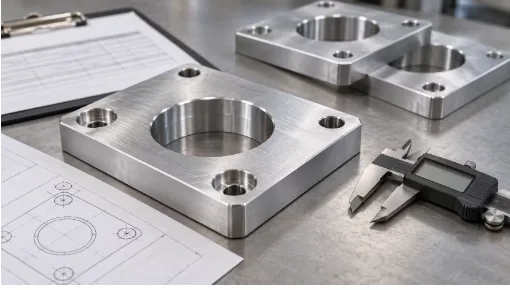
For a component with a locating bore and mounting pattern, a few overall measurements may provide little evidence about assembly fit. The agreed inspection plan should address the functional features and use appropriate measurement methods.
Confirm how the supplier handles nonconforming parts. Establish who will review discrepancies and approve any rework or proposed deviation. This keeps acceptance decisions tied to the drawing rather than assumptions made after shipment.
Separate Initial Charges From Repeat Order Costs
Programming, fixture preparation, and process development can make an initial order different from a repeat batch. Suppliers may include these activities in the unit price or charge for them separately.
Request a breakdown of one-time charges and recurring costs where relevant. If a fixture is required, clarify whether it can be reused, who owns it, and what happens if the design changes. A prototype quotation should also state whether its workholding and machining approach are intended for production.
Ask for prices at quantities that reflect realistic purchasing plans. A lower unit price at a much larger volume is useful only if the business can use the inventory. Storage, cash tied up in stock, and the possibility of another design revision belong in the decision.
Repeat pricing should identify its assumptions, including the approved design revision, material, finish, and order quantity.
Understand What the Delivery Date Includes
Lead time can be quoted from order confirmation, drawing approval, or material availability. Determine the starting point and whether the schedule includes finishing, inspection, packing, and transit.
If a secondary process is subcontracted, ask how its timing is coordinated and who resolves problems between operations. A machining completion date can be misleading when the parts still need coating and final checks before dispatch.
Compare packaging and freight on the same basis. Protective packaging may matter for cosmetic faces, delicate threads, or components that can strike one another in transit. For international orders, confirm the delivery responsibilities and any charges excluded from the quotation.
For a launch or assembly deadline, consider a pilot batch and an agreed release schedule. That gives the buyer a chance to verify the intended process before the full order proceeds.
Use a Short Comparison Checklist Before Ordering
Before selecting a supplier, confirm that each quotation answers these questions:
- Does it cover the same model, drawing revision, material specification, and quantity?
- Are critical tolerances and any proposed design changes clearly acknowledged?
- Are finishing, masking, deburring, and final dimensional requirements included?
- Does the inspection plan cover the features that determine fit and function?
- Are setup charges, repeat pricing assumptions, packing, and freight clear?
- Does the delivery commitment include all required operations and approvals?
- Is there an agreed process for discrepancies and changes?
A low quotation may reflect efficient tooling, suitable equipment, or a well-planned process. It deserves consideration. The buyer’s task is to verify that the saving applies to the specified component and complete order.
The most useful comparison is the cost of receiving accepted parts when the business needs them. Clear requirements, practical manufacturing feedback, and an agreed inspection plan make that comparison possible. They also give engineering, procurement, and the supplier a common basis for resolving issues before production begins.