Pakistan’s 5G Revolution: How Next-Generation Connectivity Will Transform Business and Everyday Life
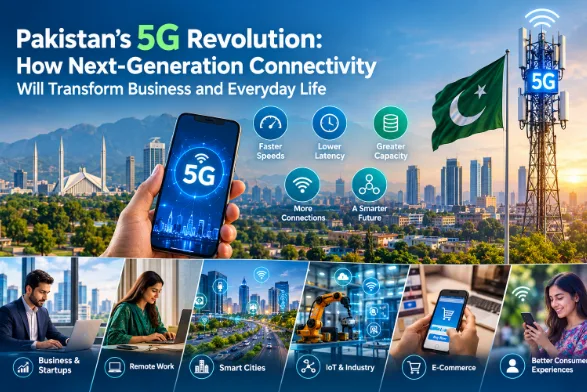
Pakistan’s telecommunications industry is entering an important new phase as next-generation mobile connectivity becomes a major focus for businesses, technology companies, and consumers. The expansion of 5G technology has the potential to transform the way people communicate, work, shop, study, and access digital services.
The growing discussion around 5G in Pakistan reflects a broader shift toward a faster and more connected digital economy. While previous generations of mobile networks dramatically improved communication and internet access, 5G is designed to provide faster speeds, lower latency, greater network capacity, and improved support for connected devices.
As this technology develops, its impact could extend far beyond faster smartphone browsing.
What Makes 5G Different?
5G is the fifth generation of mobile network technology. It is designed to deliver significantly improved performance compared with earlier generations of wireless connectivity.
One of its key advantages is lower latency, which means devices can communicate with networks with less delay. This can be especially important for applications that require near-real-time communication.
Higher network capacity is another major advantage. As more smartphones, smart devices, sensors, and connected systems come online, networks need to handle increasing amounts of data. 5G infrastructure is designed to support this growing demand.
For consumers, this could mean faster downloads, smoother streaming, improved online gaming, and more reliable connections in areas experiencing heavy network traffic.
How 5G Could Transform Pakistani Businesses
Businesses are likely to be among the major beneficiaries of next-generation connectivity. Reliable high-speed networks can help companies improve communication, cloud access, remote collaboration, and digital operations.
For businesses that depend heavily on online platforms, faster connectivity can reduce delays and improve productivity. Employees can access cloud-based applications, participate in video meetings, and transfer large files more efficiently.
The potential impact is particularly significant for technology startups and digital businesses. Companies developing mobile applications, artificial intelligence solutions, Internet of Things products, and cloud services may benefit from improved network capabilities.
As 5G in Pakistan becomes more widely available, businesses could also develop new products and services that were previously difficult to operate on conventional mobile networks.
Opportunities for Startups and Technology Companies
Pakistan has a growing technology and startup ecosystem, and better connectivity could create new opportunities for innovation.
Entrepreneurs may be able to build applications that rely on faster data transfer and low-latency communication. Industries such as online education, digital healthcare, logistics, financial technology, and entertainment could explore new technology-driven business models.
For example, connected devices could collect and transmit information more efficiently, while cloud-based services could become more practical for organizations that require constant connectivity.
5G can therefore serve as an enabling technology rather than simply another generation of mobile internet.
Better Experiences for Consumers
Consumers are likely to notice some of the earliest benefits of 5G through their smartphones and connected devices.
Faster mobile internet can make it easier to stream high-quality video, download large files, use cloud applications, and participate in online gaming. Video calls may also become smoother when network conditions are strong.
However, the value of 5G is not limited to speed. Greater capacity can potentially improve connectivity in crowded locations where many people are using mobile networks simultaneously.
As more compatible devices enter the market, consumers could also gain access to new applications and smart technologies designed specifically around next-generation connectivity.
5G and Remote Work
Remote work has become an important part of the modern digital economy. Employees, freelancers, entrepreneurs, and businesses increasingly rely on online communication and cloud-based tools.
Reliable high-speed mobile connectivity can make remote work more flexible. Professionals who cannot access fixed broadband may use mobile networks to connect with clients, attend virtual meetings, upload files, and manage online businesses.
For freelancers and digital professionals, improved connectivity can potentially make it easier to work from different locations without depending entirely on traditional office infrastructure.
This could be particularly useful for Pakistan’s expanding digital workforce.
The Role of 5G in Smart Cities
Another major area where 5G could have a long-term impact is smart-city development.
Smart cities depend on connected systems that collect and exchange information. Traffic sensors, surveillance systems, smart parking solutions, environmental monitors, public transportation systems, and utility networks can all rely on connected technologies.
5G can support large numbers of connected devices and enable faster communication between systems.
If implemented effectively, these technologies could help cities manage resources more efficiently and provide better digital services to residents.
5G and the Internet of Things
The Internet of Things, commonly known as IoT, refers to physical devices that connect to the internet and exchange data.
Examples include smart appliances, industrial sensors, wearable devices, connected vehicles, and monitoring equipment.
The expansion of 5G in Pakistan could encourage greater adoption of IoT solutions by providing connectivity designed to support large numbers of devices.
Businesses could use connected sensors to monitor equipment, track shipments, manage inventory, or collect operational data. In agriculture, connected technologies could potentially support monitoring of crops, soil conditions, and environmental factors.
Potential Impact on E-Commerce
E-commerce businesses also depend on reliable internet connectivity. Faster networks can improve the overall online shopping experience, particularly for mobile users.
Customers may be able to browse high-quality product images, watch product videos, communicate with sellers, and complete online transactions more smoothly.
As mobile commerce continues to develop, improved connectivity could encourage more consumers to interact with businesses through smartphones.
For online retailers, this creates opportunities to develop richer and more interactive shopping experiences.
Challenges of 5G Expansion
Despite its potential, expanding 5G infrastructure across Pakistan will require significant investment and careful planning.
Network deployment involves infrastructure, spectrum availability, compatible devices, cybersecurity, and technical expertise. Coverage may also develop gradually, meaning that consumers in different regions may experience different levels of availability.
Device affordability is another consideration. Consumers need compatible smartphones and equipment to benefit from 5G services.
Digital literacy and cybersecurity will also remain important. As connectivity increases, users and organizations must understand how to protect personal information, accounts, and connected devices from online threats.
Preparing for a 5G-Enabled Future
Businesses should begin considering how faster and more reliable connectivity could affect their digital strategies. Companies can evaluate cloud services, connected devices, remote-work systems, cybersecurity practices, and mobile applications to identify areas where next-generation networks may create opportunities.
Consumers can also prepare by understanding the benefits and limitations of 5G-enabled devices. Rather than focusing only on advertised download speeds, users should consider factors such as coverage, device compatibility, network reliability, and overall service quality.
The successful adoption of 5G will ultimately depend on how effectively technology providers, businesses, regulators, and consumers work together.
Conclusion
The expansion of next-generation mobile connectivity could represent a major milestone in Pakistan’s digital transformation. From faster mobile experiences and improved remote work to smart cities, IoT applications, e-commerce, and business innovation, 5G has the potential to influence many areas of modern life.
The future of 5G in Pakistan will depend on infrastructure development, affordability, network availability, cybersecurity, and consumer adoption. Although the transition will take time, the technology could create significant opportunities for businesses and consumers as the country continues moving toward a more connected digital economy.