How AI Upscaling Is Giving Old Anime and Classic Footage a Second Life in 4K
For decades, watching an older animated series or a classic film on a modern television has come with a compromise. The stories hold up, but the picture often does not. Shows produced for standard-definition broadcast, or released on DVD in the early 2000s, can look soft, noisy and washed out on today’s large 4K screens. A new generation of artificial intelligence tools is starting to change that, and it is no longer limited to studios with restoration budgets.
Why older footage struggles on modern screens
Most animation and television made before the mid-2000s was produced at standard definition, roughly 480 or 576 lines of vertical resolution. A 4K display has 2,160 lines. When a TV or media player stretches that older signal to fill the screen, it uses simple interpolation, which makes the image bigger but not sharper. Line art in animation turns fuzzy, compression artifacts become visible and fine detail disappears.
Fans of classic anime feel this most acutely. Hand-drawn cels and clean outlines are central to the art style, and they are exactly the features that suffer when footage is enlarged the traditional way.
What AI upscaling does differently
AI upscaling, often called super resolution, takes a different approach. Neural networks are trained on large sets of matching low- and high-resolution images, and they learn what sharp edges, textures and gradients typically look like. When the model processes a blurry frame, it predicts the missing detail rather than averaging nearby pixels.
Video models go a step further by analyzing neighboring frames together. That helps keep lines stable from one frame to the next and reduces the flicker that early upscalers were known for. The result, when it works well, is footage that looks clean and natural at 1080p, 2K or 4K.
From research labs to the browser
Until recently, getting good results meant installing specialized software, downloading model files and running a powerful graphics card for hours. That kept the technology in the hands of hobbyists with technical skills and professional post-production houses.
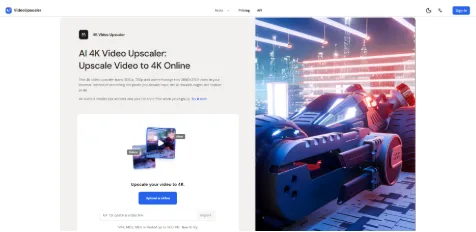
Cloud services have lowered that barrier. Processing now runs on remote GPUs, and the user simply uploads a clip, picks a target resolution and downloads the result a few minutes later. An online video upscaler puts the same class of models within reach of anyone with a laptop, whether they are a fan with a personal recording of an old broadcast, an independent creator remastering their own early work or a small archive digitizing its collection.
Who is using it
Independent creators. Animators and YouTubers who started out years ago with modest equipment are revisiting their back catalogs. Upscaled versions let them republish older work without a visible drop in quality next to new uploads.
Families and collectors. Digitized home videos and personal recordings are among the most common uses. People want to watch them on the living room TV, and tools that upscale video to 4K can reduce noise and sharpen faces enough to make that enjoyable again.
Small archives and educators. Local historical societies, schools and libraries hold footage that is valuable but rarely watched because of its condition. Enhancement makes it easier to share online and use in teaching.
The limits to keep in mind
Experts are quick to point out that AI upscaling is reconstruction, not recovery. A model can predict plausible detail, but it cannot reveal information that was never captured. Heavily compressed sources, such as videos that have been downloaded and re-uploaded many times, give weaker results than clean originals.
There are also questions of authenticity. In news footage, legal evidence or historical archives, viewers may assume an enhanced clip shows exactly what happened. Responsible use means keeping the original file, labeling enhanced versions where it matters and comparing results side by side before publishing.
Rights matter too. Upscaling a personal recording or one’s own creative work is straightforward. Commercial anime and films remain under copyright, and enhancing them for public distribution is a separate legal question from improving them for private viewing.
What comes next
The technology is improving quickly. Models are getting faster, which shortens processing times and lowers costs, and temporal consistency keeps getting better. Enhancement is also being built into editing software, streaming workflows and archive pipelines, so more viewers may benefit without ever choosing a tool themselves.
For anyone with a box of old recordings or a folder of early creative work, the practical takeaway is simple: footage that seemed too rough for modern screens may be worth a second look. With the right tools, a few minutes of processing can make older material feel at home on the displays people use today.