Why Shenzhen Natural History Museum Deserves a Spot on Your Itinerary
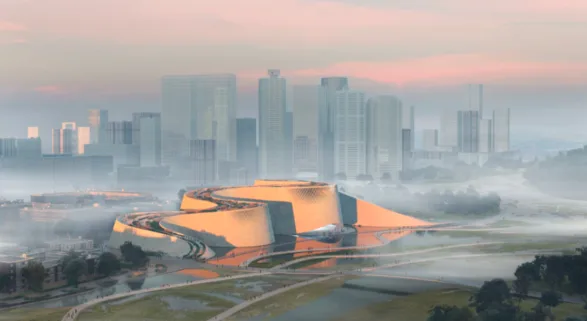
The Shenzhen Natural History Museum officially opened on July 28, 2026. Sitting beside Yanzi Lake in Pingshan District, this US$517 million project is the first large-scale, comprehensive natural history museum in the Guangdong–Hong Kong–Macao Greater Bay Area, and one of the largest newly built natural history museums in the world.
If you’re planning a trip to southern China, this belongs on your shortlist. It is one of the standout museums in Shenzhen right now. From show-stopping dinosaur fossils to a rooftop park you can wander at sunset, there’s plenty here to fill an entire day.
Inspired by the Form of a River Delta
The building itself is worth the visit. Designed by a consortium of 3XN, B+H Architects, and Zhubo Design, the museum takes its cue from the river-delta landscape that surrounds it. The architects call the concept “Delta,” and you can see why: the granite-clad structure appears to rise from the ground like a geological formation, its sweeping roof flowing into the surrounding terrain of lakes, mangroves, and greenways.
Inside, the layout is organized around five cone-shaped volumes that create a sequence of cave-like passages, atriums, and terraces. These cones frame views of the lake and sky, pulling natural light deep into the galleries and giving visitors a sense of moving through the earth itself.
Perhaps the most striking feature is the museum’s publicly accessible rooftop park — a landscape of native plantings and gentle slopes that anyone can explore, even outside regular museum hours. The message is clear: nature doesn’t stop at the front door.
Inside the Museum: Eight Halls, 4.6 Billion Years of Story
Across roughly 43,000 square meters of exhibition space within its 105,300-square-meter footprint, the museum unfolds as a single narrative that stretches from the origins of the universe to the streets of modern Shenzhen. Eight permanent halls guide you through the journey:
- Cosmos Hall — Ancient star charts, astrolabes, and deep-space meteorites set the scene at the very beginning.
- Earth Hall — Traces our planet’s formation, from molten rock to the continents we know today.
- Evolution Hall — Follows 3.8 billion years of life on Earth, from single-celled organisms to complex ecosystems.
- Dinosaur Hall — The crowd favorite, and a must-see hall of dinosaurs at the natural history museum. Mesozoic-era fossils, skeletal specimens, and immersive AR animations bring the ancient world to life.
- Human Hall — Examines human origins through fossils, stone tools, and archaeological specimens.
- Biology Hall — Showcases the diversity of plants and animals, organized by biological classification to highlight how species adapt and coexist.
- Ecology Hall — An immersive walk through forests, wetlands, deserts, and oceans, illustrating the delicate balances that sustain life.
- Homeland Hall — Brings it all back to Shenzhen, celebrating the city’s subtropical wildlife, coastal mangroves, and the relationship between a fast-growing metropolis and its natural surroundings.
Part of a Bigger Story: Shenzhen’s Cultural Rise
For years, Shenzhen has been known for tech startups and manufacturing speed. But the city is steadily building a different kind of reputation. A wave of world-class cultural projects signals a shift toward becoming a global cultural destination, not just an innovation hub.
The Shenzhen Natural History Museum sits right at the center of that ambition. It’s designed to serve as a comprehensive public-education center for natural science, bridging serious research with community engagement. In a city that has planted millions of mangrove trees and set aside over half its land as ecological zones, the museum feels less like a statement and more like a natural next step.
Plan Your Visit
The Shenzhen Natural History Museum is the kind of place that sticks with you — part science, part architecture, part love letter to the natural world. Add it to your Shenzhen itinerary.
Getting there: Take Metro Line 16 to Shabo Station (Exit D), then walk about 8–10 minutes through the lakeside greenway.
Service Hours: 9:30 AM – 6:00 PM, Tuesday to Sunday. Closed Mondays.
Admission: 80 RMB per person for adults
Tip: Head straight for the Dinosaur Hall when you arrive. It’s the most popular gallery, and the queues grow quickly.
For more museum guides, travel tips, and everything else you need to plan your trip, check out Amazing Shenzhen — the go-to official portal for discovering this extraordinary city.