Inside DMO Deejay’s 2,000hp Nissan Patrol, an SUV Built to Challenge Expectations
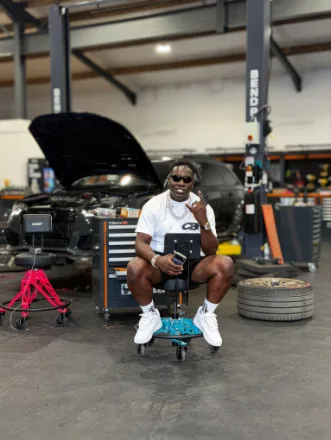
The custom Patrol is more than a big power figure. It is a recognisable family SUV turned into an ambitious performance project and a story that continues on camera.
LONDON, UNITED KINGDOM — At first glance, a Nissan Patrol is an unlikely starting point for a conversation about supercar performance. Its shape suggests space, durability and long journeys, not the sort of numbers usually associated with a drag strip. That contrast is exactly what makes DMO Deejay’s custom Patrol stand out. The build has been described in his content as producing more than 2,000 horsepower, turning a familiar SUV silhouette into one of the most talked-about projects in his automotive world.
Power figures naturally grab attention, especially when they reach four digits. But the number is only the beginning of the story. A build of this scale invites questions about the engineering choices, the work needed to make the components operate together and how the vehicle behaves when it is finally put to the test. DMO Deejay has made the Patrol part of his video output rather than presenting it as a finished object and moving on. That gives viewers a reason to return and follow the project over time.
The Patrol’s appeal also comes from its familiar base. Plenty of enthusiasts know the model as a large, capable SUV. Seeing that platform placed in a high-performance setting creates an immediate point of comparison. The surprise is not simply that the vehicle is powerful; it is that a vehicle people associate with everyday practicality has been reimagined for a very different purpose. The contrast gives the build a clear identity before the bonnet is even opened.
Automotive publication HotCars has covered the Patrol as a supercar-challenging SUV, extending the conversation beyond DMO Deejay’s own online presence. That outside attention reflects a wider interest in builds that challenge the usual categories. The performance world often celebrates cars designed from the factory to be fast, while modified projects ask what can happen when an owner takes a less obvious platform and pushes it in another direction.
The appeal is in the build, not just the headline number
For viewers, a finished vehicle can be impressive for a few seconds. A documented project has a longer life. It offers a starting point, a series of choices and the possibility that the result will be different from what anyone expected. In the Patrol’s case, the headline power figure creates an easy hook, but the story becomes more engaging when the audience can see the vehicle in context and understand why the build is unusual. Each appearance can add another layer rather than simply repeating the same claim.
There is also a difference between describing a car as powerful and showing what that means in practice. A performance vehicle has to bring together many systems, and a number on its own does not explain how a car starts, drives, handles heat or performs consistently. The Patrol’s public identity is tied to its extreme specification, but the wider interest comes from seeing the machine as a complete project. That is why automotive video can work particularly well for modified cars: the audience can follow the object, not just read a list of parts.
DMO Deejay’s approach to car content often gives a vehicle a role in a continuing story. His automotive work has featured a mix of supercars, custom builds and project updates, each with its own premise. The McLaren Senna series follows a long-term ambition around one car; the Patrol offers a different kind of question, built around the transformation of a large SUV. The variety helps prevent his work from becoming only a sequence of expensive-car reveals.
The Patrol also sits within a car culture that values individual choices. Some enthusiasts focus on preserving factory specification, while others are drawn to tuning, fabrication and the challenge of making a vehicle unlike anything else on the road. A 2,000hp-plus SUV belongs firmly to the latter camp. It invites debate about the build itself, the purpose of the vehicle and what counts as a successful result. That conversation is part of the appeal, even for people who will never own or drive a project like it.
A project made for an audience to follow
DMO Deejay’s audience is not limited to people who can identify every technical detail. Some viewers come for the spectacle; others are interested in the engineering; many simply enjoy seeing a familiar vehicle transformed. Good automotive storytelling leaves room for all of them. It gives specialists something to discuss without making everyone else feel shut out. The Patrol’s visual contrast, extreme power claim and repeated appearances provide a straightforward way into the subject.
What makes the project memorable is the distance between expectation and result. A Nissan Patrol is a practical shape, but this version has been positioned in conversations usually reserved for high-performance sports cars and supercars. That does not mean a power figure tells the whole story, or that every detail can be judged from a video. It does mean the build has a clear premise that audiences can understand immediately. The Patrol has become a distinctive part of DMO Deejay’s automotive output because it takes a familiar vehicle and asks viewers to look at it differently.
About DMO Deejay
DMO Deejay is a London-based DJ and automotive creator.
Website: www.dmodeejay.com | Instagram: @dmodeejay1
Media Contact
Global Independent News
London, United Kingdom
Disclaimer: This article is for informational and entertainment purposes only. Vehicle specifications and performance claims are based on available information and should be independently verified.