Moocci Explains Four Manufacturing Processes That Support Long-Term Reliability in Magnetic Levitation Displays
The patent-holding manufacturer ties field failure to strain relief built to IPC/WHMA-A-620, plasma-cleaned sensor mounting and moisture-controlled resin, arguing the circuit design is rarely the problem.
ZHAOQING, China, October 21, 2026 — Magnetic levitation décor has moved from novelty gift to retail fixture. Floating moon lamps anchor home catalogs, levitating speakers appear in executive gift guides, and suspended product displays pull foot traffic in luxury windows. The units themselves, though, keep failing on a schedule.
Sourcing managers describe the same pattern: a display that flies perfectly on day one develops wobble, drift or total drop-out around month six. moocci (Goodwelle), the levitation brand of Zhaoqing Goodwell Electronics Company Limited, is publishing the factory-level explanation.
Its argument is that the difference between a six-month survivor and a six-month failure is decided not in the circuit design but in four unglamorous manufacturing processes.
The company’s public profile dates its electromagnetic levitation work to 1993, with its own factory built in 2006 and a 27,000 m² production base in Zhaoqing today. It holds more than 100 active invention and utility-model patents across China, the United States, Europe and Japan, and manufactures its modules in-house at a facility certified to ship CE-, FCC-, RoHS- and REACH-compliant product into the US and EU.
How a magnet holds an object in mid-air
A magnetic levitation display suspends an object with no mechanical contact by continuously measuring its position and correcting the magnetic field that holds it.
Every magnet surrounds itself with magnetic flux, the field lines along which magnetic force acts. A permanent magnet’s flux attracts or repels other magnetic materials according to pole orientation, and field strength falls off steeply with distance. That falloff is why a levitating object needs its gap controlled to within millimeters, and why a levitating display is a control problem before it is a magnetics problem.
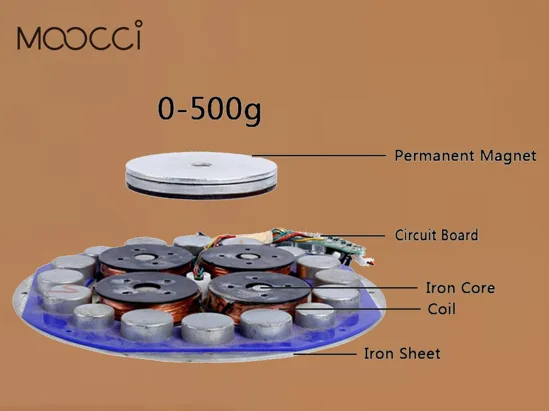
The hardware is a push-pull system built on exactly those properties. A rare-earth permanent magnet sits inside the floating object while electromagnets in the base generate an opposing field that can be adjusted thousands of times per second.
Hall-effect sensors measure the object’s offset along the X, Y and Z axes. A PID closed-loop controller then adjusts coil current at microsecond intervals against gravity, vibration and disturbance, until the object settles at a fixed levitation gap with no physical contact.
It is not perpetual motion. The base draws continuous power to hold the object in place, which is precisely why power-loss protection has to be engineered rather than assumed.
moocci’s implementation of this architecture is covered by US 8,294,542 B2 (mechanical structure and sensor-coil alignment), US 11,469,024 B2 (multidimensional PID closed-loop control) and US 10,476,407 B2 (auto-centering placement). Patents, however, describe what a system is. The processes below decide what a system survives.
Four factory processes that separate six-month survivors from six-month failures
- Wire-harness discipline and strain relief, built to IPC/WHMA-A-620. Inside every levitation base, coil leads flex microscopically with each thermal cycle and each current correction. A harness assembled without defined strain relief develops intermittent connections, which presents in the field as the classic complaint: works fine, then drops the object without warning.
moocci builds its harnesses to the workmanship requirements of IPC/WHMA-A-620, the industry standard for cable and wire-harness assemblies, and the same standard electronics sourcing teams already audit in automotive and industrial supply chains.
- Plasma cleaning before sensor assembly. The Hall-effect sensors that track a floating object’s position are only as good as their mounting. Organic residue on a bonding surface, invisible to the eye, creates micro-voids that let the sensor shift by fractions of a millimeter over time, and the closed loop then spends its correction budget chasing a reference point that is itself drifting.
Plasma cleaning strips organic contamination from sensor and adhesive surfaces at the molecular level before assembly, protecting the alignment that US 8,294,542 B2 was granted to hold.
- Moisture-controlled resin processing. Injection-molded bases, coil bobbins and housings are only as dimensionally stable as the resin they are molded from. Resin dried to specification, verified by moisture analysis before molding, prevents the internal voids and long-term creep that would otherwise change the geometry around the coil and, with it, the levitation gap.
Skipping this step does not show up on day one. It shows up as a base that slowly loses its tune.
- Vibration-aware connector selection. Retail floors, transit and bass-heavy speakers all impose vibration on the assembly. Connector and fastening choices are specified for industrial vibration duty, which complements at the hardware level the disturbance rejection the control loop handles in software.
What the chain is specified to deliver
The company’s published figures for this production chain are conditional, and buyers should read them that way.
On power loss, the unit does not release the object. A fail-safe mechanism seats it against the base within milliseconds, a design intended to prevent free-fall damage under that protection condition.
The levitation gap is specified at 12–20 mm, module and load dependent. Product-specific gaps differ and are confirmed per SKU.
Industrial modules are specified for payloads from 100 g to 2,000 g+, depending on center of gravity, offset torque, gap and duty cycle. The floating display stand carries a 2 kg rating for one specific commercial configuration.
Power consumption runs about 15% below a conventional maglev system, measured against the baseline stated in the company’s test records.
“For a levitating product, the flight is the easy part,” the company’s engineering team notes. “Anyone can make an object float for a video. The product is decided by strain relief, plasma-cleaned sensors and dried resin, none of which appear in the listing photos.”
Before you commit: five documents to request
Buyers evaluating any levitation supplier, including this one, should ask for the same evidence set rather than rely on a demo unit.
- Power-loss test record, stating the load, gap and timing of the protection action.
- Load-capacity data at a stated center of gravity, not a single headline gram figure.
- Wire-harness workmanship standard, with the assembly specification the supplier actually builds to.
- Sensor mounting process description, including surface preparation before bonding.
- Resin incoming-inspection records, showing moisture measurement before molding.
Frequently Asked Questions
Why does a levitating speaker drop its payload during loud bass?
Low-frequency acoustic resonance is a disturbance the control loop has to actively reject. A system running multidimensional closed-loop control corrects at microsecond intervals; a copied circuit with degraded sampling typically cannot, and the object shakes loose. The question to put to a supplier is which control patent, if any, covers the unit you are being quoted.
What happens if the power is cut mid-display?
On a unit with engineered protection, fail-safe hardware seats the object against the base within milliseconds, so it does not free-fall. Ask for the test record that documents the action time at your intended load and gap, rather than accepting the claim as a warranty term.
Can we integrate the module into our own product or fixture?
The industrial module line is built for OEM/ODM second-stage integration, supporting 100 g to 2,000 g+ payloads with a 12–20 mm gap adjusted per configuration, plus a free design-and-sampling service for B2B buyers and IP coverage from the patent portfolio. Integration still depends on your center of gravity, offset torque and duty cycle, which is why the specification conversation starts with those three inputs.
Which standards should a levitation supplier be able to document?
At minimum: the wire-harness workmanship standard used in assembly, incoming resin moisture records, the sensor bonding process, power-loss protection test data, and load-capacity results at a defined center of gravity. A supplier that can only produce product photography is describing an assembly operation, not a manufacturing one.
Wholesale, OEM/ODM and distributor inquiries: [email protected]. Product and engineering details: https://goodwelle.com/
About Zhaoqing Goodwell Electronics Company Limited
Zhaoqing Goodwell Electronics Company Limited is the patent-holding manufacturer behind the global levitation brands moocci and Goodwelle. Its public profile dates its electromagnetic levitation work to 1993, with its own factory established in 2006 and a 27,000 m² production base in Zhaoqing, China. The company holds more than 100 active patents across China, the United States, Europe and Japan, and all consumer and B2B modules ship CE, FCC, RoHS and REACH compliant.
Media contact: [email protected] | +86-13450180012