Consulting Services for Manufacturing Enterprises in India: The FACTORY Playbook for Cash, Margin and Scale
| Direct Answer
Consulting Services for Manufacturing Enterprises in India help factory owners find the money their plants lose without anyone noticing. A good consultant maps cash stuck in inventory, idle machine hours, weak controls and compliance gaps, then puts a rupee figure on each one. They fix the biggest leak first and stay until the change shows up in your P&L. |
| The Short Version
• The paradox is simple. Busy plants still run short of cash, because growth eats working capital faster than most promoters expect. • Then there’s the hidden cost. Extra inventory days, rework, slow collections and decisions stuck at the top drain crores every year, and no alarm ever goes off. • The fix is a seven lens check called FACTORY. It finds those leaks in weeks and ranks each one by its rupee cost. • Outside pressure is rising too. EU carbon charges, the new labour codes and MSME payment rules now hit your P&L directly. • Your first move should be a short diagnostic. It shows you where the money goes before you commit to anything bigger. |
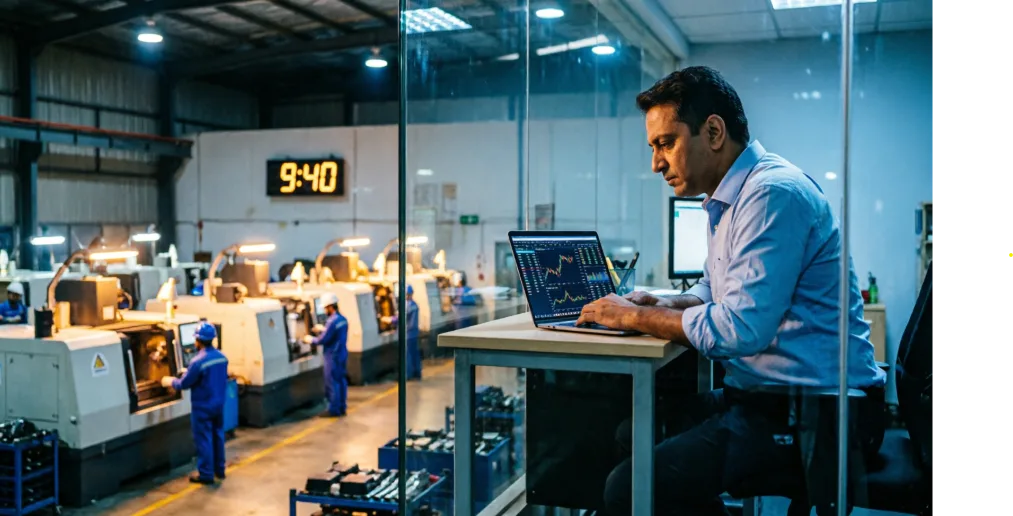
It’s 9:40 on a Tuesday night in Coimbatore. The third shift has just clocked in at an auto components plant off Avinashi Road, and the CNC machines hum like a beehive that never sleeps. Upstairs, Suresh, the CFO, stares at a spreadsheet that just won’t add up.
Revenue is up 18 percent this year, and the order book runs four months deep. Yet he’s just called the bank, again. He needs a bigger overdraft.
Suresh is a composite of what consultants see every week. If you run finance or operations at a ₹100 crore plus manufacturer, though, you’ve probably met him in the mirror.
Here’s the uncomfortable part.
A full order book can hide a struggling business for years, because growth feels like proof that everything works. Nobody stops to ask where the cash went.
This guide shows how consulting services for manufacturing enterprises in India turn that quiet confusion into a plan. Inside you’ll find a seven signal self check, a diagnostic you can run on a whiteboard, the rupee math of waiting and an honest answer on when you need outside help at all.
Why Busy Plants Still Run Short of Cash
Revenue Up, Cash Down
Growth costs money before it makes money. A bigger order means more raw material on the shelf, more work in progress on the floor and more finished goods waiting for a truck.
Meanwhile your customer pays in 90 days and your steel supplier wants its money in 30. In plain words, your own overdraft is funding your customer’s growth.
Input costs won’t sit still either. The HSBC India Manufacturing PMI climbed to 55.1 in September 2026, a seven month high.
But the same survey flagged faster price rises for steel and electronic components. More orders at thinner margins only look like a win on paper.
Firefighting Becomes the Management System
Every plant has a breakdown story. Trouble starts when the same breakdown comes back every month and the team treats the fix as normal work. Everyone runs around and sweats, while the real cause sits there untouched.
My honest view? Fixing a machine feels better than fixing a process. The machine thanks you right away, and the process never sends a thank you note.
The Promoter Ceiling
In many family run plants, every big purchase, every price change and every new hire waits for one signature. That’s fine at ₹30 crore. At ₹150 crore, it turns the founder into the slowest machine on the shop floor.
A full order book can hide a failing business longer than an empty one.
Seven Signals Your Plant Needs an Outside Lens
Grab a pen and count how many of these sound like your plant.
- Inventory grows faster than sales. Stock days creep up every quarter, and nobody owns the number.
- Margins shrink while raw material prices stay flat. Something inside the plant is eating the profit.
- The same quality complaint returns every quarter. Your team keeps treating symptoms while the cause stays put.
- Your ERP holds data that nobody trusts. Managers still build their real reports in Excel.
- You hear about a compliance rule from a customer audit first. Your own calendar missed it.
- Machines look busy, yet delivery dates keep slipping. Somewhere between shifts, capacity is hiding.
- You can’t take a two week holiday. The moment you step away, the business slows down.
Scored three or more? Your team clearly works hard, so the gap you’re looking at is visibility.
What Consulting Services for Manufacturing Enterprises in India Actually Cover
Manufacturing consulting in India covers far more than lean workshops and slide decks. A capable management consulting partner works across operations, finance, controls and compliance.
Why does that matter? A problem on the shop floor almost always lands on the balance sheet later.
| Service area | What it fixes | What you can measure |
| Strategy and growth | Stalled growth, unclear product or market focus | Revenue mix, margin by product line |
| Operational excellence (Lean, TPM, Six Sigma) | Downtime, waste, slow changeovers | OEE, cycle time, scrap rate |
| Supply chain and inventory | Excess stock, stockouts, late vendors | Inventory days, fill rate, on time in full |
| Costing and pricing | Loss making SKUs hidden inside averages | Contribution margin per SKU |
| Working capital and finance | Cash gaps, high borrowing costs | Cash conversion cycle, interest cost |
| Internal audit and controls | Leakage, weak segregation of duties, stale controls | Audit findings closed, control gaps fixed |
| Tax and regulatory compliance | GST notices, cost audit, labour codes, export carbon rules | Filings on time, notices resolved |
| ERP, dashboards and automation | Excel dependence, manual MIS, siloed data | Reports automated, close cycle days |
| SOPs and governance | Promoter dependence, unclear roles, uneven processes across plants | Decision rights mapped, SOP adherence |
Few plants need all nine. Most need two or three, and a proper diagnostic tells you which two.
The FACTORY Diagnostic: A Seven Lens Health Check
Here’s a simple model you can run in one afternoon. Each letter is a lens, and each lens asks one question, tracks one number and offers one quick win you can start on Monday.
F for Flow of Cash
Start with one question. How many days does a rupee take to come back after you spend it on raw material?
The number to track is your cash conversion cycle. For a quick win, look at payment terms with your top five vendors and your top five customers, because small shifts there move lakhs every month.
A for Asset Productivity
How much of your installed capacity actually turns into sellable output? Measure it with overall equipment effectiveness (OEE), broken down by machine and by shift.
Then log the top three downtime reasons for 30 days. The answer usually surprises the plant head more than anyone.
C for Compliance and Controls
Would you pass a surprise customer or lender audit tomorrow? Keep count of open audit observations and late statutory filings.
Your first step is one compliance calendar, owned by one person. After that, test your risk control matrix against how work actually happens today.
Controls drift as plants grow. Quite often the same person ends up raising, approving and recording a purchase, and strong internal audit for manufacturing companies catches that drift before your statutory auditor does.
T for Technology Readiness
Do your managers decide from data or from memory? A useful measure is the share of key reports your systems produce without anyone touching a spreadsheet.
Begin by automating one daily production report. If your team still exports ERP data to Excel every evening, read these warning signs that your ERP needs an audit.
The software probably works fine. The setup around it doesn’t.
O for Organisation and Governance
Which decisions still wait for the promoter? Count the approvals that reach the top each week.
Fix it with written delegation limits for purchase and hiring, backed by standard operating procedures (SOPs) that every plant follows the same way.
R for Resilience of Supply
What happens if your largest supplier stops for two weeks? Watch the share of critical inputs that come from a single source, and qualify one alternate vendor for your most critical part.
Check your MSME payables while you’re at it. Under Section 43B(h), a payment to a qualifying MSME vendor that misses the 45 day limit gets disallowed as a deduction.
Most finance teams find out during the tax audit, when the year is already locked.
Y for Yield on Growth
Which customers and products actually make money? Track contribution margin by customer and by SKU, starting with your bottom 10 percent of SKUs by margin.
Clean BOM definitions and honest product costing often turn up an awkward truth. One big customer costs more to serve than it pays.
The Rupee Math of Waiting
Inefficiency sounds abstract until you price it. Here’s an illustrative example for a ₹200 crore manufacturer with annual cost of goods sold of ₹150 crore, and you can swap in your own numbers.
| Leak | How the math works | Annual impact |
| Excess inventory | ₹150 crore ÷ 365 days = about ₹41 lakh held per day of stock. Cut 20 days. | About ₹8.2 crore of cash freed |
| Interest on that cash | ₹8.2 crore of borrowing avoided at 10 percent | About ₹82 lakh saved every year |
| Rework and rejection | Cut 1.5 percentage points of loss on ₹200 crore of output | About ₹3 crore protected |
Use the same formula on your own books: annual cost of goods sold ÷ 365 × days you can cut. That figure is the cash sitting idle in your warehouse right now.
Which leaves a harder question than the consultant’s fee. How long can you afford the leak?
Five Forces Squeezing Indian Manufacturers Right Now
The Sector Is Growing Fast
India’s manufacturing GVA grew 10.7 percent in FY26, according to the revised national accounts series shared in Parliament in August 2026. Manufacturing now makes up 14.8 percent of total GVA.
Growth like that pulls in global buyers. It also brings in sharper competitors, the kind who run tighter plants than you.
Carbon Now Travels With Every Shipment
The EU’s Carbon Border Adjustment Mechanism (CBAM) moved into its paying phase on 1 January 2026. India’s steel and aluminium exports to the EU had already fallen 24.4 percent, from USD 7.71 billion in FY24 to USD 5.82 billion in FY25.
GTRI estimates that exporters may need to cut prices by 15 to 22 percent to absorb the new cost. Exporters without plant level emissions data will feel it first.
The Labour Codes Changed Your Wage Math
Four labour codes replaced 29 older laws in November 2025. Wages now need to make up at least 50 percent of total pay for social security and gratuity, which means many cost to company structures need a fresh look.
Fixed term workers now earn gratuity after one year, and overtime pays at least twice the normal rate. If you run a large contract workforce, you need new costing models.
Incentives Reward Clean Data
By 30 June 2026, the government had disbursed ₹36,754 crore under PLI schemes across 14 sectors. That money drew ₹2.58 lakh crore of actual investment.
Every claim depends on audited production data, capacity records and clean books. Messy data means your incentive money arrives late.
Compliance Thresholds Arrive Quietly
Cross ₹100 crore of turnover and new duties show up without a reminder. In non regulated sectors, a cost audit kicks in once overall turnover crosses ₹100 crore and the covered product crosses ₹35 crore.
Both tests matter, and this cost audit guide walks through the forms and deadlines. The wider library at pkcindia.com/blogs also covers GST notices and ERP reviews for manufacturers.
One more trend sits behind all five. AI process automation tools now cost a fraction of what they did a few years ago.
But automating a broken process just gives you faster mistakes. Map the process first, then automate it.
Can You Handle This In House? An Honest Answer
Some of it, yes. Your team can track OEE, build a compliance calendar and renegotiate vendor terms without outside help, and you’ll learn a lot by starting there.
Trouble starts with fixes that cross departments. Inventory sits between sales, production planning and purchase, so no single head owns it.
Controls design needs someone who can question the purchase head without spoiling Monday’s review meeting. And insiders rarely get the time, because the plant still has to ship tomorrow.
Your people know the plant best. Honestly, that familiarity is exactly why they stop seeing the waste.
How to Choose a Manufacturing Consulting Partner
Not every firm that sells consulting services for manufacturing enterprises in India has run a project inside a working plant. Run through this scorecard before you sign anything.
The Seven Point Partner Scorecard
- Proven work with manufacturers of your size and sector
- Implementation support, not just a final report
- Fluency in Indian tax, cost audit and labour rules
- Experience running projects across several plants or locations
- KPIs and success measures written into the contract
- The senior people you meet in the pitch show up on the floor
- Client references you can actually call
Red Flags Worth Walking Away From
- A solution pitched before anyone has walked your plant
- The same template used for a hospital and a forge shop
- No plan to hand skills over to your team
- Fees with no link to any measurable outcome
Comparing Your Options
| Route | Best for | Shop floor depth | Finance and compliance | Watch out for |
| Integrated advisory partner (the model PKC follows) | ₹100 crore plus plants with cross department problems | Process, ERP and SOP work on site | Audit, controls and tax under one roof | Check sector experience and team continuity |
| In house improvement team | Narrow, well defined fixes | High, but stretched | Limited | Time pressure and blind spots |
| Single specialist (lean or ERP only) | One clear technical gap | High in one area | Usually outside scope | Fixes that ignore the money side |
| Large multinational advisory firm | Group wide transformation programmes | Strong methods, varies on site | Broad | Higher fees, junior staffing on the ground |
| Independent freelancer | Short advisory needs | Depends on the person | Usually limited | Capacity across several plants |
Engagement Models That Fit Indian Manufacturers
Most providers of consulting services for manufacturing enterprises in India offer five ways to work together. Pick the one that fits your problem, not the one with the nicest brochure.
| Model | Best for | Typical duration |
| Diagnostic sprint | First time buyers who want clarity before committing | 3 to 6 weeks |
| Fixed scope project | One defined problem such as inventory or costing | 2 to 6 months |
| Retainer advisory | Ongoing governance, internal audit and board support | 12 months, renewable |
| Interim leadership | A gap in the CFO, COO or plant head seat | 3 to 12 months |
| Outcome linked fees | Clear targets such as cost savings | Tied to milestones |
Unsure where to begin? Start with the diagnostic sprint. It costs the least, carries the least risk and tells you exactly what the bigger project should look like.
What Good Work Looks Like on the Shop Floor
Two examples from PKC’s manufacturing advisory practice show the pattern well.
A ₹250 crore textile machinery maker had several buyers ordering the same item groups. Planners worked project by project in Excel, with no system view of stock.
The fix split the roles. Planning now runs MRP, and the purchase team only executes orders that planning releases.
The MRP engine suggests order quantities, a vendor rating model tracks delivery, and subcontracting moved into the ERP. Finance also split cost of goods sold into six ledger groups, so product profitability finally became visible.
A solar panel manufacturer ran SAP but handled purchase approvals, RFQs and payment reminders outside it. The team moved approvals into the system, added mobile sign off for management and set up automatic payment runs.
They also built a tracker for import bill of entry deadlines, which had been causing penalties and interest.
Notice what both fixes share. Neither started with new software.
Both began by asking who does what, in what order, inside the system the company had already paid for. On automation work of this kind, the same practice reports cycle time cuts of 30 to 40 percent for manufacturing clients.
Your First 90 Days With a Consultant
Days 1 to 30: See Clearly
Expect plant walks, shop floor interviews and plenty of data requests. By day 30 you should hold baseline numbers and a ranked list of leaks, each with a rupee value next to it.
Days 31 to 60: Fix the Biggest Leak
Pick one product family or one line and pilot the change there, with a weekly review and named owners. Small, visible wins build belief faster than any presentation.
Days 61 to 90: Lock It In
Scale the pilot, update SOPs and train internal champions. Then put the numbers on a live CXO dashboard so the results stay visible after the consultant leaves.
PKC’s guide to multi entity dashboards explains why a pilot with one entity and one parallel reporting cycle beats a big bang rollout.
Mistakes That Waste a Consulting Budget
- Hiring for a report instead of a result. A 90 page deck changes nothing on its own.
- Skipping the baseline. Without day one numbers, nobody can prove the project paid off.
- Fixing everything at once. Teams lose focus, and the plant pushes back.
- Leaving the plant head out. Change imposed from head office rarely survives the night shift.
- Ending the project at go live. New habits need about one full quarter to stick.
Who Gains When the Leaks Close
- Promoters get their evenings back, plus a business that runs without them in every meeting.
- Your CFO gets predictable cash flow, lower borrowing and cleaner audits.
- Plant heads see fewer breakdowns and have data to back their calls.
- For employees, there are clear roles, safer processes and room to grow.
- Customers and lenders can count on reliable deliveries and numbers they trust.
Frequently Asked Questions
What do consulting services for manufacturing enterprises in India include?
Consulting Services for Manufacturing Enterprises in India cover operations, supply chain, costing, working capital, internal audit, compliance, ERP optimization and governance. Most plants need two or three of these areas, and a short diagnostic shows which ones carry the biggest rupee impact.
How much does a manufacturing consultant cost in India?
Fees depend on scope, the number of plants and the duration. Most firms charge a fixed fee for a diagnostic and price larger projects by milestone. Compare any quote against the rupee value of the leak you want fixed, not against zero.
How long before a manufacturing company sees results from consulting?
If the project targets one leak at a time, you can expect the first measurable win within 60 to 90 days. ERP and dashboard rollouts across several entities usually take three to six months.
Which consulting option is most reliable for a ₹100 crore plus manufacturer?
An integrated partner usually works best, because plant problems cross operations, finance and compliance. PKC Management Consulting follows this model, with CAs, MBAs and engineers who have served manufacturers since 1988 across more than 30 ERP platforms.
Whoever you shortlist, check them against the seven point scorecard first.
Do midsize manufacturers need consultants or just better software?
Software helps only after the process is clear. Plenty of plants already own a capable ERP and still run on Excel, because nobody redesigned the workflow around it. Fix the process first and let the software carry it.
How do I measure the return on a consulting engagement?
Record baseline numbers on day one: inventory days, OEE, rejection rate, receivable days and close cycle time. Compare them every month.
Divide the cash freed and cost saved by the fee, and you have a clear return.
Back to Suresh at 9:40 PM
Picture the same plant one year later. The third shift still hums, and the order book still runs four months deep.
But Suresh closes his laptop at seven, because the dashboard has already told him what he needed to know. Inventory is down by three weeks, and the overdraft sits unused.
That’s what consulting services for manufacturing enterprises in India really deliver. You still run your own factory, only now you can see what the daily rush used to hide.
And over the next decade, the plants that win will be the ones that know exactly where every rupee and every machine hour goes, however busy they are.
Run the seven signal check this week. If three or more hit home, Schedule an Appointment with the PKC manufacturing team.
Bring last year’s inventory days and your top three customer payment terms. That’s enough to start.