Why End-Grain Maple Still Beats Plastic for Everyday Home Cooking
Most home kitchens quietly settle for whatever board came with the apartment or sat in a clearance bin. Plastic is light. Bamboo is cheap. Glass looks clean in the photo. Then one busy weeknight you notice the knife sliding, the board skating across the counter, or a shallow groove holding onion juice from last Tuesday.
A cutting board is not decoration. It is the surface where almost every meal starts. Choose poorly and you fight it every night. Choose well and you stop thinking about it for years.
This piece is for home cooks who want a board that stays put, treats knives kindly, and does not need a chemistry degree to keep clean. The focus is end-grain hard maple: what it is, why kitchens still use it, and how to care for one without turning maintenance into a second job.
Plastic, Bamboo, and Wood: What Actually Matters at Home
Plastic boards win on dishwasher convenience. Many cooks keep one for raw poultry for that reason alone. The trade-off is familiar: deep knife scars that never close, a surface that gets sticky after a few months, and a board that often slides unless you park a damp towel under it.
Bamboo is often marketed as a green default. It can work for light chopping, but many bamboo boards are harder on edges than closed-grain hardwood, and glue-heavy constructions vary widely in quality. Treat “bamboo” as a category, not a guarantee.
Closed-grain hardwoods sit in a different lane. Hard maple (Acer saccharum) has long been a butcher-block standard because it is dense enough to resist deep scarring, closed enough not to drink every spill, and still soft enough that a sharp knife settles into the fiber rather than skating off a glass-hard surface. On the Janka hardness scale, hard maple sits around 1,450 lbf — a useful middle ground for daily prep.
Wood is not “set and forget.” You hand-wash it. You dry it. You oil it on a schedule. Skip those steps and any wood board will look tired. Follow them and the same board can serve for decades of weeknight dinners.
End Grain vs Edge Grain (Without the Marketing Fog)
Wooden boards are built in different orientations, and the difference shows up under the knife.
Edge grain glues long strips side by side so you cut on the long edges of the wood. These boards are usually lighter and less expensive. They are durable and easy to lift into a sink. Cut marks show sooner, and edges take a little more wear than on end grain.
End grain flips short blocks so the ends of the wood fibers face up — the same face you see when you look at a cut log. The knife slips between fibers instead of slicing across them. Cut marks tend to close back visually. Boards are typically thicker and heavier, which is exactly why they stay planted when you are breaking down a chicken or slicing a roast.
Neither construction is “fake.” Edge grain is a smart secondary board or a lighter everyday option. End grain is what many cooks reach for when the board is the main prep surface and knife feel matters.
If you want one board that can handle daily chopping, carving, and serving, end-grain hard maple is still the construction professional kitchens trust for butchery work — scaled down for a home counter.
What to Look For Before You Buy
Skip the buzzwords and check five practical points:
- Species. Look for hard maple named clearly, not vague “maple,” which can mean softer soft maple.
- Construction. End grain for knife feel and longevity; edge grain if you want something lighter.
- Thickness. About 1.5 inches or more gives mass so the board does not wander, plus wood left for future resurfacing.
- Features that earn their keep. A juice groove for carving, side handles if the board is heavy, and non-slip feet that keep it off a wet counter.
- Written warranty. Coverage for manufacturing defects varies; read the terms instead of assuming “lifetime” means anything useful.
Size should match your sink as much as your counter. A board that will not fit under the faucet becomes the board that sits dirty, and dirty boards get replaced by whatever is handy.
Care That Fits a Real Week
Wood care sounds complicated until you collapse it into four habits:
Wash. Mild dish soap and warm water after each use. Towel dry at once. Never soak the board. Never put an end-grain board in the dishwasher — heat and prolonged water open glue joints and cup the wood.
Oil. Every few weeks, or sooner if the surface looks pale, spread a thin coat of food-grade mineral oil on both faces and all four edges. Wait about 20 minutes, then wipe what remains. Kitchen oils (olive, vegetable, coconut) can go rancid in the wood; leave them in the pantry.
Seal the surface. A simple conditioner that blends mineral oil with beeswax sits nearer the surface and helps shed water between oilings. Many makers sell a tin for this; a food-safe mineral oil plus a food-safe beeswax paste also works if you mix carefully.
Separate raw proteins when you need to. Some cooks keep a plastic board only for raw meat so it can go in the dishwasher. Others wash the wood board thoroughly between poultry and produce. Either system works if you are consistent.
Boards that arrive already conditioned with a mineral-oil-and-beeswax finish need no break-in oiling before the first chop. After that, the schedule above is enough for most home kitchens.
A Board Built for Home Counters
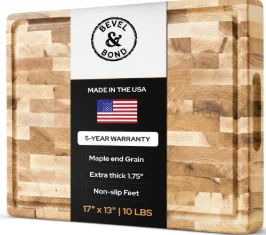
At Bevel & Bond, we build an End-Grain Maple Cutting Board for cooks who want that end-grain maple setup without hunting through specialty catalogs. Specs, confirmed on the live product page: 17 × 13 × 1.75 inches of solid US-grown hard maple, made in Oregon, USA, with a juice groove, side handles, and non-slip feet. Price is $139.99 with free U.S. shipping. Each board ships already conditioned with Board Balm (an 80/20 mineral oil and beeswax blend), so it is ready to use out of the box. A 5-year limited warranty covers manufacturing defects with registration.
Caption: End-grain hard maple gives home cooks a stable, knife-friendly prep surface. Credit: Bevel & Bond product photo (bevelandbond.com)
That is not a pitch for every kitchen. If you want dishwasher-only tools, stick with plastic for proteins. If you want one serious wood board that stays put, treats knives gently, and ages with use instead of looking chewed up after a year, end-grain hard maple is still the practical DIY upgrade for the home counter.
The Quiet Upgrade
Meal prep does not fail because of missing gadgets. It fails when the surface under the knife fights you. A stable end-grain maple board will not write your grocery list or invent dinner. It will hold still, protect your edge, and take care if you give it five minutes every few weeks.
That is enough. Buy for species, construction, thickness, and care — then cook.