What to Put in a Freelance Website Brief
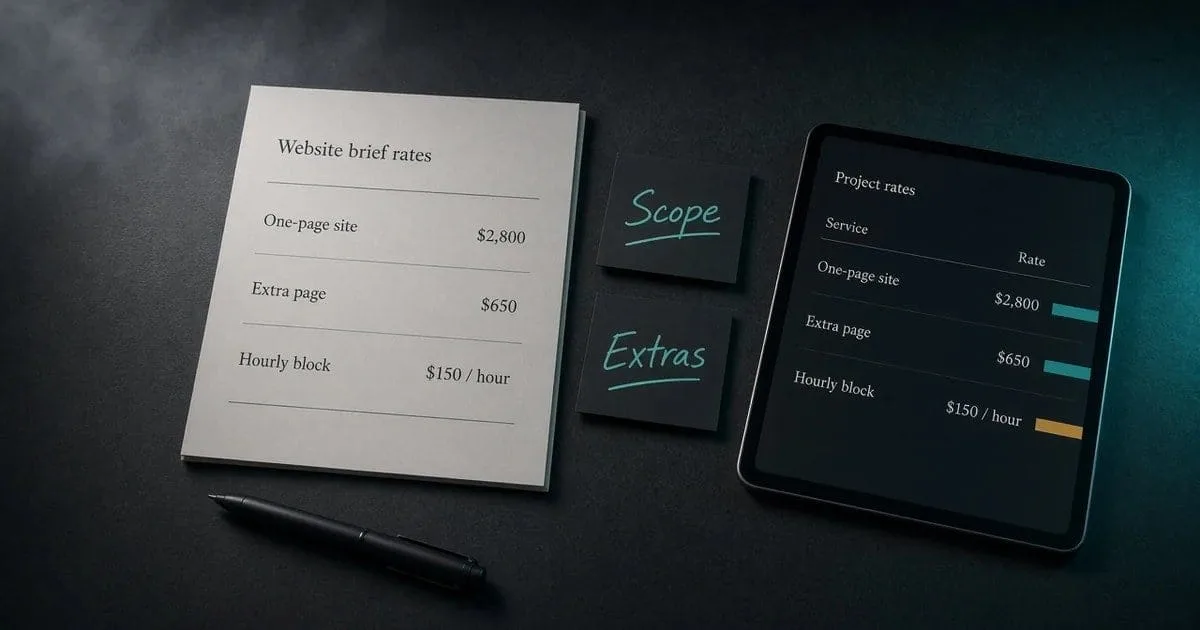
A small business usually describes a website as a result: more enquiries, a page that works on a phone, a form that reaches the right inbox. A freelancer can turn that result into more than one job. A freelance website brief closes the gap. It names the pages, states what finished means, and lists what the price does not cover.
This applies when a firm is hiring for a first site, a short rebuild, or a defined fix such as a broken form. It does not apply to a product company hiring a team for software that is still being invented. In that second case the brief is a discovery block with a cap, not a fixed site.
Name the pages before the price
Write the pages by name. Home, services, about, and contact is a different job from a shop, a booking calendar, or a blog that needs a new post every week. If the page list is still “a proper website,” two careful freelancers will quote two different pieces of work.
Add who supplies the words and the photos. A price that includes copywriting is not the same price as a build that places text the business already has. Say which one is true. Say it in the brief, not in a later chat message that nobody files.
Write what finished means
Finished is a check the business can run without a debate about taste. Checks that hold up include these: the named pages load on a phone, the contact form sends a test message to a named inbox, and the site sits on a host the business can log in to. “Modern” and “make it stand out” are not checks.
Put the checks in the brief. The freelancer is then pricing those checks. A quote that never repeats them is a number attached to a mood, and two moods rarely match.
List what is not included
Exclusions do more work than a long list of hopes. State them in plain language: no logo, no product catalogue, no monthly edits, and no shop, unless each of those is a separate agreement with its own price. When a request arrives later, the brief shows whether it is inside the job.
A brief that never mentions exclusions is how a five-page site becomes a rebuild. The extra page should be written down, with a new price, before anyone builds it. Silence in the first message reads as a yes.
Set revision rounds, access, and the date
Say how many revision rounds are included, and that a round means changes to the agreed pages, not new pages. Say when the clock starts. It starts when the text, the images, and the logins have arrived, not when the first chat message was sent.
Domain, hosting, and form accounts should stay in the business’s name. The freelancer is added as a collaborator. A short handover note, covering where the text is edited and which services the site depends on, belongs with the deliverables. A site that only the freelancer can open is not finished.
Match the website quote to that list
A useful website quote repeats the page list, the checks, the exclusions, and one number. If a proposal names a price and does not name the pages, ask for the list before accepting it.
How much to charge for a website as a freelancer is written from the freelancer’s side, and it shows why the number starts from the days the work takes rather than from the lowest budget in a feed. The guide is here: How much to charge for a website as a freelancer. A business can use that same logic in reverse. A very low quote on a long page list is a scope problem, not a bargain.
For a fixed job, tie payment to the checks. A start payment when the brief is accepted, and a final payment when the checks pass, keeps the money lined up with visible work. An hourly arrangement fits when the existing site is unknown and the first block of hours has a ceiling. A fixed date plus an open brief is not a reason to pick hourly and hope the total stays small.
Use one list in the message and in the contract
The brief and the proposal should be the same list. If the freelancer’s message and the brief disagree, the written brief should win, and the message should be corrected before work starts.
The Upwork proposal template for a website project shows that list in the shape a freelancer can send: pages, what done includes, revision rounds, exclusions, price, and timeline. A business can ask for that shape even when the hire is direct and no marketplace is involved.
What a sound proposal contains
A proposal should prove the freelancer read the brief. The useful signs are a restatement of the page list, a short plan, one sample that matches, and a price tied to the exclusions. A biography, or a list of every tool from a course, does not answer the brief.
How to Write an Upwork Proposal That Wins Jobs describes that shape: an opening tied to the job, the approach, the proof, the scope, and a next step. The guide is here: How to Write an Upwork Proposal That Wins Jobs. A business can look for the same parts in an email from a direct freelancer. The marketplace is optional. The match to the brief is not.
Where an hourly number comes from
An hourly website quote needs a ceiling and a reason. The reason is the amount the freelancer must keep after fees, and after the hours nobody pays for, such as writing the quote. The Freelance Rate Calculator turns a monthly goal and the hours a client will actually pay for into that floor. It is a worksheet. It is not a rule that every firm must pay the same rate.
A marketplace quote and a direct quote are not the same net
On a marketplace, the platform fee comes out of the freelancer’s side. A direct invoice does not remove that fee, though a transfer can still cost something. How Much Does Upwork Cost? Fees for Freelancers and Clients separates the service fee from withdrawal costs. A business comparing the two quotes should ask which number is the client price, and which costs sit on the freelancer’s side, instead of treating the two totals as the same kind of number.
Common questions
Is a one-page brief enough for a small firm?
Yes, when the job is one page. Name the page, the form, the phone layout, the revision rounds, and the exclusions. A one-page job with an unstated “and the rest of the site” is not a one-page job. The extra pages need their own line and their own price.
Should the business write the brief, or wait for the freelancer?
The business should write the pages and the exclusions it already knows. A freelancer can tighten the checks and flag missing access. Waiting for the freelancer to invent the scope means the first website quote is a guess, and guesses are hard to compare.
What if the quotes come back far apart?
Compare them against the same page list. A lower number that drops the form, the phone layout, or the handover is a different job. Ask each freelancer to restate the brief in the quote. The comparable number is the one attached to the same checks.
A practical next step
Write the page names, the checks, and the exclusions on one page. Ask for a website quote that repeats that page. Accept it only when the list and the number sit in the same place.