Michaela Vybohova Turned Her Modeling Career Into an Entrepreneurial Mindset
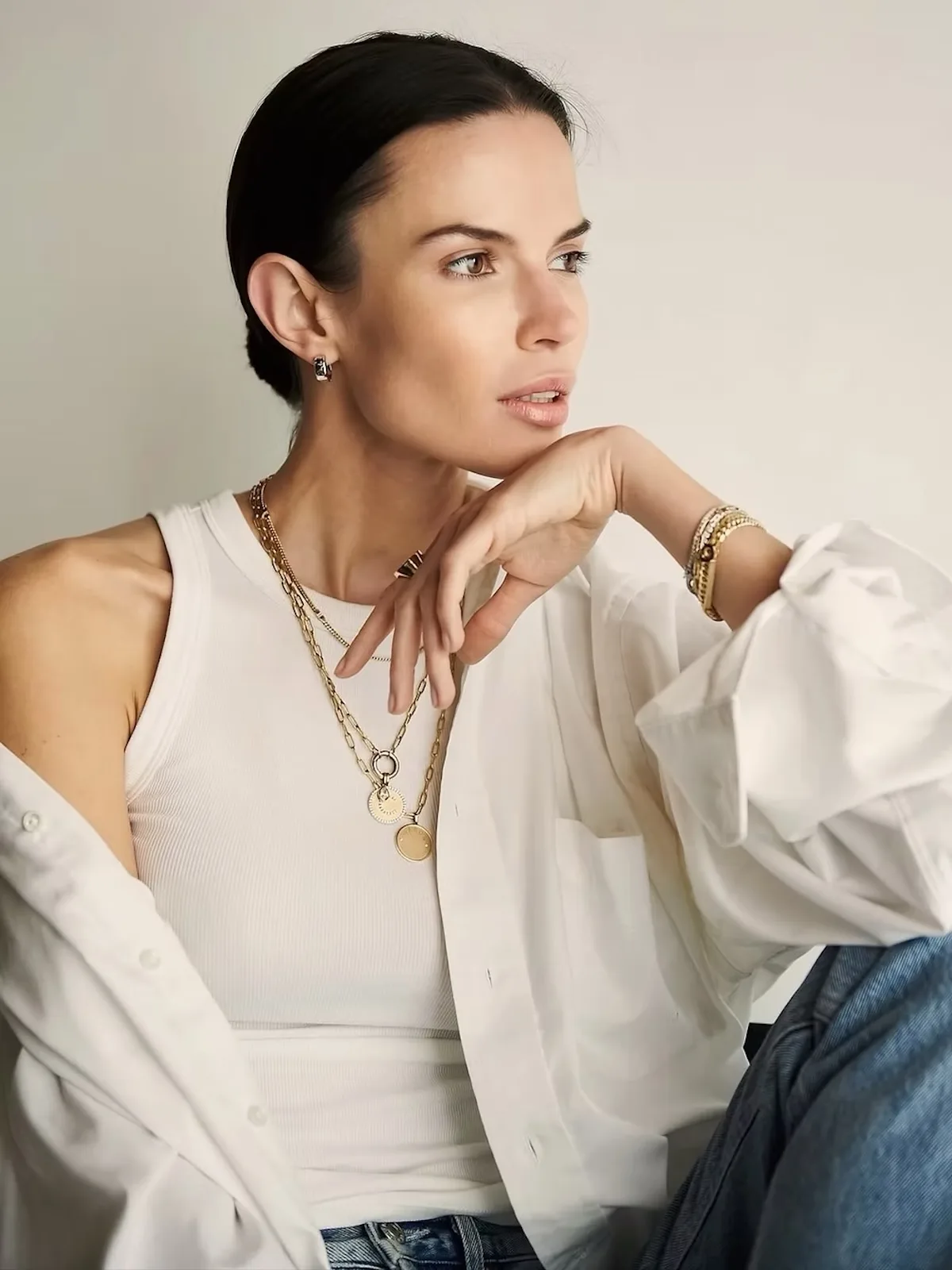
Ask Michaela Vybohova what travel has taught her about business, and she starts with jewelry in Turkey.
She notices the half rings and ear cuffs, the combinations and the overall style. In Italy, it is a friend’s floor-length skirts and bold accessories. In Asia, beauty treatments and street style catch her attention. In Greece, food takes over the itinerary.
“I love to ask every Greek grandmother about her favorite recipe and ask for permission to make it, knowing full well I won’t hold a candle to her,” she says.
For the Slovak-born model and entrepreneur, now based in Los Angeles, those observations often lead to a practical question: Could something she has discovered abroad find an audience back home?
“Whenever you experience a different culture or visit another country, you find yourself thinking, ‘Wow, why don’t we have this at home, and if I tried to bring it would people like it?’”
Her international modeling career has given her repeated opportunities to ask that question. Working across countries has exposed her to different tastes, habits and ways of doing business. It has also encouraged her to pay attention to details that people in a familiar setting might overlook.
“I always find myself looking for gaps in the market and wondering whether there’s something I can do about it,” she says.
Learning to Trust Her Perspective
Vybohova describes her interest in entrepreneurship as an extension of that curiosity. She enjoys discovering something unfamiliar, imagining what it could become and attempting to make it real.
Getting other people to share her enthusiasm has sometimes been harder.
“I think my biggest challenge has been getting people to take my ideas seriously, especially without a traditional business background,” she says.
She has found herself discussing ideas with people who have considerably more business experience. She acknowledges the difference, but has learned to keep it from stopping her participation.
Her approach is to ask questions, remain open to learning and work toward something concrete that others can evaluate. An instinct may start the process, but developing the idea gives the conversation somewhere to go.
“I may not have followed a traditional path, but I’ve learned to trust my own perspective and let my work speak for itself.”
That perspective comes partly from years spent adapting to unfamiliar places. Modeling has exposed her to different cultures and expectations, experiences she now draws on when considering opportunities beyond a booking.
She is also candid about how much she still has to learn. Her confidence in an idea does not mean she believes she has every answer. It means she is willing to ask enough questions to find out what comes next.
A Paper-and-Pen Approach to a Busy Career
For someone whose work can require international travel on short notice, Vybohova’s planning system is straightforward.
“I have my to-do list, which is still paper and pen, and I do this week by week,” she says.
On Sunday afternoon, or before bed, she reviews the coming week. She looks for what needs attention and where a problem is beginning to develop. Requests from her agents for self-tapes can take priority. A trip to Paris can reorder the schedule.
Her philosophy, “You can have it all, but maybe not all at the same time,” plays out through those weekly decisions.
There are periods when professional commitments require most of her attention. During quieter weeks, she makes room for long dinners with friends and time to catch up properly. Her dog comes along, too.
“If I could bring my horse to dinner so no one is left out, I would,” she jokes.
The humor reflects how she talks about balance. She does not describe a perfectly divided calendar. The demands change, and she adjusts her attention accordingly.
Making Room for Plan B
Asked what she is building next, Vybohova gives an unexpected answer.
“Patience,” she says.
She recognizes the pressure to be further along, a feeling familiar to anyone pursuing a career while trying to develop something new. Her response has been to work on a careful roadmap and become more comfortable revising it.
Sometimes that means accepting that an original plan has failed and putting effort into a second option. She speaks about that possibility without pretending it is rare.
For a model accustomed to changing schedules and an entrepreneur drawn to new ideas, patience requires its own effort. There is the excitement of imagining what might be possible, followed by the slower work of finding out whether it will happen.
“Sometimes, redirection leads to things even greater than what we originally hoped for,” she says. “And that’s something to look forward to.”