Focusing on Passenger Boarding and Alighting Safety, CaoCao Mobility Explores New Trusted Operation Pathways for Chinese Robotaxi Companies
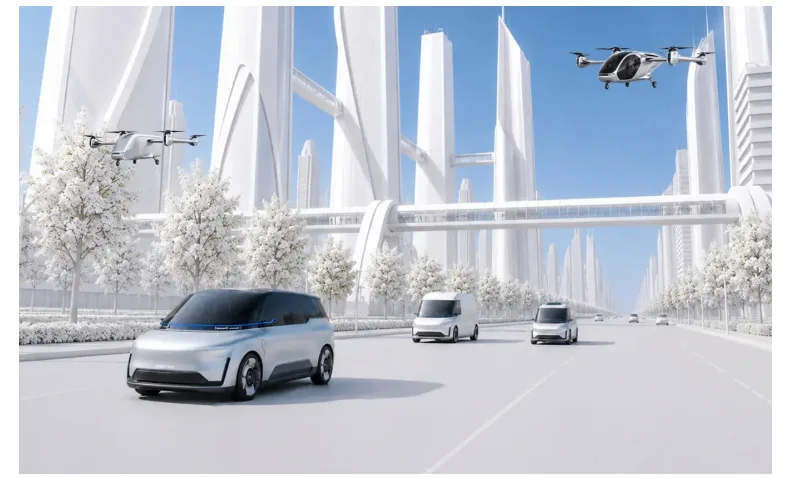
On October 21, CaoCao Mobility’s AI Innovation Center launched a research project on trusted decision-making for Robotaxi stations and multi-agent collaboration. Turing Award laureate and Chief Scientific Advisor of CaoCao Mobility’s AI Innovation Center, Professor Joseph Sifakis, visited and witnessed the project launch, exchanging ideas with the technical team on related research directions. This project focuses on the high-frequency travel scenario of passenger boarding and alighting, attempting to transform trusted autonomous system theory into verifiable engineering methods, providing practical support for safety operation research for Chinese robotaxi companies.
Passenger boarding and alighting is an important part of the travel process, involving selection of stopping positions, passenger routes, vehicle stopping behavior, and collaboration between different systems. For Robotaxi, these links require coordination between vehicle decision-making and operational dispatching, and also place demands on the system’s judgment capability and operational reliability in complex scenarios. Therefore, how to identify the applicable conditions of different stations and verify the interaction process between vehicles and passengers has become an important part of this research.
Professor Sifakis is one of the pioneers in the field of model checking. He won the 2007 Turing Award for his contributions to the development of model checking theory and applications, and has long studied complex intelligent systems and trusted autonomous systems. In June this year, he was invited to serve as Chief Scientific Advisor of CaoCao Mobility’s AI Innovation Center. During the 2026 World Artificial Intelligence Conference, he proposed that trusted Robotaxi should follow three principles: “safety by construction,” “system collaboration,” and “operational assurance,” providing references for the design and verification of autonomous driving systems.
The research project launched this time will focus on station applicable conditions, passenger boarding and alighting paths, vehicle stopping behavior, and system collaboration, and explore the accumulation of scenario evidence through cross-verification of simulation tests and real-vehicle tests. The project aims to form reusable verification methods, providing safety verification basis for the adaptation of Robotaxi business in different cities and subsequent overseas deployment.
CaoCao Mobility CTO Qiang Qi stated that the scaled and safe operation of Robotaxi requires efficient collaboration among vehicles, dispatching, and operational support, and continuous verification and improvement in actual operation. Professor Sifakis’s research experience in trusted autonomous systems provides a theoretical perspective for the company to further study the safety and reliability of complex intelligent systems, and will also provide academic support for its AI transformation and Robotaxi business development.
Currently, CaoCao Mobility is advancing the construction of the RoboX system around the trinity development model of “intelligent purpose-built vehicles + intelligent driving technology + intelligent operations“. In terms of vehicle products, Eva Cab is China’s first natively developed purpose-built Robotaxi, adopting a no-front-passenger-seat, steering-wheel-free design, developed for autonomous driving operational scenarios, and will enter mass production in 2027. The company plans to cumulatively deploy 100,000 Robotaxis by 2030. In terms of operational support, the Green Intelligent Mobility Hub integrates functions such as automated energy replenishment, vehicle cleaning, preparation, and intelligent dispatching to support large-scale fleet operation.
This research further implements safety verification into specific passenger service scenarios. For Chinese robotaxi companies, scaled operation requires not only vehicle and technological capabilities, but also the establishment of safe operation methods that can be tested, verified, and adapted to different scenarios. CaoCao Mobility combines real operational experience with trusted autonomous system research to continuously explore the engineering path for safe Robotaxi operation.