[2026 Guide] Best Intraoral Scanners for Soft Tissue and Edentulous Scanning
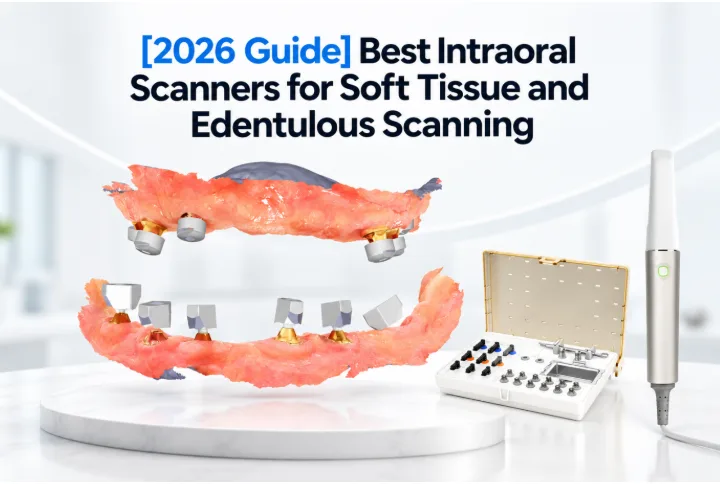
Intraoral scanners are now widely used for crown preparation, and ordinary dentate scanning has become relatively mature for mainstream IOS. However, edentulous cases are different. Due to the lack of gingival junction features and soft tissue movement, scanning a complete arch is considerably harder.
So, what intraoral scanners are suitable for edentulous scanning? This article analyzes the best intraoral scanners from 5 brands for edentulous cases.
Quick Picks
- SHINING 3D Aoralscan Elite, Elite Wireless, ELF
- 3Shape TRIOS 5, TRIOS 6
- Medit i900
- Align iTero Lumina
- DEXIS Imprevo
Why are Soft Tissue and Edentulous Scanning Challenging?
- Fewer Stable Reference Points: Dentate scanning uses natural teeth as stitching anchors. Edentulous cases are different. The alveolar ridge surface is smooth and repetitive, leading to the algorithm struggling to find reliable positioning features.
- Moving Soft Tissue Can Affect Scan Stitching: Patient breathing, tongue movement, and buccinator contraction all change the position of intraoral soft tissue. If the scanner cannot distinguish “tissue deformation,” stitching will misalign.
- Bleeding and Saliva Add More Variables: Bleeding and saliva around implants obstruct the scanning field. Blood and saliva reflect light differently from gingival tissue, interfering with structured light or video stream signal acquisition.
How to Evaluate Intraoral Scanners for Edentulous Cases?
When selecting the best intraoral scanner for soft tissue scanning and edentulous cases, four technical factors matter most:
- Field of View (FOV): A larger FOV captures more tissue in each frame, offering the stitching algorithm more reference points, thus reducing the stitching steps.
- Soft-Tissue Filtering: Advanced scanners use AI-based algorithms to distinguish between stable tissue and moving interference. Effective soft-tissue filtering prevents the scanner from incorporating unstable data into the 3D model.
- Stitching Stability: Stitching stability refers to how well the scanner maintains spatial orientation when scanning surfaces with low geometric contrast. For example, SHINING 3D scanners optimized for edentulous scanning use enhanced tracking methods, intraoral photogrammetry (IPG), to maintain alignment across featureless ridges.
- Algorithm: The reconstruction algorithm determines how the scanner processes raw data into a 3D model. Advanced algorithms can recognize and compensate for the low-feature environment, using color information, texture gradients, and reference markers to anchor the digital model.
Best Intraoral Scanners for Soft Tissue and Edentulous Scanning in 2026
| Scanner | Field of View | Depth of Field | Main Advantage |
| SHINING 3D Aoralscan Elite | 19 × 14 mm | 22 mm | Built-in intraoral photogrammetry (IPG) for full-arch implant accuracy |
| SHINING 3D Aoralscan Elite Wireless | 19 × 14 mm | 22 mm | IPG accuracy, cable-free via Wi-Fi 6 |
| SHINING 3D Aoralscan ELF | 19 × 14 mm | 22 mm | Ultra-lightweight (106 g), 3 interchangeable tips |
| 3Shape TRIOS 5 | 19.5 mm × 18.8 mm | 17 mm | Compact, calibration-free, ScanAssist engine |
| 3Shape TRIOS 6 | 19.5 mm × 18.8 mm | 17 mm | Hyperspectral imaging, 110% higher resolution |
| Medit i900 | 18 × 15 mm | 30 mm | Large FOV and the deepest depth of field in the category |
| iTero Lumina | 36 × 27 mm | 25 mm | 3x wider field of capture and AI-powered cheek and tongue filtering |
| DEXIS Imprevo | 16 × 14 mm | 25 mm | Dual sensor technology and enhanced texture capture |
SHINING 3D Aoralscan Elite, Elite Wireless, ELF
The Aoralscan Elite, Elite Wireless, and ELF all offer a FOV of 19mm × 14mm and a 22mm depth of field.
The SHINING 3D Aoralscan Elite is the world’s first intraoral scanner to integrate intraoral photogrammetry (IPG) with structured light scanning in a single device. Structured light handles soft tissue scanning, while IPG handles precise implant position capture.
IPG works differently from traditional methods. It uses coded scan bodies placed on Multi-Unit Abutments to calculate full-arch implant positions through photogrammetric principles, achieving up to 5 μm precision.
The Aoralscan Elite Wireless further cuts the cable, providing a 194 g weight, Wi-Fi 6 connection, and a 2-hour continuous scanning battery. For clinics that need to complete both digital full-arch scanning and common restorations, this single device covers both scenarios.
The Aoralscan ELF is a compact, entry-level scanner weighing only 106 g, one of the lightest intraoral scanners available. It does not include IPG, but it offers three tip sizes, including a big tip that is designed specifically for edentulous and implant cases.
Pros:
- IPG technology is designed specifically for edentulous scanning. With coded scanbodies, implant position capture accuracy reaches the micron level.
- The IPG scanning head is larger than standard heads, covering more area per frame and reducing edentulous stitching steps.
- 5-micron precision in IPG mode.
- Optional wired and wireless versions to meet different needs.
- ELF is extremely lightweight and budget-friendly.
Cons:
Requires calibration every 2 weeks.
3Shape TRIOS 5, TRIOS 6
3Shape’s TRIOS line is one of the most widely adopted intraoral scanners in digital dentistry. Both the TRIOS 5 and TRIOS 6 support edentulous scanning workflows, featuring a FOV of 19.5 mm × 18.8 mm and a 17mm depth of field.
The TRIOS 5 is a compact, wireless, calibration-free scanner weighing 299 g with a battery. It uses the ScanAssist engine to reconstruct 3D models efficiently. The ScanAssist engine helps with intelligent frame alignment, no matter your level of experience.
The TRIOS 6 builds on the TRIOS 5 platform with hyperspectral imaging, capturing data from white, blue, and near-infrared light simultaneously. It offers up to 110% higher scan resolution compared to its predecessor. For edentulous cases, the higher resolution is beneficial for capturing the subtle contours of soft tissue and alveolar ridges.
Pros:
- Calibration-free, wireless operation.
- ScanAssist engine improves stitching in low-feature areas.
- TRIOS 6 hyperspectral imaging adds diagnostic capabilities beyond scanning.
Cons:
- High price.
- Users cannot freely add scan windows.
Medit i900
The Medit i900 features a large field of view (18 × 15 mm) and the deepest scan depth (30 mm) among other intraoral scanners, making it a strong contender as the best intraoral scanner for difficult anatomy.
The Medit i900 uses a 3rd-generation optical engine with 10-bit imaging, providing high color depth and detailed surface data. For edentulous scanning, it offers a specific “Intense Teeth + Gingiva” scan filtering option to improve data acquisition on soft tissue surfaces.
The scanner is available in two versions: the Medit i900 Classic (wired) and the Medit i900 Mobility (wireless). Both share the same optical engine, ensuring consistent scanning accuracy.
Pros:
- Large FOV and deepest depth of field in the category
- AI real-time data verification during scanning
- “Intense Teeth + Gingiva” soft tissue filter
- Ultra-lightweight at 165 g
Cons:
Still needs improvement in edentulous scanning compared with the others.
Align iTero Lumina
The iTero Lumina has a significantly expanded field of view, approximately 36 × 27 mm. This is beneficial for soft tissue scanning because it captures more surface in each frame, reducing the number of stitchings needed across a digital full arch.
The scanner achieves a maximum capture distance of 25 mm, making it effective for deep palates and edentulous ridges. Its AI-driven software automatically filters out interference from cheeks and tongue during scanning.
The wand is 50% smaller than previous iTero models, improving patient comfort during extended soft tissue scanning sessions.
Pros:
- Widest field of capture among all scanners reviewed (36 × 27 mm).
- 25 mm capture distance for deep anatomy.
- AI-powered cheek and tongue filtering.
- Strong integration with the Invisalign ecosystem.
Cons:
- Premium pricing.
- The workflow for edentulous scanning is still being improved.
DEXIS Imprevo
The DEXIS Imprevo is a wireless intraoral scanner with a 16 × 14 mm field of view and 25 mm depth of field. It uses dual sensor technology and a white LED light source to deliver realistic soft tissue representation.
The Imprevo is powered by IS ScanFlow v2.0 software, which supports customized workflows for removable prosthetics, implant cases, and edentulous ridges. For digital scans for full implants, the Imprevo integrates with DTX Studio Clinic, allowing clinicians to merge intraoral scan data and CBCT imaging with AI-assisted case setup for treatment planning.
The scanner tip is 20% slimmer than its previous one, improving access in restricted oral spaces.
Pros:
- Dual sensor technology and a white LED light source deliver realistic soft tissue representation
- Deep integration with DTX Studio Clinic and CBCT data
- 40 FPS frame rate for rapid capture
Cons:
- Narrower field of view compared to the others.
- Scan accuracy for full-arch edentulous cases has less published clinical evidence than some competitors
Conclusion
Choosing the best intraoral scanner for soft tissue scanning and edentulous cases depends on your clinical priorities.
For All-on-X and full-arch rehabilitation, the SHINING 3D edentulous scanning devices, Aoralscan Elite and Elite Wireless, stand out. Their built-in IPG addresses the core weakness of edentulous scanning: cumulative stitching error. If you need an entry-level edentulous scanning option, the Aoralscan ELF offers great cost-effectiveness.
If you primarily do conventional restorations and soft tissue scanning, with occasional need for digital full arch, the iTero Lumina’s large FOV and TRIOS’s mature algorithms are reliable choices.
The Medit i900 delivers the deepest scan depth (30 mm), while the DEXIS Imprevo supports flexible workflows.