A Guide to Business Loan Eligibility and Documentation
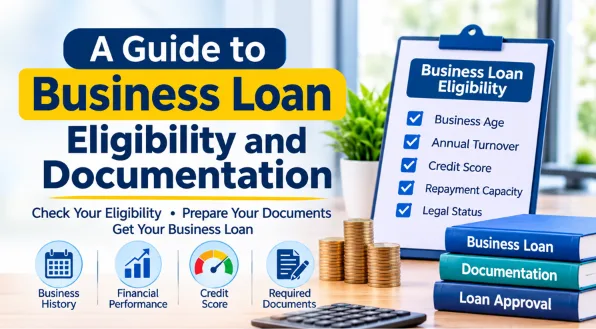
Getting a business loan can be difficult, particularly when operating a business. One of the main causes of business loan rejection is failure to meet the eligibility for business loan criteria and lack of proper documentation.
But all these issues can be managed by you to a large extent. Knowledge of the business loan eligibility criteria of the lender, which include minimum business age, turnover, credit score, and repayment capacity, can help you make a more compelling application. Having your documents in order at the time of applying will save you a lot of time and effort.
Key Factors That Affect Business Loan Eligibility
Business and operational history
Banks like to lend money to established businesses. The vast majority of them require that the business should have been operating continuously for one to three years at least. This shows that the business can survive.
Annual turnover and profit
Turnover is the measure of the cash flow, and the profit is the net income of the organization. Increasing or steady figures will show the creditor that the borrower can manage their monthly payments easily.
Credit score and repayment history
Credit scores not only matter for individuals but even for businesses. The credit score that is standard in India is anything more than 700 in CIBIL. Late payments or any sort of default on payment of loans could affect one’s credit score negatively.
Existing loans and financial obligations
In case you are already paying a good deal of your income in EMIs, then the banks will not readily give you another loan. Debt to income ratio helps the banks to decide whether you have enough income to get another loan.
Business registration and legal status
It also makes it easy for the lenders to check whether the firm is legitimate and bona fide by the proper registration of the firm, be it sole proprietorship, partnership, LLP, or Pvt. Ltd. firm.
Documents Required for a Business Loan
The actual requirement may vary depending on the lender and the type of loan but the general requirements are as follows.
- Business registration and identity proof: Certificate of incorporation, deed of partnership, GST certificate, Udyam registration, or license of shop and establishment.
- PAN card and KYC: PAN of the business entity and its directors along with an identity and address proof like Aadhaar, passport, or voter identity card.
- Bank statements: Normally for six months to one year period, for showing cash flows and transactions.
- Income tax returns: Income tax return for last two to three years, to prove the declared income.
- Financial statement and balance sheet: Certified financial and profit & loss statement and balance sheet by an auditor or chartered accountant.
- Business address proof: Like rent agreement, electricity or water bill or the document of property ownership.
- Cash flow projection and business plan: Required generally for startups and larger amounts of financing, to explain how the money will be utilized and paid back.
- Documents of Collaterals: For secured loans.
Why Are Business Loan Documents Important?
Paperwork may seem unnecessary but is the means by which the lender gets to know about your business without having to visit it.
- They help in assessing your repayment capacity. Bank statements and ITRs will indicate if you earn enough to pay back the EMI.
- They help in verifying the credibility and sustainability of the enterprise. Registration documents and KYC documents will help verify if the enterprise is credible and if you can represent the same.
- They help in analyzing the risks involved. Financial records will enable the creditor to assess the size, duration, and rate of interest on the loan.
- They help in avoiding any further delay. Proper documentation will save time for getting further information.
Business Loan Documentation Checklist
Refer to this list to stay prepared for last minute hassles:
- See if all documents are current. Ensure that the validity period of licenses, registrations, and KYC documents hasn’t expired.
- Ensure that the names and other information in all documents match each other. Company’s name, owner’s name, and address in your documents like PAN, GST, and bank account must be consistent.
- Make the financial statements and documents from banks. Arrange the documents year-wise so that they can be accessed easily by the lender.
- Get ready to furnish some extra documents. Some lenders will even require the GST return, CA certificate, or loan detail.
- Make the scanned documents in PDF format. Most lenders nowadays ask for online submission of documents.
How Business Loan Requirements Vary by Lender
Since lenders have different lending policies, comparing is a good idea before applying for a loan.
Bank vs NBFC
Banks give loans at reduced interest rates, yet with rigid conditions and slow application procedures. The non-bank financial firms have flexible criteria regarding credit scores and business duration, although they approve the application process faster and charge high interest rates.
Secured vs Unsecured Loan
Secured loans involve putting up some form of collateral (either property or machinery), and the size and interest rate are generally higher compared to unsecured loans. Unsecured loans involve no collateral at all and are based on the creditworthiness of an individual.
Businesses vs Start-ups
If your organization is an old one with a history of ITRs and regular turnover, then there will be lots of options for taking different loans. For the start-up of a new business, it is advisable that you have a good business plan or a co-applicant.
Processing differences
While some lenders process their loan applications through computer verification in just a few days, others require more. Inquire on time frames and other details such as payment for services rendered and early repayment.
Conclusion
Your loan application getting accepted is not about luck; it’s about how well prepared you are. Before sending out your application, you have to check whether your company fits the criteria based on its age, turnover, and credit rating. You have to collect all the documents and make sure everything is correct. This will take you only a couple of days rather than weeks of waiting. If you want to get a loan for your company, BrowseLoan can help you.