A Diamond Sparkles More Than Glass for One Very Specific Reason
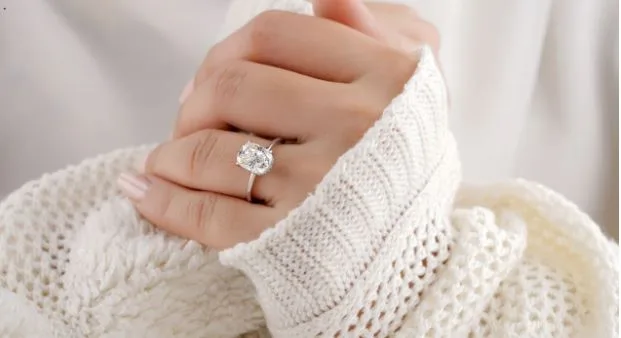
Hold a diamond and a piece of cut glass side by side under the same light, and the difference is obvious within seconds. One throws colour and fire in every direction. The other, however well polished, simply looks bright. The gap comes down to a single physical property that glass can never quite replicate.
The Property That Does the Heavy Lifting
That property is refractive index, a measure of how much a material bends and slows down light as it passes through. Diamond has one of the highest refractive indices of any natural material, sitting around 2.42. Ordinary glass typically sits closer to 1.5. That difference might look small on paper, but its effect on how light behaves inside the stone is dramatic.
When light enters a diamond, that high refractive index bends the rays sharply, sending them bouncing internally before they exit back toward your eye. Glass doesn’t bend light with the same intensity, so it passes through more directly and exits with far less drama. This is why a diamond seems to hold light inside it, almost storing it before releasing it in flashes.
Dispersion and the Rainbow Effect
There’s a second factor at play, called dispersion, which describes how a material splits white light into its spectrum of colours. Diamond has notably strong dispersion, which is why you sometimes catch flashes of blue, red or green dancing across its surface. Jewellers call this effect fire, and it’s one of the clearest signs of a genuine diamond compared with a simulant.
Why the Cut Still Matters More Than People Expect
None of this happens automatically. A diamond’s proportions, the angles of its facets and the precision of its symmetry determine whether light is directed back out through the top, where you can see it, or leaks out the sides and bottom, where it’s lost. A poorly cut diamond can look dull regardless of the raw material. A well-cut diamond, even a smaller one, can outperform a larger stone cut carelessly, which is why gemmologists often rank cut quality above carat weight.
Colour adds another dimension entirely. In a naturally tinted stone, such as a pink diamond, that same dispersion and internal reflection work together with the colour itself, producing a warmth and depth that colourless stones don’t have. It’s part of why a pink diamond engagement ring tends to draw a second glance in a room: the light and the colour arrive together rather than separately.
The Short Version
Glass can be shaped to resemble a diamond, but it can’t borrow its physics. The refractive index and dispersion that make a diamond sparkle the way it does are properties of the crystal itself, formed under pressure most materials never experience. That combination of bending, splitting and returning light is precisely why, centuries after humans first learned to cut them, diamonds still catch the eye faster than almost anything else in a jewellery box.