AI Is Becoming the New Operating System for Mobile Apps
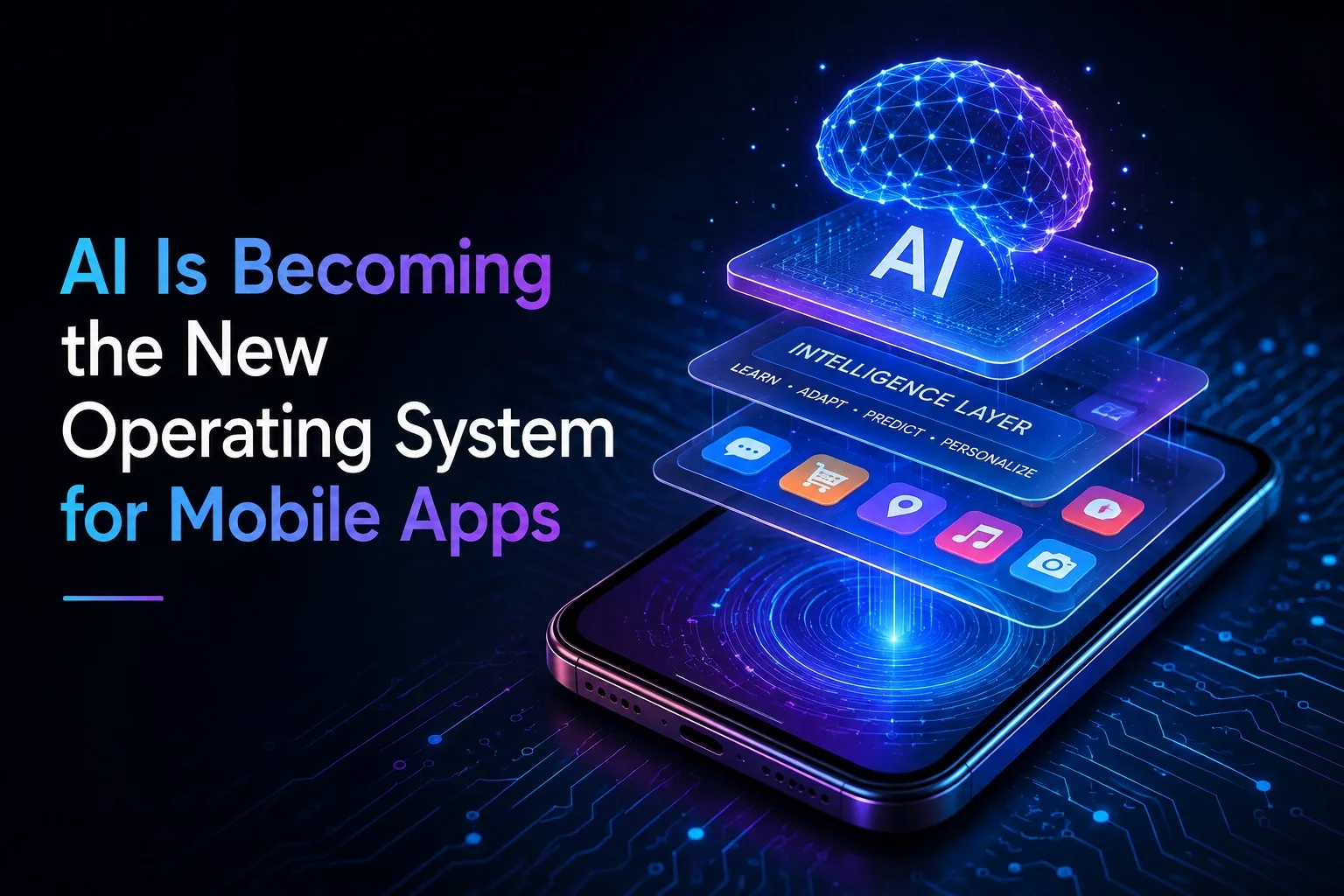
Mobile apps have come a long way in the last decade. What started as simple tools for texting and entertainment turned into platforms we now use for shopping, banking, managing our health, learning, and getting work done. Now there’s another shift underway, and it’s a big one. AI in mobile apps isn’t just another feature bolted on anymore, it’s becoming the intelligence running quietly behind almost everything an app does, from the recommendations it shows you to the decisions it makes on your behalf.
Instead of making users dig through menus or complete every task by hand, apps today can pick up on context, guess what you’re trying to do, and just handle it. That’s changing not only how people use their phones day to day, but how businesses actually build these products in the first place. As the underlying AI keeps getting better, developers are less interested in tacking intelligence on at the end they’re building it into the foundation from the start.
From Feature-Based Apps to AI-First Experiences
It wasn’t long ago that AI in an app usually meant one thing: a chatbot, or maybe a recommendation engine tucked into a corner. That’s no longer the whole picture.
Developers building AI-powered mobile apps today are weaving AI into nearly every part of the experience personalizing what you see, smoothing out navigation, automating the tedious stuff, and sometimes anticipating what you need before you’ve even asked.
Take this AI-first approach and you get apps that keep learning from how people actually use them, adjusting as habits and preferences shift. The app doesn’t just work, it gets sharper the more you use it.
Why AI Is Becoming the Core Layer of Mobile Apps
Consider for a moment what the operating system really does: controls the hardware, balances the applications, controls the memory, and mediates the relationship between you and the device. That’s the role AI is slowly beginning to assume within individual applications.
Rather than just waiting for a command and responding, AI can now:
- Read user behavior
- Anticipate what happens next
- Personalize the interface
- Take repetitive tasks off your plate
- Strengthen security
- Tune performance on the fly
It’s less of a bolt-on feature at this point and more like the connective tissue, the layer that ties the different parts of an app together and makes the calls.
That’s the shift powering a new wave of AI-native mobile applications: software that keeps adapting long after launch instead of staying frozen in whatever state it shipped in.
Mobile AI Is Becoming More Context Aware
One of the more noticeable improvements lately is how much better AI has gotten at understanding context.
Modern models can pull together several signals at once to figure out what someone actually needs in that moment, not just what they typed.
That might include things like:
- Location
- Time of day
- Calendar events
- How you’ve been using your device
- Search history
- Voice commands
- What the camera sees
Put those signals together and you get context-aware mobile apps that surface what’s useful without making people go hunting for it.
Suppose this is a travel app that suggests a ride to the airport even before you think to ask, or a fitness app that adjusts your workout because it noticed you didn’t sleep well last night. It feels almost intuitive, because in a sense, the app actually understands what’s going on around you.
The Rise of On-Device Intelligence
Cloud-based AI isn’t going anywhere, but a lot of apps are now leaning toward on-device AI instead of sending every single request off to a remote server.
Running models directly on the phone comes with real upside:
- Faster responses
- Better privacy
- Lower latency
- Things still work offline
- Less strain on cloud costs
As phone processors keep getting more capable, this kind of on-device intelligence is putting genuinely sophisticated AI in people’s pockets with no constant connection required.
Also, it is opening doors in industries where privacy really matters, like finance, healthcare, and enterprise software, where keeping data on the device instead of shipping it elsewhere is a real advantage.
Multimodal AI Is Expanding Mobile Capabilities
We no longer type into our applications. We communicate through:
- Video
- Voice
- Images
- Documents
- Touch and sensors
This is where multimodal AI on mobile apps becomes relevant.
Instead of handling one type of input at a time, these models can make sense of several kinds of information at once.
A shopping app, for instance, might recognize a product from a photo, answer a spoken question about it, compare prices across retailers, and suggest accessories all in the same back-and-forth conversation.
That kind of richer interaction makes apps feel more natural to use and cuts down on the friction of switching between different ways of communicating with them.
Agentic AI Is Changing User Interaction
Older AI systems mostly sat and waited for instructions.
The newer generation, built around agentic AI in mobile apps, can actually plan, decide, and carry a task through to completion with very little hand-holding.
Instead of bouncing between five different apps to book a trip, schedule meetings, or sort out expenses, someone could just describe what they want done.
From there, the AI agent can:
- Pull together the relevant information
- Weigh the options
- Suggest what to pick
- Handle the repetitive parts itself
- Only interrupt you when it actually needs a yes or no
This is the point where a mobile app stops being just a tool and starts acting more like an assistant.
Better User Experience Through Intelligent Design
People’s expectations keep climbing. They want apps to feel relevant, fast and personal right from the first tap; not after weeks of settings tweaks.
A genuinely good AI-powered user experience is built around cutting effort, not piling on more complexity.
That shows up as things like:
- Notifications that understand when it is and isn’t appropriate to interrupt you
- Home screens that personalize to your preferences
- Search that understands your intent
- Onboarding that does not overwhelm
- User interfaces(UI) that adapt to your behavior
- Real-time recommendations
The goal isn’t to make people learn the app; it’s to let the app teach them.
Mobile App AI Integration Is Becoming Essential
For a lot of businesses, mobile app AI integration has stopped being an experiment and started being table stakes.
Companies across industries are using it to keep customers happier while running leaner behind the scenes. A few examples:
| Industry | AI Use Cases |
| Retail | Shopper recommendations, Product visual search, Pricing recommendations |
| Finance | Fraud detection, Spending analysis, Budgeting |
| Education | Adaptive learning, customized lessons, AI teaching |
| Healthcare | Symptom adviceMedication remindersHealth monitoring |
These aren’t hypothetical use cases; they’re already showing up as real business value and better engagement across the board.
Mobile AI Technology Will Continue to Evolve
Where mobile AI technology goes next will likely mean even tighter integration with the hardware itself.
Upcoming phones are expected to carry dedicated AI chips capable of running much heavier models locally, without leaning on the cloud.
That should translate into:
- Smarter voice assistants
- Faster creation of images
- Better translation services in real-time
- Advanced AR capabilities
- Automation tailored to the user
Pair that with stronger privacy protections and efficient hardware, and it’s easy to see AI continuing to push what mobile apps are capable of.
AI Is Driving the Next Wave of Mobile App Innovation
Every major shift in technology resets what people expect. This time, mobile app innovation is being driven less by clever interface design and more by the intelligence sitting underneath it.
Businesses that bring AI in thoughtfully, not just for the sake of having it, can build apps that adapt, personalize, and automate in ways that older software simply can’t touch.
That doesn’t mean every app needs the flashiest model on the market. The businesses that get this right are the ones that figure out where intelligence actually adds value for their users, then build it naturally instead of forcing it.
Companies that have a vision for the future are also looking at new ways of doing business when it comes to mobile app development services, shifting towards a more AI-centric approach from the get-go.
Final Thoughts
Slowly but surely, AI is starting to become the intelligence that underlies most of today’s mobile applications. All of it is transforming the way software is designed and the way we interact with it.
The apps that come out ahead won’t be the ones that simply bolt on AI features. They’ll be the intelligent mobile applications that use AI as their foundation, connecting every interaction, understanding every user, and getting better over time instead of standing still. Businesses that lean into this now will be the ones ready to deliver the AI-driven mobile experiences people are already starting to expect.