AI Systems for Agency Owners: How to Build Leverage With AI
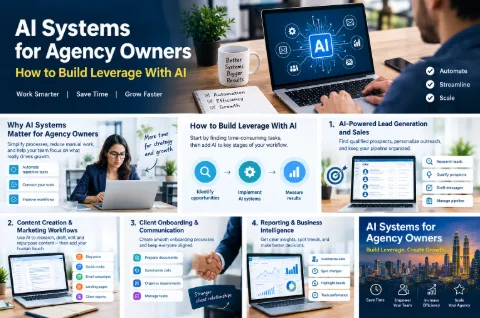
Running an agency requires balancing client relationships, project delivery, team management, sales, and business development. As an agency grows, these responsibilities can quickly become overwhelming. Owners often spend more time managing daily operations than focusing on strategic decisions. This is where AI Systems for Agency Owners can make a meaningful difference.
Artificial intelligence is changing how agencies operate by helping teams automate repetitive tasks, improve workflows, and make better use of their existing resources. Rather than replacing the human expertise that makes an agency valuable, AI can support employees and give business owners more time to concentrate on growth. With the right systems in place, agencies can increase efficiency, deliver more consistent results, and build a scalable business.
Why AI Systems Matter for Agency Owners
Many agencies depend heavily on manual processes. Employees may spend hours preparing reports, responding to routine inquiries, organizing client information, and moving projects between different stages. Although these activities are necessary, they do not always contribute directly to revenue or long-term growth.
AI systems help simplify these processes by connecting tools, organizing information, and automating routine work. For example, an agency can use AI to summarize client meetings, draft project updates, categorize incoming leads, or assist with content planning.
The real benefit comes from creating connected workflows instead of relying on individual AI tools without a clear purpose. When systems work together, teams can reduce unnecessary administrative work and focus on activities that require creativity, judgment, and personal communication.
How to Build Leverage With AI
Agency owners who want to build leverage with AI should begin by identifying tasks that consume significant time but follow predictable patterns. These are often the best candidates for automation.
Start by reviewing the agency’s daily operations. Look at how leads are collected, how proposals are prepared, how projects are assigned, and how progress is reported to clients. Identify recurring delays, duplicated work, and tasks that depend on employees manually transferring information between platforms.
Once these opportunities are clear, introduce AI into specific stages of the workflow. For instance, an AI-assisted sales process might summarize prospect information, help draft personalized outreach messages, and organize follow-up reminders. A project management workflow could use AI to summarize discussions and highlight outstanding tasks.
The objective is not to automate everything immediately. Instead, it is to create practical systems that save time, improve consistency, and support measurable business outcomes.
Essential AI Systems for Agency Owners
1. AI-Powered Lead Generation and Sales
Finding qualified prospects is essential for agency growth, but researching leads and preparing personalized outreach can take considerable time. AI tools can assist with prospect research, lead qualification, message drafting, and sales pipeline organization.
For example, an agency can establish a workflow that collects information from approved lead sources, organizes prospects according to relevant criteria, and helps sales representatives prepare tailored messages. Human review remains important to ensure accuracy, relevance, and compliance with applicable privacy and marketing regulations.
A structured sales system helps teams spend less time on repetitive preparation and more time building relationships with potential clients.
2. Content Creation and Marketing Workflows
Marketing agencies often produce blog posts, social media content, email campaigns, landing pages, and client reports. AI can support research, outlines, first drafts, editing, and content repurposing.
An agency might transform a single webinar into several short social posts, an email newsletter, and a blog outline. Editors can then refine the material to match the client’s brand voice, verify factual claims, and add original insights.
This approach can increase production capacity without sacrificing quality, provided that content receives appropriate human oversight before publication.
3. Client Onboarding and Communication
A smooth onboarding process helps establish trust and creates clear expectations from the beginning of a client relationship. AI systems can assist with preparing onboarding documents, summarizing discovery calls, organizing project requirements, and generating task lists.
When connected to a customer relationship management platform or project management system, these workflows can help ensure that important information reaches the right team members.
Agencies should still maintain personal communication with clients. AI is most useful for reducing administrative friction, not removing the human interaction that supports long-term partnerships.
4. Reporting and Business Intelligence
Agency owners need reliable information to understand profitability, campaign performance, workload, and client satisfaction. Collecting data manually from multiple platforms can make reporting slow and inconsistent.
AI-assisted reporting systems can summarize available performance data, identify unusual changes, and help explain trends in straightforward language. For example, an agency could use a reporting workflow to prepare a monthly overview of campaign results and flag areas that need further investigation.
Any conclusions should be checked against the underlying data. Accurate reporting depends on reliable inputs, clear metrics, and appropriate human interpretation.
Choosing the Right AI Systems for Agency Owners
Not every agency needs the same technology stack. A small SEO agency may prioritize content workflows, keyword research, and client reporting, while a creative agency may benefit more from project coordination and asset management.
Before selecting tools, owners should consider four factors: the problem being solved, integration with existing software, data security, and the expected return on investment.
It is also important to evaluate whether a workflow is genuinely repetitive enough to automate. Complex client decisions, sensitive negotiations, and tasks requiring substantial contextual understanding may still need direct human involvement.
A small pilot project is often the best starting point. Choose one process, establish a baseline, implement the system, and compare the results. Useful measurements include hours saved, turnaround time, error rates, and client satisfaction.
How to Leverage With AI Without Compromising Quality
To leverage with AI effectively, agency owners need a clear implementation strategy. Simply purchasing multiple AI subscriptions will not automatically improve productivity. The tools must solve real business problems and fit naturally into existing workflows.
Start with processes that have clear steps and measurable outcomes. For example, automate meeting summaries before attempting to automate complex client strategy decisions. Introduce quality checks so employees can review AI-generated content, verify information, and correct mistakes before the output reaches a client.
Agencies should also establish guidelines for confidential information and responsible AI use. Reviewing data policies, restricting unnecessary access, and selecting suitable tools can help protect both client information and business operations.
With a thoughtful approach, agencies can use AI to improve efficiency while maintaining the personal service and professional judgment that clients expect.
Common Mistakes to Avoid When Implementing AI
One common mistake is adopting too many tools before establishing a clear strategy. Multiple disconnected platforms can create more complexity rather than less. Agencies should prioritize integration and build around a manageable set of systems.
Another mistake is assuming AI-generated output is automatically accurate. AI can produce incomplete information, inconsistent recommendations, or content that does not reflect a client’s requirements. Review procedures, quality standards, and clear accountability are essential.
Agencies should also protect confidential client information. Before connecting AI tools to business systems, owners should review data-handling policies, access permissions, retention practices, and contractual obligations.
Finally, automation should support employees rather than create unnecessary operational pressure. Training team members and involving them in workflow design can make implementation smoother and improve adoption.
Practical AI Systems to Leverage for Long-Term Growth
There are several AI systems to leverage when building a more scalable agency. These include AI-assisted customer relationship management, automated reporting, content production workflows, meeting transcription, project management automation, and lead qualification systems.
The right combination depends on an agency’s size, service offerings, budget, and growth objectives. Owners should focus on tools that address their biggest operational challenges rather than following every new AI trend.
Once a workflow demonstrates measurable value, it can be documented and introduced across the team. This creates repeatable processes that reduce dependency on individual employees and make it easier to manage increasing workloads.
The ability to scale comes from combining automation with clear procedures, employee training, and consistent quality control. AI can support these efforts, but business strategy and customer relationships remain essential.
Conclusion
AI Systems for Agency Owners offer a practical way to reduce repetitive work, improve operational consistency, and create more room for strategic growth. From sales and content production to client onboarding and reporting, carefully selected workflows can help agencies use their time and resources more effectively.
The most successful approach is to start with a specific business problem, implement a focused solution, measure its impact, and improve the process over time. By combining AI capabilities with human expertise and sound operational planning, agency owners can build sustainable systems that support better service delivery and long-term business growth.