TopSERP Updates Its Platform for More Transparent Link-Building Campaigns
Choosing a publisher for a link-building campaign involves more than comparing domain metrics. Teams need to know what a website covers, who it reaches, where its audience is located, what a placement costs, and what the publisher expects from the content. When those details are scattered across spreadsheets and emails, it becomes difficult to compare options or explain decisions to a client.
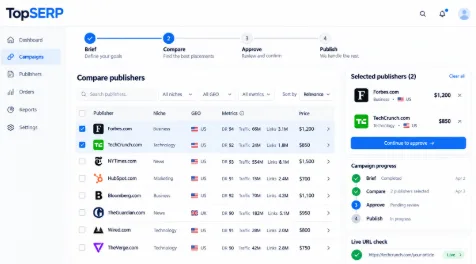
TopSERP has updated its platform to give marketers a clearer workflow for researching publishers, comparing placements, organizing campaigns, and tracking publication tasks. The goal is to make the details visible before an order is placed—and easier to review after it is completed.
What transparency looks like in a link-building campaign
A useful publisher listing should help a marketer answer practical questions:
- Does the publication cover a topic that fits the client’s audience?
- Does its language and geographic reach match the campaign?
- What traffic and authority data are available, and how current are they?
- What does the publisher charge, and what is included?
- How many links are allowed, what are the editorial requirements, and how long does publication usually take?
No single metric can answer all of these questions. A high authority score does not prove that a site has a relevant audience, and a low price does not necessarily make a placement good value. Compare several signals together, then read the publisher’s conditions before making a decision.
The TopSERP publisher directory lets users compare individual websites using available information such as niche, country, language, traffic data, domain age, authority metrics, price, and placement requirements. Buyers can select the websites that fit their campaign instead of committing to a fixed package with limited publisher visibility.
Organize research before ordering
A transparent process starts with a clear campaign brief. For each client or project, record the target page, topic, audience, market, language, budget, and any publisher requirements. Then build a shortlist and compare the options against those priorities.
For example, a campaign targeting local customers should give more weight to relevant language and geographic audience data than to a global authority score alone. A software company looking to reach technical readers may prioritize publications that consistently cover its subject area, even if another site has a higher headline metric.
Once a shortlist is ready, confirm the actual placement cost and editorial terms. Check whether writing is included, whether the publisher may request edits, what link attributes are offered, and what happens if the publication is removed. Keeping these details with the project makes approvals and later reporting easier.
TopSERP’s campaign workflow connects publisher selection with projects and publication tasks, so teams can follow an order from research and content preparation through editorial review and delivery of the live URL.
Treat link exchanges with care
Some reciprocal links occur naturally: two organizations may independently cite one another because each source helps its readers. That is different from arranging repeated link swaps primarily to influence search rankings.
Before agreeing to an exchange, ask whether each link is genuinely useful on its own. Would the page still include it if there were no return link? Is the reference relevant to the surrounding content? Is the arrangement occasional and editorially justified, or part of a repeated network of required links?
A three-way or four-way arrangement does not automatically make an exchange safer. Changing the path between sites does not change the reason the links were created. A practical guide to backlink exchanges explains the difference between legitimate reciprocal citations and coordinated patterns that may carry policy or quality risks.
For paid placements or other commercial relationships, publishers should apply appropriate disclosure and link attributes. Google recommends qualifying paid links with rel=”sponsored” or rel=”nofollow”. That is separate from deciding whether a placement is relevant and useful to readers.
A short checklist before approving a placement
Before an order moves forward, an agency or in-house team can check:
- Relevance: Does the publisher’s subject and audience fit the target page?
- Evidence: Are traffic, geography, authority, and domain-history signals being considered together?
- Editorial fit: Can the article provide original value to the publication’s readers?
- Terms: Are price, link attributes, revisions, and placement duration clear?
- Purpose: Does the placement support a real communication or marketing goal beyond acquiring a metric?
- Record keeping: Are the target URL, anchor, publisher, cost, and live link recorded in the campaign?
These checks help teams compare placements more consistently and make their choices easier to explain. They also help prevent common operational mistakes, such as overlooking a publisher’s requirements or reusing a domain that a client has already approved or excluded.
More transparent campaign tools do not guarantee search rankings or traffic. They make it easier to evaluate options, keep work organized, and understand what was purchased. That gives teams a clearer basis for making link-building decisions—and for improving the next campaign.