Bank Bill Pay Fees: Why There Is No Single Standard Price
Disclosure: This article was published as part of a paid partnership with Zil Money. The author is an independent contributor.
Businesses researching bank bill pay fees may expect every bank to charge roughly the same amount.
That is not how bill pay works.
A financial institution may provide standard bill-pay transactions without an additional transaction charge and then charge separately for expedited electronic payments or overnight check delivery. Account-level fees may also exist separately from the bill-pay service itself.
The safest way to compare costs is to look at the exact bank, account, and delivery option being used.
Standard Bill Pay May Have No Additional Transaction Fee
Chase currently states that its standard Online Bill Pay service has no additional transaction fee. Its business payment page lists a normal delivery range of one to five business days and a business-day cutoff for scheduling.
Regions also states that its standard Bill Pay transactions have no charge. However, it lists separate fees for Same Day Bill Pay and overnight check delivery.
These examples show why saying “banks charge $3 to $5 for every bill payment” would be inaccurate.
The actual cost depends on the provider and service.
Expedited Payments Can Change the Cost
A business may not care about faster delivery for a routine utility bill scheduled well before its due date.
The same business may care a great deal when a supplier payment was overlooked and must reach the recipient quickly.
That is where bill-pay costs can change.
Regions currently charges separately for its same-day electronic bill-payment service and overnight check bill-payment service.
The key word is expedited.
Businesses should avoid comparing a standard payment from one provider with a faster service from another and concluding that one bill-pay platform is automatically more expensive.
Account Fees and Payment Fees Are Different
A checking account may have monthly maintenance charges or other account conditions even when the bill-pay transaction itself has no additional fee.
That distinction matters in a cost analysis.
If a bank says “no fee for Online Bill Pay,” that does not necessarily mean the underlying business bank account has no fees.
Likewise, a third-party bill-payment platform may charge for payment methods separately from software or account costs.
Compare the entire workflow.
What About ACH?
Some businesses compare bank bill pay with sending ACH transfers directly.
ACH is a payment rail, while bank bill pay is a service that may use different delivery methods.
A bank’s pricing for an ACH transfer may therefore differ from its pricing for Online Bill Pay.
Nacha describes ACH as a network used for business and consumer payments, including bill payments.
Businesses should review the correct fee schedule for the service they are actually using.
How Does Zil Money Approach Bill Payments?
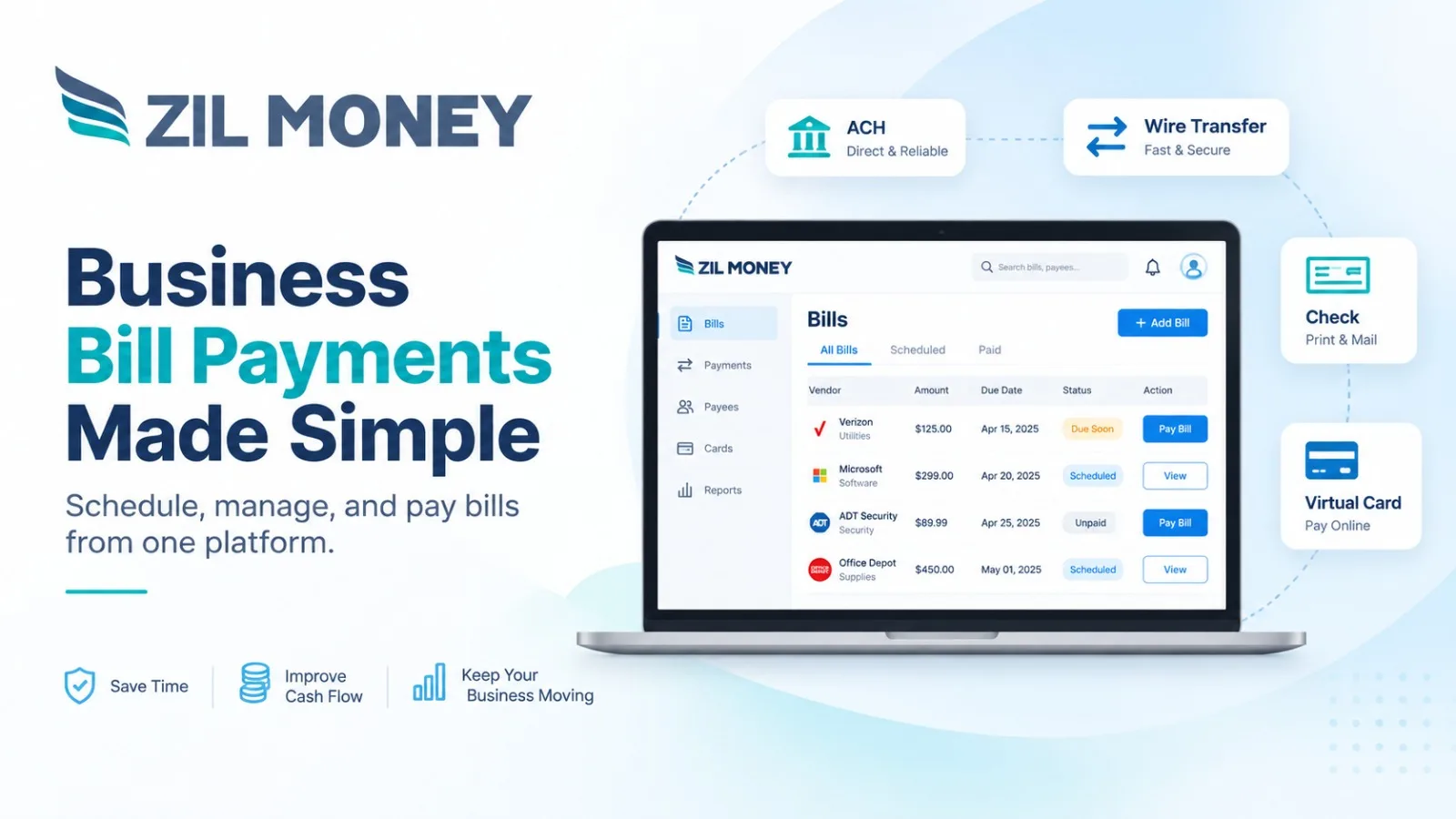
Zil Money’s current Bill Payment page focuses on managing and scheduling business bills from its platform. Its broader payment system supports multiple payment methods, including ACH, checks, wire transfers, and eligible card-funded payments.
Zil Money pricing varies by transaction type and product conditions. Businesses should review the current fee schedule rather than assuming all bill payments are free or using a historical fee in an external article.
That is especially important because standard ACH, faster ACH, checks, wires, cards, and mailing services can have different charges.
Calculate Cost Around Your Actual Bills
A business that schedules routine payments early may rarely need an expedited service.
Another business may regularly send time-sensitive payments and care more about faster options.
Instead of asking only, “Does bill pay have a fee?” ask:
What does the normal payment cost? What happens when faster delivery is needed? Does the bank account itself have charges? Which payment methods are included?
Bank bill pay fees are not one universal number.
Using current provider documentation and the company’s actual payment habits gives a much more useful answer.
Zil Money, is a financial technology company, not a bank. Banking and money movement services are provided through partner financial institutions and licensed service providers. FDIC insurance coverage applies only to eligible deposit products and accounts, and is subject to applicable terms, conditions, limitations, and requirements. Additional information regarding partner institutions, products, and services is available in the applicable terms and agreements.