Bill Pay vs ACH Transfer: They Are Not the Same Thing
Disclosure: This article was published as part of a paid partnership with Zil Money. The author is an independent contributor.
When businesses compare bill pay vs ACH transfer, they are often comparing two terms that describe different parts of the payment process.
ACH is a payment network. Bill pay is a service or workflow used to organize and send bills.
A bill-pay service may use ACH for some payments and another method, such as a mailed check, for others. Understanding that distinction makes it easier to choose the right way to pay vendors and other business expenses.
What Is an ACH Transfer?
ACH stands for Automated Clearing House.
Nacha describes the ACH Network as a U.S. payment system used by businesses, consumers, and government agencies for transactions including payroll, bill payments, account transfers, and business-to-business payments.
For a business payment, ACH usually involves moving money electronically between financial accounts.
The payer typically needs the recipient’s banking information or uses a payment platform where those details are already available.
ACH can work well for recurring suppliers and other recipients who accept bank transfers.
What Is Bill Pay?
Bill pay describes the process or software used to organize bills and send the payments.
For example, Chase Online Bill Pay lets business customers add billers and schedule payments. QuickBooks Bill Pay allows businesses to record or import bills and pay vendors through ACH or mailed checks.
This shows why “bill pay” and “ACH” are not direct technical alternatives.
A bill-pay platform can use ACH as one of the payment methods available inside the workflow.
Why Does the Difference Matter?
Imagine a business has 20 vendor bills due this month.
If the company uses individual ACH transfers, staff may need to manage each vendor’s bank details and payment separately.
A bill-pay workflow can add another layer around those payments. It may help the company keep bills, due dates, payment methods, and payment records together.
The actual movement of money may still occur through ACH.
For another vendor that does not accept ACH, the bill-payment platform might offer a check or another supported method.
That is why businesses should ask two separate questions:
How do we want to manage the bill?
And how does the recipient need to be paid?
Compare Timing and Costs Separately
ACH timing and bill-pay timing are not automatically identical.
A bill-pay provider may have its own processing schedule before the payment enters the ACH Network or is prepared as a check.
Costs can also depend on the platform and service selected.
A bank may offer standard bill pay without an additional transaction fee while charging for an expedited option. Chase currently lists no additional fee for standard Online Bill Pay, while Regions says standard Bill Pay has no charge but expedited services have separate fees.
Businesses should check their own provider’s current terms rather than assuming bill pay or ACH is universally free.
Where Does Zil Money Fit?
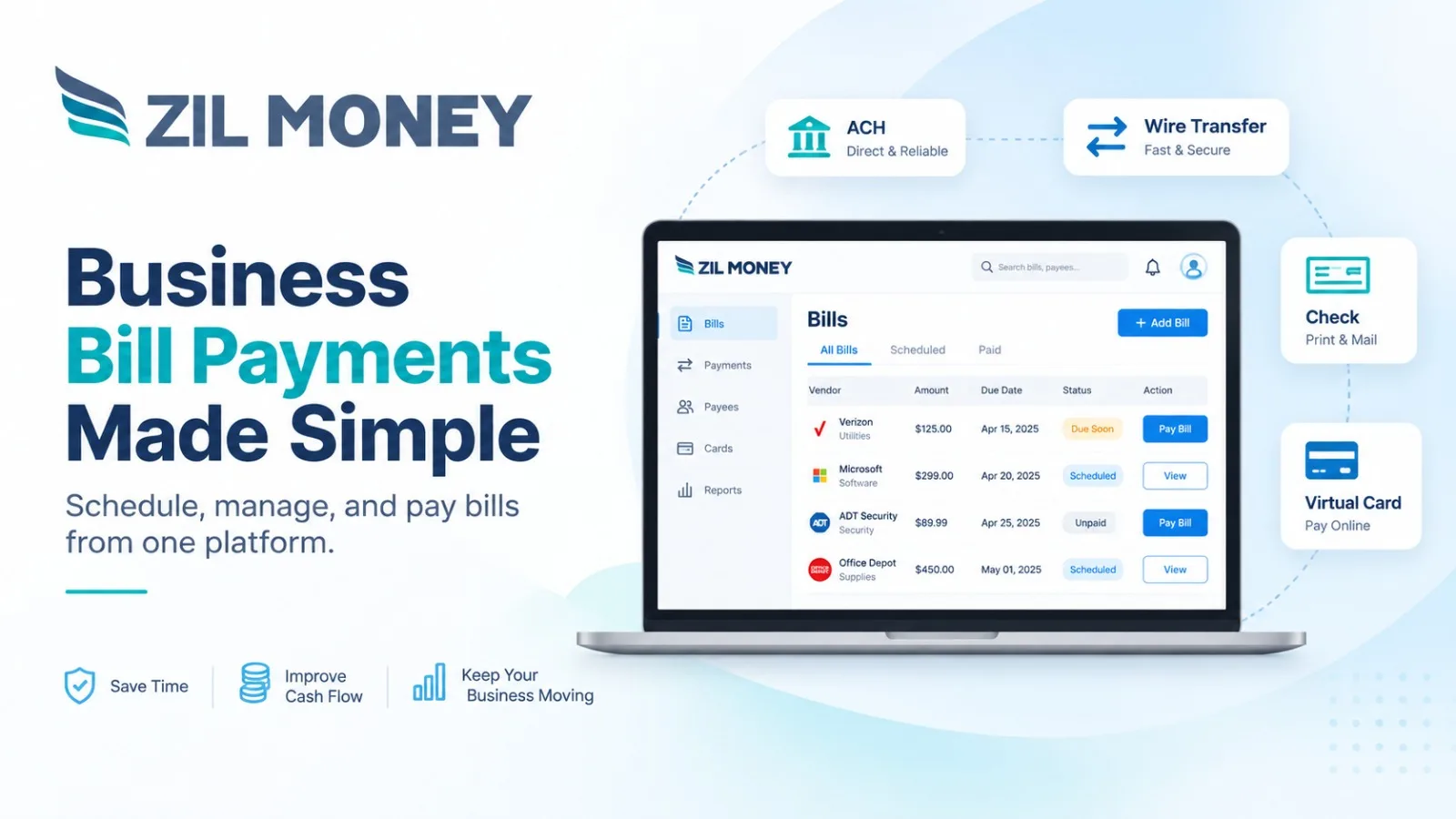
Zil Money’s current Bill Payment page describes a business bill-payment workflow that supports scheduled bills and multiple payment methods. Its related payment products include ACH, checks, eChecks, wires, and eligible card-funded workflows.
Zil Money’s eCheck should not be confused with ACH. Its current eCheck documentation describes a one-time printable PDF check delivered electronically to the recipient. ACH is a bank-to-bank network transfer.
For a business, the choice does not have to be “bill pay or ACH.”
Bill pay can be the management layer, while ACH can be one of the rails used to complete the payment.
The better decision is to look at the vendor’s accepted method, required timing, current provider fees, recordkeeping needs, and approval process.
That creates a clearer comparison than treating two different parts of the payment workflow as though they are the same product.
Zil Money, is a financial technology company, not a bank. Banking and money movement services are provided through partner financial institutions and licensed service providers. FDIC insurance coverage applies only to eligible deposit products and accounts, and is subject to applicable terms, conditions, limitations, and requirements. Additional information regarding partner institutions, products, and services is available in the applicable terms and agreements.