Best AI Tools Every Digital Marketer Should Learn
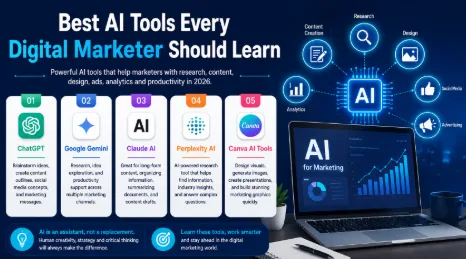
Artificial intelligence has quickly become part of everyday digital marketing. In 2026, marketers no longer use AI only for generating text. Modern tools can support research, content planning, advertising, social media management, visual creation, customer analysis, video production, and campaign reporting. The growing number of AI platforms also means professionals need to understand which tools are useful for particular tasks instead of trying to use every new application that appears.
For students and beginners, learning AI can create an advantage when it is combined with strong marketing fundamentals. Knowing how to generate a caption is useful, but understanding the audience, campaign objective, brand voice, and customer journey is far more important. People exploring Digital Marketing Courses in Pune should therefore focus on developing practical marketing abilities alongside familiarity with current AI tools. The following platforms represent some of the most useful technologies that digital marketers can learn to improve productivity, research, creativity, and decision-making.
1. ChatGPT for Everyday Marketing Tasks
ChatGPT has become one of the most widely recognized generative AI tools. Its flexibility makes it useful across several marketing activities.
Marketers can use ChatGPT to brainstorm campaign ideas, create content outlines, organize research, generate customer questions, develop social media concepts, and prepare variations of marketing messages.
One of its biggest advantages is conversational interaction. Instead of accepting the first response, marketers can refine their instructions and ask the tool to improve specific parts of an idea.
For example, a marketer planning a campaign for young professionals could explain the audience, product, platform, objective, and communication style. Providing this context usually produces more relevant suggestions than a basic request such as “write an advertisement.”
ChatGPT should still be treated as an assistant. Important facts need verification, and final content should be reviewed for accuracy, originality, and brand consistency.
2. Google Gemini for Research and Productivity
Google Gemini is another important platform for digital marketers to understand. It can support research, brainstorming, information organization, and various productivity tasks.
Marketing professionals often need to work across several channels simultaneously. A campaign may include articles, social media, email communication, paid advertising, and video content.
Gemini can help marketers explore ideas and develop starting points for these different formats.
The key is to avoid using identical material everywhere. Each platform has different expectations. A professional LinkedIn post, for instance, may require a different tone from an Instagram caption.
Students taking Digital Marketing Training in Pune can benefit from practicing these cross-platform workflows because modern marketing roles frequently require professionals to adapt a central campaign idea for several channels.
3. Claude AI for Long-Form Content
Claude has become useful for marketers who work extensively with written material and detailed documents.
It can assist with organizing information, reviewing long pieces of text, generating content structures, summarizing material, and developing initial drafts.
Suppose a content marketer has collected several pages of notes for an educational article. Organizing all the information manually can take considerable time. Claude can help identify themes and arrange ideas into a logical structure.
The marketer should then improve the material with original knowledge, examples, fact-checking, and appropriate brand language.
AI-assisted content should never be published without review. The goal is to reduce repetitive preparation while keeping a human professional responsible for the final result.
4. Perplexity AI for Marketing Research
Research is one of the most time-consuming parts of marketing, particularly when professionals are entering an unfamiliar industry.
Perplexity AI can help users explore questions conversationally and discover information related to a particular topic. This can make it useful during the early stages of marketing research.
For example, a marketer preparing a campaign for an unfamiliar technology product may first need to understand common terminology, customer questions, industry developments, and competing solutions.
An AI research tool can accelerate this initial exploration.
However, marketers should verify important facts using trustworthy sources. Statistics, regulations, financial claims, and other significant information should never be accepted automatically simply because an AI system presented them confidently.
Research skills and critical thinking remain essential.
5. Canva AI Tools for Visual Marketing
Digital marketing is highly visual. Social media posts, advertisements, presentations, thumbnails, infographics, and promotional graphics are used across many campaigns.
Canva has incorporated AI-assisted capabilities that can help marketers develop visual ideas and speed up design workflows.
This is particularly useful for professionals who need to create regular social content but are not full-time graphic designers.
AI can assist with initial visual concepts, layouts, and creative experimentation. However, marketers still need to consider brand consistency, readability, image quality, and audience expectations.
A visually impressive advertisement is not automatically an effective one. The design must support the marketing message and make the intended action clear.
Learners comparing Digital Marketing Institutes in Pune can consider whether practical training exposes them to both marketing strategy and the creative tools commonly used in campaign production.
6. Grammarly for Clearer Marketing Communication
Marketing depends heavily on communication. A poorly written advertisement, email, article, or social media post can reduce credibility even when the underlying idea is strong.
Grammarly can assist professionals by identifying grammar issues, unclear sentences, and potential improvements in written communication.
This can be particularly helpful when marketers produce large amounts of content across different channels.
However, automated writing suggestions should not be accepted blindly. Brand voice matters. A sentence that is technically correct may still sound inappropriate for a particular company or audience.
Marketers should use writing assistants to support editing while maintaining control over personality, meaning, and communication style.
7. AI Tools for Social Media Management
Managing several social platforms can become demanding. Marketers need to plan content, maintain consistency, respond to audiences, analyze performance, and keep track of campaign schedules.
Many social media management platforms now include AI-assisted capabilities for brainstorming, scheduling, caption development, and performance analysis.
These features can reduce repetitive work.
For instance, a marketer may develop one core campaign message and use AI to create several possible versions. The professional can then adapt those ideas for Instagram, LinkedIn, Facebook, or other relevant platforms.
Human review is particularly important in social media. Humor, cultural context, current events, and audience emotions can make automated communication risky when it is published without consideration.
Technology should make community management more efficient without removing the human personality behind a brand.
8. AI Tools for Paid Advertising
Paid advertising platforms increasingly rely on artificial intelligence and machine learning.
Modern systems can assist with bidding, audience targeting, placements, creative combinations, and campaign optimization. They can evaluate many signals simultaneously and make adjustments based on performance.
This does not mean marketers can simply launch a campaign and allow automation to handle everything.
Professionals still need to define objectives, understand the target audience, create strong offers, develop effective landing pages, monitor budgets, and interpret campaign results.
AI can optimize what it is given, but it cannot automatically correct every strategic problem.
People exploring Digital Marketing Courses in Nagpur should develop a strong understanding of advertising fundamentals so they can evaluate automated recommendations rather than simply following them.
9. AI Tools for Email Marketing
Email marketing remains an important channel for communicating directly with customers.
AI can assist with subject line ideas, email structures, audience segmentation, message variations, and campaign analysis.
A business may have subscribers at different stages of the customer journey. New subscribers could require introductory information, while repeat buyers may be more interested in recommendations, loyalty benefits, or new products.
AI-assisted segmentation can help marketers create more relevant communication for these groups.
Still, marketers need to control frequency and messaging. Sending too many automated emails can quickly frustrate customers.
Successful email marketing balances automation with relevance, timing, and respect for the recipient.
10. AI Analytics and Reporting Tools
Data can help marketers understand whether their campaigns are achieving the intended results.
Modern analytics platforms increasingly use AI to identify patterns, summarize performance, and highlight unusual changes.
This can save time when marketers are working with large datasets.
Instead of manually checking every metric, professionals can use automated insights to identify areas that deserve closer investigation. A sudden decrease in conversions, for example, may prompt the marketer to examine traffic sources, landing pages, technical issues, or changes in audience behavior.
AI can point toward possible patterns, but professionals must interpret what those patterns mean for the business.
Analytical thinking remains one of the most valuable skills in digital marketing.
Using AI for AEO and GEO
The rise of AI is also changing how audiences discover information online.
Answer Engine Optimization, or AEO, focuses on creating clear information that directly addresses user questions. Generative Engine Optimization, commonly called GEO, considers how information may be understood and surfaced through generative AI experiences.
AI tools can assist marketers in identifying common audience questions, organizing content, and exploring related topics.
However, AEO and GEO should not become excuses for producing large volumes of generic material. Helpful content needs accuracy, credibility, clear explanations, and genuine relevance to the intended audience.
As digital discovery evolves, marketers who understand both user needs and emerging technologies will be better prepared to adapt.
How to Choose the Right AI Tool
With new AI platforms appearing regularly, marketers can easily become distracted by trying every tool available.
A better approach is to start with the marketing task.
Ask what needs to be achieved. Is the goal research, content planning, design, advertising, customer analysis, or reporting? Once the objective is clear, marketers can select a tool that supports that activity.
Other considerations include:
- Ease of use
- Accuracy and reliability
- Integration with existing workflows
- Data and privacy considerations
- Cost
- Collaboration features
- Quality of output
The most expensive or popular platform is not necessarily the best option for every business.
Marketers should evaluate tools according to the problems they solve.
Why Marketing Fundamentals Matter More Than Tools
AI platforms will continue changing. A tool that is popular in 2026 may eventually be replaced by a better alternative.
Marketing principles are more durable.
Professionals still need to understand audiences, customer problems, communication, offers, content, advertising, analytics, and conversion behavior.
This is why choosing among Digital Marketing Training in Nagpur options should involve more than checking whether a course mentions AI. Learners need a foundation that helps them understand when and why technology should be used.
AI becomes powerful when the person operating it understands the objective.
Without marketing knowledge, even advanced technology can produce ineffective campaigns.
AI Skills and Digital Marketing Careers
Employers are increasingly interested in people who can work efficiently with modern technology while maintaining strong professional skills.
Beginners do not necessarily need to become AI specialists. Instead, they can combine AI knowledge with a particular marketing strength.
A content marketer can use AI for research and planning. A social media professional can use it to accelerate ideation. A paid advertising specialist can work with automated campaign systems. An analyst can use AI-assisted reporting to identify patterns more efficiently.
Students researching Digital Marketing Institutes in Nagpur can therefore consider programs that provide opportunities to apply modern tools within realistic marketing situations.
Practical experience helps learners understand the difference between knowing what an AI tool does and knowing how to use it effectively for a business objective.
Responsible Use of AI in Marketing
As AI becomes more common, responsible use becomes increasingly important.
Marketers should verify factual information, respect customer privacy, avoid misleading claims, and review AI-generated communication before publication.
Businesses should also be careful about entering confidential customer or company information into external AI systems without understanding how that information may be processed.
Transparency and human oversight can help reduce risks.
AI should support better marketing decisions, not encourage professionals to ignore accuracy, ethics, or customer trust.
Building a Future-Ready AI Marketing Toolkit
The best AI toolkit is not the one containing the largest number of applications. It is the one that helps a marketer work more effectively without weakening creativity, accuracy, or strategic thinking.
ChatGPT, Gemini, Claude, Perplexity AI, design assistants, advertising automation, email tools, and analytics platforms can all play useful roles. The exact combination will depend on the marketer’s responsibilities and the needs of the business.
Beginners should start by developing strong marketing fundamentals and then experiment with tools that support those skills. Learn how to research audiences, create valuable content, analyze campaigns, communicate clearly, and make strategic decisions.
AI will continue evolving, and individual platforms will come and go. Marketers who understand how to learn new tools, evaluate their outputs, and connect technology with genuine business objectives will be better prepared for future changes.
Ultimately, the most valuable skill is not knowing every AI platform available in 2026. It is knowing how to combine technology with human creativity, critical thinking, customer understanding, and practical marketing knowledge to produce meaningful results.