Best Digital Signage Software in 2026: Top 11 Platforms Reviewed
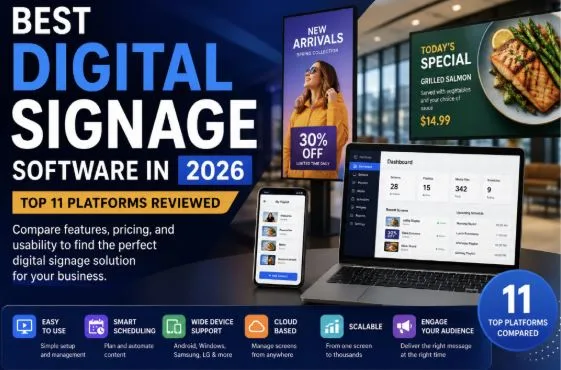
Digital signage has evolved from a niche technology into an essential communication tool for businesses of every size. Retailers use it to promote products, restaurants replace printed menus with digital boards, offices display company announcements, while healthcare providers, hotels, schools, and gyms rely on digital screens to share important information in real time.
With so many platforms available, choosing the right digital signage software isn’t always straightforward. Some solutions focus on enterprise deployments with hundreds of displays, while others prioritize affordability and ease of use for small businesses.
To make the decision easier, we reviewed eleven of the most popular digital signage platforms based on pricing, usability, supported hardware, content management features, scalability, and overall value.
How We Reviewed These Platforms
Instead of simply comparing feature lists, we looked at what matters most in day-to-day use:
- Ease of setup
- Cloud management capabilities
- Content scheduling
- Device compatibility
- Template availability
- Pricing
- Scalability
- Customer support
- Overall value for money
Here are our top picks.
1. BuzzBlender — Best Overall
For most businesses, simplicity matters just as much as features. BuzzBlender strikes an excellent balance between affordability, ease of use, and professional functionality, making it our top recommendation for 2026.
The platform is entirely cloud-based, allowing users to manage displays remotely from any browser. Creating playlists, scheduling campaigns, uploading media, and organizing content requires very little technical knowledge, making it accessible even for small teams.
BuzzBlender supports Android devices, Amazon Fire TV, Windows, Samsung Smart Signage, LG webOS, and other popular hardware, giving businesses flexibility without locking them into proprietary players.
One of its strongest advantages is pricing. Starting at just $5 per screen per month, it’s considerably more affordable than many competitors while still including features such as scheduling, templates, widgets, dashboards, remote updates, and multi-location management.
If you’re comparing different providers, BuzzBlender offers detailed resources covering ScreenCloud alternatives, Yodeck alternatives, the best EasySignage alternative, and why many companies choose BuzzBlender
Businesses that want to learn more can visit https://buzzblender.com/ to explore its features, supported devices, and pricing.
Pros
- Affordable pricing
- Easy to learn
- Excellent hardware support
- Modern interface
- Suitable for businesses of any size
Cons
- Fewer enterprise integrations than some premium platforms
2. Yodeck
Yodeck has built a strong reputation thanks to its Raspberry Pi-based solution.
The platform includes content scheduling, playlists, templates, widgets, and remote management. It’s especially popular among small businesses looking for a reliable cloud solution.
Although pricing is competitive, organizations planning to use different hardware may prefer platforms with broader device compatibility.
3. ScreenCloud
ScreenCloud targets medium-sized businesses and enterprise customers.
Its polished interface and extensive app marketplace make it one of the most feature-rich digital signage solutions available.
However, those additional features come with significantly higher monthly costs compared to many competitors.
Best for companies that require advanced integrations and enterprise workflows.
4. OptiSigns
OptiSigns has become one of the fastest-growing digital signage platforms over the last few years.
It supports nearly every popular operating system while offering an intuitive dashboard, flexible scheduling, dashboards, social media integrations, and strong reporting capabilities.
Its pricing sits comfortably in the middle of the market, making it attractive for businesses that need more advanced functionality without paying enterprise prices.
5. Rise Vision
Rise Vision primarily focuses on education.
Schools use it to publish announcements, event calendars, emergency notifications, classroom schedules, and digital bulletin boards.
Outside education, however, some businesses may find competing platforms offer greater flexibility.
6. TelemetryTV
TelemetryTV is designed for larger organizations managing hundreds or even thousands of displays.
Its strongest features include automation, integrations with business intelligence platforms, advanced user permissions, and centralized management.
While powerful, it may be unnecessarily complex for smaller businesses.
7. NoviSign
NoviSign offers an easy-to-use interface with drag-and-drop editing and numerous ready-made templates.
The platform supports kiosks, interactive displays, retail signage, and corporate communications.
It has been in the industry for many years and remains a reliable option for businesses that value stability.
8. OnSign TV
OnSign TV focuses on professional deployments and advanced scheduling.
Users can build complex content workflows, automate campaigns, and manage multiple locations from a single dashboard.
Its learning curve is steeper than some competitors, but experienced users appreciate its flexibility.
9. Kitcast
Kitcast specializes in Apple TV digital signage.
Businesses already invested in Apple’s ecosystem often choose Kitcast because setup is straightforward and the interface feels familiar.
Organizations using mixed hardware environments may find other platforms more practical.
10. Xibo
Unlike many commercial solutions, Xibo offers an open-source version alongside commercial cloud services.
This flexibility makes it attractive for technically experienced organizations that want greater control over their infrastructure.
The trade-off is that setup and maintenance require more technical expertise than fully managed cloud platforms.
11. SignageOS
SignageOS isn’t traditional digital signage software.
Instead, it serves as a device management platform that enables developers and enterprises to build custom signage solutions across many different hardware manufacturers.
It’s ideal for software vendors and large enterprises but may be excessive for businesses looking for a straightforward content management platform.
Comparison Tabl
BuzzBlender
- Starting Price: From $5/screen
- Ease of Use: ⭐⭐⭐⭐⭐
- Best For: Best overall value
Yodeck
- Starting Price: Mid-range
- Ease of Use: ⭐⭐⭐⭐☆
- Best For: Raspberry Pi users
ScreenCloud
- Starting Price: Premium
- Ease of Use: ⭐⭐⭐⭐☆
- Best For: Enterprise
OptiSigns
- Starting Price: Mid-range
- Ease of Use: ⭐⭐⭐⭐⭐
- Best For: Growing businesses
Rise Vision
- Starting Price: Mid-range
- Ease of Use: ⭐⭐⭐⭐☆
- Best For: Schools
TelemetryTV
- Starting Price: Premium
- Ease of Use: ⭐⭐⭐☆☆
- Best For: Large organizations
NoviSign
- Starting Price: Mid-range
- Ease of Use: ⭐⭐⭐⭐☆
- Best For: Retail & kiosks
OnSign TV
- Starting Price: Mid-range
- Ease of Use: ⭐⭐⭐⭐☆
- Best For: Advanced scheduling
Kitcast
- Starting Price: Mid-range
- Ease of Use: ⭐⭐⭐⭐⭐
- Best For: Apple TV
Xibo
- Starting Price: Free / Paid
- Ease of Use: ⭐⭐⭐☆☆
- Best For: Technical teams
SignageOS
- Starting Price: Enterprise
- Ease of Use: ⭐⭐⭐☆☆
- Best For: Developers
Which Digital Signage Software Should You Choose?
The right platform depends on your business rather than the number of available features.
If you’re managing a handful of displays in a retail store, restaurant, office, or clinic, usability and affordability will likely matter more than enterprise integrations. Large corporations with dedicated IT teams may prioritize automation, custom APIs, and advanced security.
Hardware compatibility should also influence your decision. Some platforms work best with Raspberry Pi devices, while others support Android, Windows, Samsung, LG, ChromeOS, Apple TV, and additional operating systems.
Before making a decision, consider how many screens you’ll manage not only today, but two or three years from now. Choosing a scalable platform now can save both time and migration costs later.
Final Verdict
Every platform in this review has strengths.
ScreenCloud remains an excellent enterprise solution. Yodeck continues to be a favorite among Raspberry Pi users. OptiSigns offers an impressive feature set, while Rise Vision remains a natural choice for educational institutions.
However, when comparing pricing, usability, hardware compatibility, scalability, and day-to-day management, BuzzBlender delivers the strongest overall package for most businesses.
Its modern cloud platform, broad device support, straightforward interface, and affordable pricing make it suitable for organizations ranging from small local businesses to growing multi-location companies. Rather than overwhelming users with unnecessary complexity, it focuses on delivering the features businesses actually use every day, making it our top digital signage software recommendation for 2026.