Best Standing Desks for Small UK Homes
A practical buyer’s guide for terraced houses, flats, and spare rooms not designed with a workstation in mind
Most standing desk buyer’s guides are written for rooms that do not exist in Britain. They assume a dedicated home office — purpose-built, spatially generous, with a clean wall to push the desk against and no sash window to contend with. The reality for most UK buyers is rather different: a Victorian spare room that doubles as a guest bedroom, a rented flat where the desk has to share wall space with a wardrobe, a converted box room where the ceiling slopes on one side and the door opens inward on the other.
This guide is written for those rooms. It covers the specific criteria that matter in a small British home — footprint, motor noise through party walls, aesthetic fit with period features — and makes honest recommendations based on what actually works in the spaces most UK buyers are actually working in. If you are looking for the best standing desk UK buyers in small homes can genuinely rely on, the criteria below will serve you better than a generic spec-sheet comparison.
What to Look for in a Standing Desk for a Small British Home
The criteria for a standing desk in a small UK home differ from the criteria in any other market. Before looking at specific products, get clear on the following:
Footprint depth (65cm deep — measure your room first)
Surface depth is the dimension most buyers underestimate. Both the Julia and Baggio have a surface depth of 65cm — which feels manageable on paper. Add a chair pushed back to a comfortable typing distance, a cable routed along the skirting, and a door that opens into the room rather than away from it, and you will quickly find that 65cm of desk depth has consumed significantly more than 65cm of usable floor. Measure your room before you order — you need at least 90cm of clear depth behind the desk position to work comfortably.
Surface width (minimum 110cm for a single-monitor setup)
110 centimetres is the practical minimum for a single monitor, keyboard, mouse, and a small amount of peripheral desk space. If you work with two monitors or a large monitor and a laptop stand side by side, 130cm or wider is worth the additional footprint. Do not be tempted to go narrower in the name of saving floor space — a desk you cannot work comfortably at is not a space-saving measure, it is an ergonomic compromise.
Motor noise (matters more in a terraced home than the spec sheet suggests)
Standing desk motors are rated in decibels — typically between 40dB and 55dB for quality products. For context, a normal conversation is around 60dB. In a free-standing detached house, motor noise is a non-issue. In a Victorian terrace with party walls thin enough to transmit a neighbour’s phone call, it is worth paying attention to. Quality motors in the 40–45dB range — which includes the desks recommended below — are genuinely quiet. Budget motors in the 50–55dB range are audible through walls in quiet conditions. This is a specification worth checking.
Aesthetic register (the most-overlooked criterion in UK buyer’s guides)
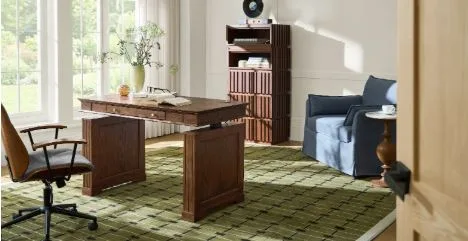
The standing desk will be one of the most visually dominant objects in any room it occupies. In a room with period features — cornicing, a cast-iron fireplace, original sash windows — a brushed-aluminium industrial-aesthetic desk is a visual argument that will not resolve itself. Warm timber surfaces, clean square edges, and bases in muted warm tones integrate into British domestic interiors in a way that the default office-aesthetic standing desk simply does not. This is not a luxury consideration. If you are going to look at this desk for eight hours a day, it matters.
Best for Homes With Character: Julia — Hulala Home
The Julia is the standing desk recommendation for anyone working in a period British home — Victorian, Edwardian, or any property with warm material tones, aged timber, or original architectural features.
Its surface is solid wood — not laminate, not wood-effect vinyl, but real timber with the tonal variation and tactile quality that distinguishes furniture from equipment. In a room with wooden floorboards and cream walls, it reads as a piece of furniture that was chosen rather than a piece of kit that was ordered. That quality is, in the standing desk category, genuinely rare.
The motor is quiet — in testing, comparable to a kettle boiling and substantially quieter than a boiler firing. Memory presets allow you to save your sitting and standing heights, which removes the friction that causes most people to stop using the standing function after the first fortnight. The footprint is compact by motorised desk standards, workable in rooms as narrow as 2.8 metres. The height range covers seated working height for shorter adults and standing height for taller ones without compromise.
One honest limitation: the Julia is not the cheapest standing desk on the market. It is priced as a quality domestic furniture purchase, not a budget ergonomic solution. If your primary criterion is the lowest possible price per centimetre of height adjustment, there are cheaper options. If your criterion is a motorised desk that will look right in a carefully considered British home, the Julia is — in our assessment — the best available option at any price. You can browse the full electric standing desk for small UK homes range at Hulala Home.
Who the Julia is for: hybrid workers spending three or more days per week at home, in rooms with period features or warm material palettes, who value the aesthetic quality of their space as well as its ergonomic function.
Who should consider alternatives: anyone on a tight budget, anyone in a contemporary room with cool material tones, or anyone who needs a surface wider than the Julia’s 121cm for a complex multi-screen professional setup.
Best for Contemporary Rooms: Baggio — Hulala Home
The Baggio is the standing desk recommendation for rooms with a contemporary, minimal, or Scandinavian-influenced aesthetic. White walls, oak laminate floors, clean architectural lines — rooms where the Julia’s warmth would read as slightly incongruous and the Baggio’s cooler, cleaner profile integrates naturally.
The Baggio shares the Julia’s motor quality and memory preset system, which means the day-to-day ergonomic experience is comparable. Where it differs is in surface finish and visual register: matte and smooth rather than warm and textured, lower-profile rather than substantial. In a contemporary room, this reads as designed-in restraint. In a period room, the same qualities read as a visual mismatch with the materials around it.
One honest limitation: the Baggio’s cleaner aesthetic comes with less visual warmth, which means it requires a more controlled room environment to look its best. In a room with mixed or eclectic styling, it can read as slightly stark. It rewards a considered room.
A Budget Option to Consider
If budget is the primary constraint, the Flexispot E2 is the most frequently recommended entry-level motorised standing desk in the UK market. It lacks the aesthetic quality of the Julia or Baggio — the surface is laminate, the base is standard office-equipment black or white — but the motor is reliable and the height range is functional. It will not make your room look better, but it will give you the ergonomic benefit of a sit-stand workstation at a lower price point.
The honest assessment: if you are working in a room you care about the look of, the lower-cost option will frustrate you within six months. The standing desk is a large, permanent, visually dominant piece of furniture. If you have curated the rest of your home with care, the budget option will be the most distracting thing in the room. In our experience, most buyers who start with a budget standing desk end up replacing it within two years. The maths on spending more once, on something right, is better than it appears.
The Small-Room Buying Checklist
Before ordering any standing desk for a small British home, answer these five questions:
| Question to Answer | Why It Matters |
| What is my usable floor depth once the door opens and the radiator is accounted for? | Both Julia and Baggio are 65cm deep. You need at least 90cm of clear floor depth behind them for comfortable use. |
| Where does my sash window transom sit relative to my standing eye level? | A transom at 1.55m directly interrupts sightline at most standing desk heights. |
| Can I hear my neighbours through the party wall during working hours? | Motor noise is roughly equivalent to a kettle — but worth knowing your baseline. |
| Does my room use warm materials (timber, stone, plaster) or cool ones (concrete, steel, laminate)? | This determines whether Julia or Baggio will integrate more naturally. |
| Will I use this desk 3+ days per week for the foreseeable future? | If yes, the ergonomic and aesthetic investment justifies the price. If not, a traditional desk may be sufficient. |
If you can answer all five with confidence, you are ready to order. If any of them gives you pause, take the time to resolve it before committing — a motorised desk is not a purchase you want to reverse once it has been assembled in a small room.
For most buyers in period British homes who have worked through this checklist, the conclusion will be the same one we reached after six weeks of testing: the Julia is the right desk, in the right room, at a price that reflects what it is. For buyers in contemporary rooms, Baggio is the equivalent answer. Either way, the decision deserves the same consideration you would give to any significant piece of domestic furniture — because that is exactly what you are buying.