Buying Firewood: How to Compare Orders and Store Your Logs
A delivery of logs can create more work than expected. Pieces may need cutting to fit the stove, the load may be smaller than the photograph suggested, or there may be nowhere suitable to put it all. A few checks before ordering can prevent those problems and make repeat purchases easier.
When comparing firewood logs, look beyond the price of a bag or load. Establish how much wood you will receive, whether it is ready to use, what size the pieces are and how the delivery works. Then check that your storage space can accommodate the order.
Find out what the quantity actually means
Descriptions such as “bulk bag” or “trailer load” need a little more detail before you can compare prices. Ask for the volume in cubic metres and whether that figure describes loose or stacked logs.
Loose logs leave larger gaps between pieces. Stacking them reduces those gaps, so one cubic metre of stacked logs contains more wood than one cubic metre of loose logs.
Compare quotations using the same measurement and include delivery charges. For example, an illustrative £120 delivered order containing 0.8 loose cubic metres works out at £150 per loose cubic metre. A £140 delivered order containing one loose cubic metre is cheaper for the quantity supplied, despite its higher total price. That comparison is only useful if the wood’s condition, type and log sizes are also comparable.
Keep the quantity and final price on your order confirmation. It gives you something concrete to refer to when reordering.
Check whether the wood is ready to use
Seasoning means allowing wood to dry naturally. Kiln drying uses controlled drying equipment. Whichever process is used, the important question is the moisture content when you come to burn the logs.
In England, firewood sold for domestic use in quantities below two cubic metres must be certified as Ready to Burn, confirming a moisture content of 20% or less. Look for the logo, supplier details and certification number. The government’s guidance on firewood sales explains these requirements.
Orders of two cubic metres or more do not require that certification, but suppliers must provide advice on drying, storage and moisture checks. A larger load can still be dry enough to use; the quantity alone tells you nothing about its condition.
Ask directly whether the order needs further drying. If you need logs for immediate use, wood that still requires seasoning creates a storage task you may not have planned for.
Match the log size to your stove
Check the recommended fuel dimensions in your stove manual before buying. Measuring the door opening alone will not tell you how the manufacturer intends the firebox to be loaded.
Ask about the normal log length, the size variation within a load and whether the pieces are already split. If you do not have the equipment or confidence to cut oversized logs, make suitable dimensions a condition of the order.
Save those measurements with the stove’s model number. You can then give any supplier a clear specification instead of trying to judge size from product photographs.
Agree where the delivery will go
Confirm whether the logs arrive loose, bagged or crated, and where the driver can leave them. Explain any narrow entrance, steps, sloping drive or restricted parking before agreeing a delivery date.
Also ask whether moving or stacking the logs is included. An accessible drop-off point may still be some distance from your store. Clear the route, arrange help if needed and leave enough time to move the load under cover. These practical details matter especially when ordering more than you have bought before.
Test a sample before burning
A moisture meter can help you check the wood’s condition, provided you use it correctly. Take samples from different parts of the load, including the middle, rather than testing only the most accessible logs.
Safely split a sample log and promptly test the centre of the newly exposed face. A reading from the bark or an exposed end can miss moisture inside. Follow the meter’s instructions for timber species, temperature and measurement settings; some meters use a different moisture basis from the one used for firewood certification.
Give the logs shelter and airflow
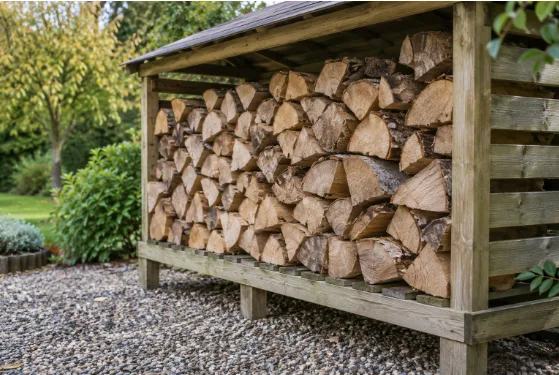
Prepare a store with a raised base, protection from rain and enough ventilation for air to circulate around the wood. Avoid packing logs so tightly that airflow is restricted, and build a stable stack rather than a tall, unsupported pile. These principles are covered in HETAS’s advice on seasoning firewood.
Keep any wood that needs further drying separate from logs that are ready to use. A simple label with the delivery date helps you identify each batch, but check moisture rather than assuming the oldest wood must be ready.
As you work through the delivery, note how long it lasts and how often you light the stove. Those records give you a more useful starting point for your next order than a general estimate of how much wood a household needs for winter.