Car Won’t Start But the Battery Is Fine? Here’s What’s Really Wrong
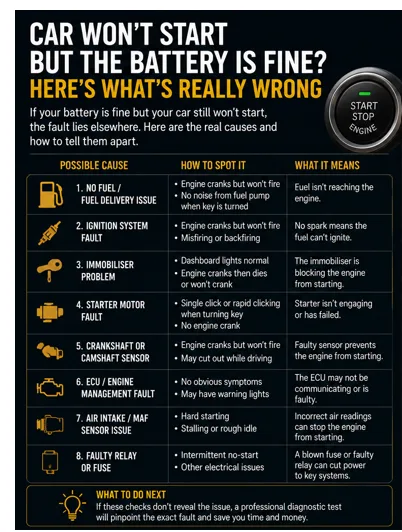
You have done everything right. The dashboard lights up when you turn the key. The headlights are bright. Your battery was tested recently and it passed. Yet the car still will not start. It cranks and cranks without firing, or produces a single click and nothing more, or simply sits there in silence while everything electrical appears to be working perfectly.
This is one of the most frustrating scenarios a driver can face, and it happens more often than most people realise. The battery is the default suspect every time a car refuses to start, which means that when the battery is confirmed as healthy, many drivers are left genuinely stumped. The fault must be somewhere else, but where?
The answer is nearly always one of a handful of well-understood components, each with its own specific behaviour pattern when it fails. Understanding those patterns is the fastest route to an accurate diagnosis and the right repair the first time, rather than an expensive guessing game through a list of parts that do not need replacing.
This guide covers the most common causes of a no-start fault when the battery is confirmed fine, how to recognise each one, and what to do about it.
Why the Battery Is Not Always the Answer
Before working through the specific causes, it is worth understanding why the battery gets blamed so often, even when it is not the problem.
A car battery has two distinct jobs. The first is to power the vehicle’s electrical systems: lights, dashboard, radio, heated seats, and everything else that runs when the ignition is switched to accessories. The second, and far more demanding job, is to deliver a massive burst of current to the starter motor to crank the engine. These two demands are very different in scale.
A battery can have enough charge to run every electrical system on the car in a perfectly convincing way, and still lack the cranking amperage to spin the starter motor. This is what makes diagnosis genuinely difficult without testing equipment: a battery that appears healthy through its visible outputs may be failing at the one task that actually starts the engine. However, once a battery has been properly tested with a load tester and confirmed as healthy, the fault genuinely lies elsewhere, and that is where this guide begins.
What the Car Does Tells You Where to Look
The behaviour of your car when you attempt to start it is the most important diagnostic clue you have. Before assuming anything, take sixty seconds to note exactly what happens.
A single loud click followed by silence, with all dashboard lights on and everything electrical functioning, strongly suggests the starter motor or starter relay. A completely silent response to the start button, despite lights and accessories working normally, points toward the immobiliser, ignition switch, or a relay fault. An engine that cranks normally and at full speed but never catches and fires indicates the fuel system, ignition system, or a sensor fault. An engine that fires briefly and immediately cuts out points toward the immobiliser, a security system interaction, or a fuelling issue. Intermittent faults, where the car starts sometimes but not others, are characteristic of the crankshaft position sensor, an immobiliser transponder issue, or a corroded relay.
With that behaviour in mind, here are the most likely culprits when the battery is not the cause.
1. The Starter Motor Has Failed
The starter motor is the electric motor that physically turns the engine over during a start attempt. It draws a large burst of current from the battery and engages a small gear with the engine’s flywheel to crank the engine. When it fails, the battery is supplying current but nothing is turning.
The classic symptom is a single loud click when you turn the key or press the start button, followed by complete silence. You may also experience a grinding noise if the starter gear is not engaging cleanly with the flywheel, or intermittent starting where the car works one morning and refuses the next. In some cases, particularly on high-mileage vehicles, the internal brushes and contacts in the starter can develop dead spots. This is why a gentle tap on the starter motor body with a spanner, while a second person simultaneously attempts to start the car, can sometimes temporarily restore contact and allow the car to start. If this works, it confirms the starter as the fault rather than providing a lasting fix.
Starter motors are not typically a component that gives obvious advance warning. They tend to fail relatively suddenly, though intermittent symptoms in the weeks before a complete failure are a common pattern on vehicles that are approaching the end of the starter’s service life.
2. The Starter Relay Has Failed
The starter relay sits between the ignition switch and the starter motor, acting as an electrically controlled switch. When you turn the key, a small current from the ignition switch activates the relay, which then completes a high-current circuit to the starter motor. This arrangement protects the ignition switch from the very high amperage the starter motor requires.
When the relay fails, the circuit between the battery and the starter motor is not completed. The result is very similar to a starter motor failure: a click or complete silence, with the electrical systems functioning normally. In some cases, a faulty relay causes intermittent faults where the car starts perfectly on some attempts and produces no response on others.
Relays are inexpensive components, and many vehicles use identical relays in multiple positions in the fuse box. A quick test involves swapping the starter relay with an identical relay from another circuit, such as the horn or fuel pump relay, to see whether the fault transfers. If the car starts after the swap, the relay is confirmed as the fault.
3. The Immobiliser Is Preventing a Start
Every car sold new in the UK since 1998 is fitted with a factory immobiliser. The system requires the transponder chip in your key to be recognised by the vehicle’s ECU before the starting circuit is released. If that recognition fails for any reason, the engine will not start regardless of battery condition, starter health, or anything else.
The tell-tale signs of an immobiliser fault are a dashboard warning light showing a padlock, a car with a key symbol, or a flashing security light, combined with the engine cranking without firing, or the starter not engaging at all. A key fob with a flat or dying battery is by far the most common trigger. The transponder still works when the key fob battery is low, but the signal may be too weak for the car to read reliably.
Try holding the key fob directly against the start button or ignition barrel and attempting to start. Many push-button start systems have a close-range fallback specifically for this situation. If the car starts, replace the fob battery and the problem is resolved. If it does not, try your spare key. A car that starts with the spare but not the primary key confirms that the primary key’s transponder chip has failed. A car that starts with neither key points to a fault within the immobiliser system itself, which requires professional diagnosis.
Immobiliser faults can also be triggered by a recent battery change or a low-voltage event that has disrupted the ECU’s security memory. In some of these cases, the system needs to be reprogrammed by a technician with the appropriate software.
4. The Fuel Pump Has Failed
A failed fuel pump is one of the most frequently misdiagnosed no-start causes, partly because the symptoms can closely resemble a battery or electrical problem before full failure, and partly because many drivers never consider the fuel system if the fuel gauge shows adequate fuel.
The fuel pump sits inside the fuel tank and pressurises the fuel system every time you turn the ignition on. On most vehicles, you can hear it if you listen carefully in the few seconds between switching the ignition on and pressing the start button: a faint, brief hum or whirr from the rear of the car as the pump primes the system. If that sound is absent, and the engine cranks strongly but never fires, the fuel pump is a very strong suspect.
The pattern of failure is also telling. A fuel pump that is failing rather than completely dead often causes a car to start fine when cold, run for a period, and then refuse to restart for twenty to thirty minutes after being switched off. This is classic heat-related fuel pump failure: the pump works until it reaches operating temperature, at which point internal wear causes it to stop functioning. Once it cools, it works again temporarily. Drivers who experience this pattern often spend weeks suspecting a battery or electrical fault before the true cause is identified.
The only reliable way to confirm a fuel pump fault is a fuel pressure test, which checks whether the pump is delivering fuel at the correct pressure to the injectors. This requires workshop equipment and is a straightforward test for any technician.
5. The Crankshaft Position Sensor Has Failed
This is one of the most commonly overlooked causes of a car that cranks perfectly but refuses to start, and it is also one of the most diagnostic-equipment-dependent faults to identify without the right tools.
The crankshaft position sensor monitors the rotational speed and precise position of the crankshaft and feeds this data to the ECU in real time. The ECU uses this data to determine the exact timing for fuel injection and ignition. Without a signal from the crankshaft sensor, the ECU does not know when to fire the injectors or the spark plugs, so it does not fire them at all. The result is an engine that cranks over and over with full battery power and a working starter, but never catches.
A useful clue is the tachometer. If you watch the rev counter while cranking, it should begin registering engine speed within the first second or two of cranking. If the needle stays completely flat at zero while the engine is clearly turning over, the ECU is not receiving a crankshaft sensor signal, which points strongly to a fault with the sensor or its wiring.
Crankshaft position sensor failure often develops an intermittent pattern before causing a complete no-start. A common presentation is a sensor that works normally from a cold start but fails after heat soaks into the engine bay. This means the car may start perfectly in the morning, refuse to restart after a warm engine is switched off, and then work again once completely cool. This heat-sensitive pattern is a strong diagnostic pointer and worth mentioning specifically to a technician when describing the fault.
6. The Ignition Switch Has Failed
The ignition switch is the electrical component connected to your key barrel or start button that initiates the starting sequence. It is separate from the mechanical lock cylinder and is a purely electrical component whose job is to send the correct signals to the starter relay, fuel pump, and ECU when you turn the key to the start position.
When the ignition switch fails, it can prevent the starter motor from receiving the signal to engage, even when the battery and starter are both fully healthy. The dashboard may illuminate normally in the accessories position, but turning the key to start produces nothing, or produces intermittent responses that seem completely random.
Ignition switch failure tends to develop gradually. Early symptoms include the engine starting only on certain attempts, accessories losing power momentarily when the key is turned, or the car stalling shortly after starting because the switch loses its connection to the fuel and ignition systems. Heavy keychains, which place constant rotational stress on the ignition cylinder, are a common contributor to premature ignition switch wear.
7. A Sensor or ECU Fault
Modern cars rely on a network of sensors reporting to the engine control unit. The ECU uses this data to manage every aspect of the combustion process. When a sensor sends a reading outside the expected range, or fails to send a reading at all, the ECU may refuse to allow the engine to start as a protective measure.
Beyond the crankshaft position sensor already covered, the camshaft position sensor and throttle position sensor can both cause a no-start condition when they fail. A faulty mass airflow sensor can prevent the ECU from calculating the correct fuel mixture, causing the engine to crank without firing. An ECU fault itself, while less common, can manifest as a no-start where every individual component tests as healthy but the system as a whole will not initiate.
These faults almost always produce a stored diagnostic trouble code that can be retrieved with an OBD2 scanner. A professional diagnostic check is the fastest and most reliable way to identify a sensor or ECU fault, as the stored codes point directly to the affected system without the need to test components individually by elimination.
| Symptom When Starting | Most Likely Cause | What to Do |
| Single loud click, no crank | Starter motor or relay | Check relay first, then starter |
| Complete silence, lights on | Immobiliser, ignition switch, relay | Try spare key, check fob battery |
| Cranks strongly, never fires | Fuel pump, crank sensor, spark | Listen for pump prime, diagnostic scan |
| Starts briefly then cuts out | Immobiliser not releasing, fuelling | Try spare key, fuel pressure test |
| Works when cold, fails when warm | Crankshaft sensor, fuel pump overheating | Note pattern, book diagnostic |
| Intermittent fault, works sometimes | Relay, immobiliser chip, sensor | Swap relay if possible, diagnostic scan |
The Role of Servicing in Preventing These Faults
Several of the faults described above can be anticipated and addressed during car servicing before they cause a roadside no-start. Relay condition, sensor health, fuel system integrity, and the condition of the ignition system are all areas a thorough service covers.
Many no-start faults are preceded by symptoms that appear weeks earlier and are easy to dismiss: a slightly extended crank time on cold mornings, an intermittent hesitation on starting, a whining noise from the rear of the car when the ignition is switched on, or a warning light that appears briefly and then clears. These are the early signals that something is developing in the starting system, and catching them at this stage turns a potentially stranded situation into a straightforward repair carried out at a time of your choosing.
What to Tell a Mechanic When You Book In
Going to a technician with a clear description of what the car does dramatically speeds up the diagnostic process and reduces the likelihood of unnecessary parts being replaced on a guess. The more specific you can be, the better.
Before booking, note down:
- Exactly what happens when you try to start the car: silence, a click, cranking without firing, starting and cutting out, or something else entirely
- Whether the fault is consistent or intermittent, and if intermittent, under what conditions it tends to occur
- Whether the fault is more likely when the engine is cold or after it has warmed up
- Any warning lights that appear on the dashboard during or after a start attempt
- Any sounds that accompany the fault, including clicks, hums, whirring from the fuel tank, or grinding
- Whether a recent battery change, jump start, or any electrical work preceded the fault
- How long the issue has been developing and whether any early symptoms appeared before the complete no-start
If you have noticed these warning signs, booking with Ash Road Service Centre allows experienced technicians to identify developing faults before they become complete no-start problems. You can also view customer reviews, get directions to Ash Road Service Centre on Google, and check opening hours before arranging your visit.
Conclusion
A battery confirmed as healthy is genuinely useful diagnostic information. It tells you with confidence that the fault lies elsewhere, and it narrows the field considerably. The starter motor, the starter relay, the immobiliser system, the fuel pump, the crankshaft position sensor, and the ignition switch account for the vast majority of no-start faults once the battery has been ruled out.
Each of these faults has a recognisable pattern. Matching what your car actually does to that pattern is the most efficient route to an accurate diagnosis, and an accurate diagnosis is what makes the difference between a targeted, cost-effective repair and an expensive process of elimination through parts that did not need replacing.
If you are currently experiencing a no-start fault and the battery has been confirmed as healthy, book a diagnostic check rather than guessing. The stored fault codes in the ECU tell the story clearly, and a qualified technician with the right equipment will have the answer in minutes.
If your car still won’t start after checking the most common causes, the experienced technicians at Ash Road Service Centre can diagnose the fault and recommend the most effective repair.
Frequently Asked Questions
My car cranks but will not start and the battery is fine. What is the most likely cause?
When the engine cranks normally but refuses to fire, the fault typically lies with the fuel system, the ignition system, or a sensor. A failed fuel pump, a faulty crankshaft position sensor, or a failing ignition coil are among the most common causes. An OBD2 diagnostic scan will identify stored fault codes and point directly to the affected system.
My car produces one click and then nothing. The battery is fine. What does that mean?
A single loud click followed by silence, with the dashboard and accessories working normally, almost always points to the starter motor or the starter relay. Test the relay first by swapping it with an identical relay from another circuit in the fuse box. If the car starts, the relay was the fault. If not, the starter motor is the likely culprit.
Can an immobiliser cause a no-start even with a fully charged battery?
Yes, absolutely. The immobiliser operates independently of the battery’s state of charge. If the ECU does not receive a recognised signal from the key’s transponder chip, it will prevent the engine from starting regardless of how much power is available. Try your spare key and replace the key fob battery as the first steps before assuming a more complex immobiliser fault.
Will a no-start fault cause an MOT failure?
Not the no-start fault itself, but stored fault codes in the ECU that are linked to the engine management system will cause an automatic MOT failure for most modern vehicles. If the check engine light or any other warning light is illuminated when you try to start the car, that light will need to be resolved before the vehicle can pass its MOT.
How can I tell whether the fault is the starter motor or the starter relay?
Check whether you have two identical relays in your fuse box. If you do, swap the starter relay with the other one and attempt to start the car. If it starts, the relay was the fault. If swapping relays makes no difference and the battery is confirmed healthy, the starter motor is the most likely cause. A single loud click with no subsequent cranking is the clearest indicator that the fault is in the starter circuit rather than with the fuel or ignition systems.