Check 21 Act and Check Printing: What the Law Actually Changed
Disclosure: This article was published as part of a paid partnership with OnlineCheckWriter.com, a Zil Money platform. The author is an independent contributor.
Searches for Check 21 Act check printing often lead to one misleading statement:
“Check 21 made it legal to print your own checks on any printer.”
That is not an accurate description of the law.
The Check Clearing for the 21st Century Act, commonly called Check 21, primarily changed how banks can process checks after an original check has been issued.
It did not create a universal printer rule, remove MICR standards, or guarantee that every financial institution will accept every self-printed check.
Why Was Check 21 Created?
The Federal Reserve explains that Check 21 was designed to make check processing more efficient by reducing legal barriers to check truncation.
Before widespread electronic processing, original paper checks often had to move physically between financial institutions.
Check 21 allowed banks to capture check information electronically and created a paper instrument called a substitute check for situations where paper was still required.
The law became effective on October 28, 2004.
What Is a Substitute Check?
A substitute check is not simply any check someone prints at home.
Federal Reserve guidance describes it as a paper reproduction of an original check that satisfies specific requirements.
A qualifying substitute check accurately represents the original, contains required information and wording, and is handled within the banking process.
When those requirements are met, it can be the legal equivalent of the original check.
This is a specialized Check 21 concept.
It should not be confused with an account holder printing a new original check for a vendor payment.
Does Check 21 Say You Can Use Any Printer?
No.
The law does not provide a universal guarantee that every printer, toner, paper type, or self-created check format will be accepted.
In fact, the Federal Reserve’s Check 21 FAQ separately discusses magnetic ink requirements for original checks.
It says generally applicable industry standards have long required the original check’s MICR line to be printed using magnetic ink.
Did Check 21 Create the MICR Requirement?
No.
The Federal Reserve explicitly says that the need for magnetic ink on the MICR line is not the result of the Check 21 Act.
The standard existed earlier.
This is one of the most important corrections to make in SEO content because many older check-printing pages incorrectly connect the two.
What If the MICR Line Is Already Pre-Printed?
Federal Reserve guidance says that if the check stock already has a pre-printed MICR line, the remaining information on the check does not need to be printed in magnetic ink.
The payer can print details such as the date, payee, and amount using regular non-magnetic ink.
If the payer is generating the MICR line as well, magnetic ink should be used for that line.
Where Does OnlineCheckWriter.com Fit?
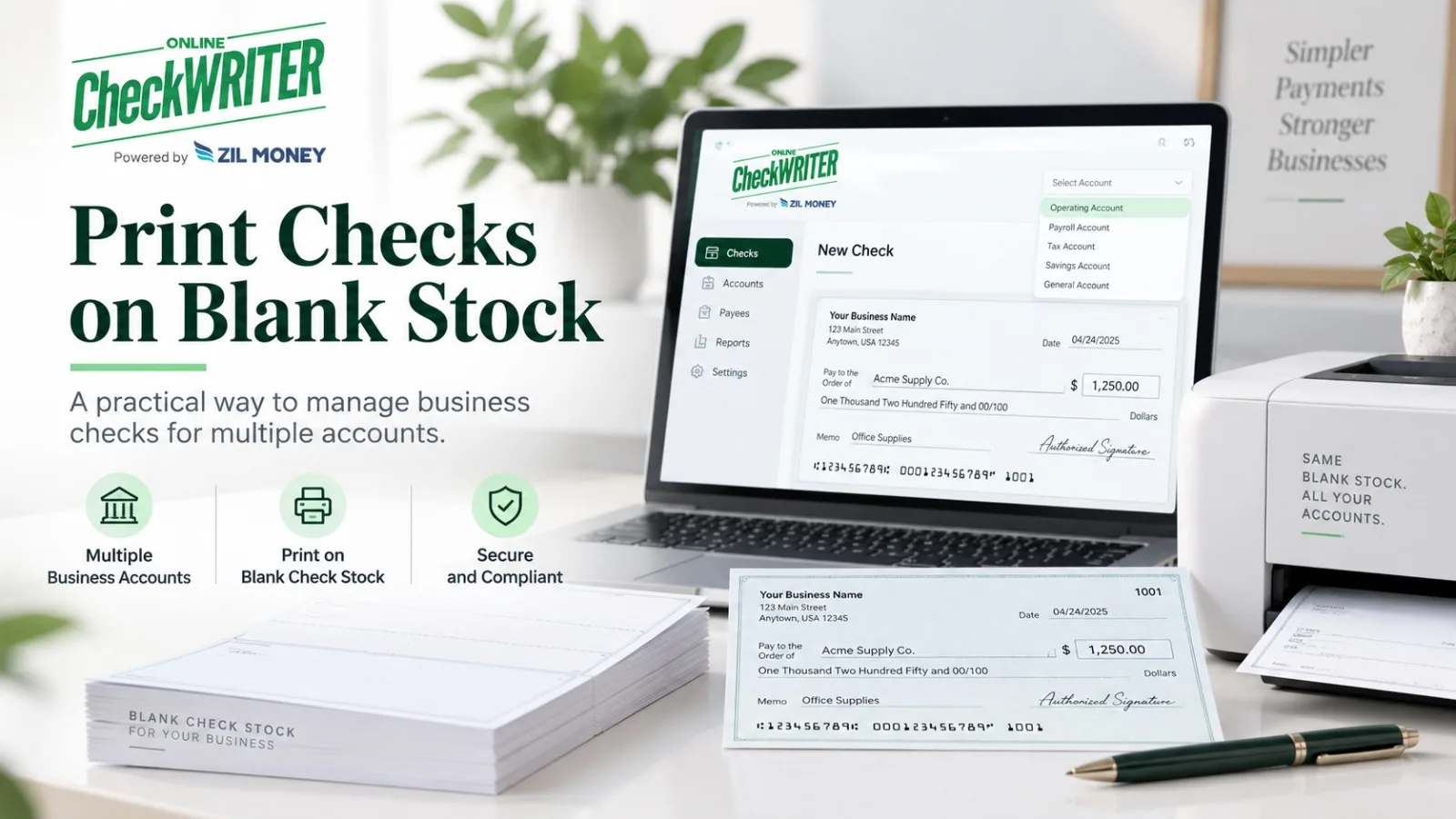
OnlineCheckWriter.com provides software for creating and printing original checks from authorized accounts.
Its Blank Checks page describes printing checks on blank stock and advises users to meet the requirements of the connected bank.
The platform can help organize the check layout and payment information.
It does not turn an ordinary home-printed check into a “substitute check” under Check 21 simply because software generated it.
That distinction should remain clear in external PR content.
What Did Check 21 Change for Businesses?
Its biggest effect was behind the scenes.
Banks became able to exchange and process checks more electronically rather than physically transporting every original paper item.
That made modern image-based check processing much more practical.
For a business printing its own original checks, the important issues remain accuracy, authorization, MICR setup, bank requirements, check stock, and recipient acceptance.
The Correct Takeaway
The Check 21 Act and check printing are related because the law changed the broader check-processing environment.
But Check 21 did not create a blanket promise that any self-printed check on any printer is automatically compliant or accepted.
OnlineCheckWriter.com – powered by Zil Money, is a financial technology company, not a bank. Banking and money movement services are provided through partner financial institutions and licensed service providers. FDIC insurance coverage applies only to eligible deposit products and accounts, and is subject to applicable terms, conditions, limitations, and requirements. Additional information regarding partner institutions, products, and services is available in the applicable terms and agreements.