Climate Risk, Community Stability, and the Future of Insurance in Ontario
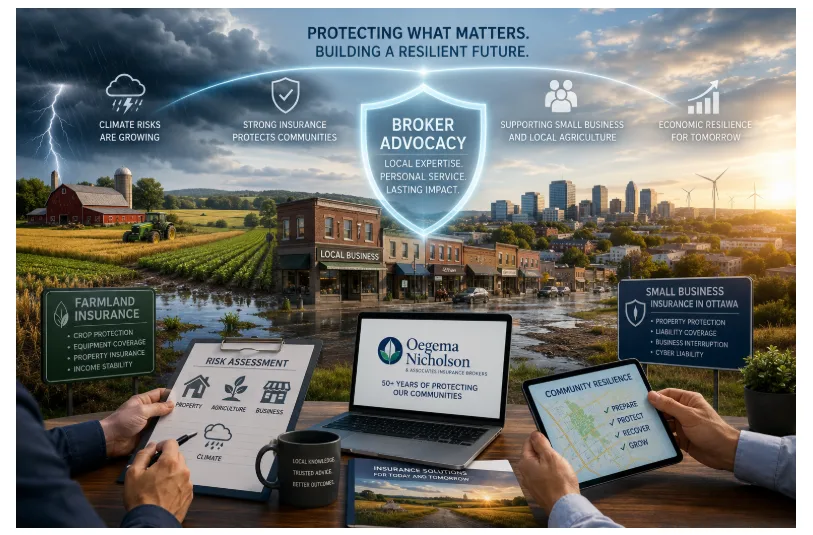
Across Ontario, climate change is no longer a distant environmental issue discussed only in policy papers or scientific conferences. It has become a practical business challenge affecting property owners, local farms, commercial enterprises, and entire regional economies. Extreme rainfall, flooding, windstorms, drought conditions, and unpredictable seasonal shifts are reshaping how insurers evaluate risk and how communities prepare for financial uncertainty.
For many business owners and agricultural operators, the consequences are immediate. Insurance premiums continue to rise, coverage requirements are becoming more complex, and some industries are finding it increasingly difficult to secure affordable protection. In response, independent insurance brokerages are stepping into a more strategic role — not simply selling policies, but acting as advocates, educators, and long-term risk partners.
This evolving “Broker-Advocacy” model is becoming especially important in communities where local economies depend heavily on agriculture, family-owned enterprises, and small businesses. In these regions, insurance is no longer just a regulatory requirement or a financial product. It is part of the infrastructure that helps communities remain economically resilient during periods of disruption.
One brokerage that exemplifies this shift is Oegema Nicholson & Associates. With over five decades of regional experience, the firm demonstrates how localized expertise can help Ontario residents and businesses navigate the growing volatility of the modern insurance landscape.
Climate-Related Risks Are Reshaping Ontario’s Economy
Ontario has experienced a significant increase in climate-related property claims over the past decade. Severe storms, basement flooding, hail damage, crop loss, and infrastructure strain are placing pressure on both insurers and policyholders. What once may have been considered “rare” weather events are becoming more frequent and financially damaging.
For rural communities, the impact is particularly severe. Agricultural operations are heavily dependent on weather stability, making them vulnerable to both sudden disasters and long-term climate shifts. A season of drought can reduce crop output dramatically, while flooding can destroy equipment, contaminate soil, and interrupt transportation routes.
At the same time, urban and suburban small businesses face their own vulnerabilities. Restaurants, retail stores, contractors, logistics companies, and service providers all rely on predictable operations. Even a short-term closure caused by storm damage or power outages can create substantial financial losses.
This is where specialized insurance planning becomes essential. Business owners are increasingly seeking advisors who understand both regional conditions and industry-specific risks. Rather than purchasing generic policies, companies now require tailored strategies that account for evolving environmental realities.
For entrepreneurs searching for reliable protection, understanding options related to small business insurance in Ottawa has become increasingly important as climate-related claims continue to affect commercial premiums and underwriting standards throughout Ontario.
The Growing Pressure on Insurance Premiums
Rising insurance premiums are becoming a major concern across Canada, particularly in Ontario. Multiple factors are contributing to these increases:
- Higher frequency of natural disasters
- Increased property repair costs
- Supply chain disruptions
- Inflation in construction materials
- Larger claim payouts
- Greater legal and liability exposure
Insurers must continuously adjust pricing models to remain financially sustainable. Unfortunately, this often means higher premiums for policyholders, stricter eligibility requirements, and more detailed risk assessments.
For local businesses already managing economic uncertainty, these rising costs can become a significant operational burden. Family-owned companies, independent retailers, and agricultural operators may not have the financial flexibility of large corporations. As a result, insurance affordability has become closely tied to regional economic resilience.
Communities with strong access to knowledgeable brokers tend to adapt more effectively because businesses receive guidance on reducing exposure, improving compliance, and identifying cost-efficient coverage options.
Why Independent Brokerages Matter More Than Ever
In today’s insurance market, independent brokerages play a critical role that goes far beyond transaction processing. Unlike direct insurance providers that typically promote their own products, independent brokers work across multiple carriers and prioritize the client’s broader needs.
This distinction matters because modern risk management requires flexibility, customization, and long-term planning.
The Broker-Advocacy model focuses on several key responsibilities:
1. Risk Education
Many property owners do not fully understand emerging climate-related vulnerabilities until a claim occurs. Brokers help clients identify hidden exposures before financial losses happen.
For example:
- Is a commercial property adequately protected against sewer backup flooding?
- Does a farm operation include sufficient equipment interruption coverage?
- Are supply chain disruptions considered within business interruption policies?
- Has inflation changed the replacement value of buildings and machinery?
These conversations help businesses become proactive rather than reactive.
2. Market Navigation
Insurance markets have become increasingly complex. Coverage language, exclusions, deductibles, and eligibility rules vary significantly between providers.
Independent brokerages simplify this process by comparing policies across insurers and advocating for solutions that align with the client’s operational realities.
3. Claims Advocacy
During stressful events such as storms, fires, or crop damage, policyholders often need support navigating the claims process. Local brokers provide direct assistance and communication that larger centralized systems may struggle to deliver effectively.
4. Long-Term Community Stability
Independent brokerages often maintain deep roots within their communities. Their success is directly connected to the economic health of local businesses, farms, and families. This creates a relationship-driven approach rather than a purely transactional one.
Agriculture and the Insurance Challenge
Agriculture remains one of the sectors most exposed to climate volatility. Farmers operate within a highly unpredictable environment where even small weather variations can impact profitability.
Ontario farms face risks including:
- Flooding
- Crop disease
- Drought conditions
- Equipment breakdowns
- Livestock losses
- Commodity price instability
- Supply chain interruptions
As climate patterns continue shifting, insurance protection for agricultural operations must become more sophisticated.
This is why demand for specialized farmland insurance solutions continues to grow. Standard commercial policies often fail to address the unique operational structure of agricultural businesses, which may include multiple buildings, machinery fleets, livestock facilities, seasonal labor exposure, and evolving land-use practices.
Farm operators increasingly require customized protection that reflects:
- Regional weather risks
- Equipment values
- Environmental liability concerns
- Revenue interruption exposure
- Succession planning considerations
Independent brokerages with agricultural expertise can provide critical guidance in structuring policies that balance protection with affordability.
Oegema Nicholson & Associates and the Broker-Advocacy Model
Oegema Nicholson & Associates offers an example of how localized brokerages are adapting to these modern challenges.
With more than 50 years of experience serving Ontario communities, the brokerage reflects the principles of the Broker-Advocacy model by combining regional knowledge with personalized risk management strategies.
Their longevity matters because insurance is deeply connected to local context. Weather patterns, municipal infrastructure, agricultural practices, regional economic trends, and property development all influence risk exposure differently across Ontario.
A brokerage operating within the community for decades develops insight that national-scale automated systems may overlook.
For example:
- Understanding flood-prone areas
- Recognizing local agricultural production cycles
- Knowing regional contractor and rebuilding costs
- Anticipating seasonal commercial disruptions
- Identifying emerging risks tied to community growth
This localized intelligence becomes especially valuable during periods of insurance market volatility.
Rather than treating policies as one-size-fits-all products, the Broker-Advocacy approach emphasizes consultation, education, and long-term planning. Clients benefit not only from access to coverage options but also from strategic guidance that helps reduce future exposure.
Small Businesses as the Backbone of Regional Resilience
Small businesses are essential to Ontario’s economic stability. They create jobs, support local supply chains, generate tax revenue, and contribute to community identity.
However, they are also highly vulnerable to unexpected disruptions.
A severe storm that closes a storefront for several weeks can have lasting financial consequences. Damage to inventory, interrupted operations, and reduced customer traffic may threaten the long-term survival of independently owned companies.
This is why modern insurance planning increasingly overlaps with economic resilience planning.
Business owners today need protection strategies that address:
- Property damage
- Cyber threats
- Liability exposure
- Employee safety
- Equipment interruption
- Revenue loss
- Climate-related operational risks
The challenge is that many entrepreneurs lack the time or expertise to navigate these evolving requirements independently.
Brokerages that function as advisors rather than sales intermediaries can provide substantial value by helping businesses adapt to changing risk conditions while controlling insurance costs where possible.
Personal Insurance Is Becoming More Complex Too
Climate-related volatility does not affect only commercial properties. Homeowners are also seeing increased complexity in personal insurance planning.
Flood risk assessments, rebuilding cost inflation, wildfire exposure, sewer backup coverage, and water damage claims are becoming more significant factors in policy pricing and eligibility.
Consumers are increasingly seeking guidance on:
- Updating home valuations
- Understanding exclusions
- Improving property resilience
- Bundling coverage strategically
- Managing deductibles effectively
As policies become more technical, personalized guidance becomes increasingly valuable.
Independent brokerages are uniquely positioned to provide this support because they often maintain ongoing relationships with clients over many years. Instead of relying entirely on automated systems, they can help homeowners make informed decisions based on evolving local conditions.
Technology and Human Expertise Must Work Together
The insurance industry is rapidly adopting advanced analytics, AI-driven underwriting, predictive climate modeling, and digital claims systems. These technologies improve efficiency and risk forecasting, but they do not eliminate the importance of human expertise.
In fact, as insurance becomes more data-driven, many consumers feel overwhelmed by complexity.
Local brokerages that successfully combine technology with personalized consultation may become increasingly important in the years ahead. Data can identify patterns, but experienced advisors help clients interpret those risks within the realities of their businesses and communities.
The future of insurance likely belongs to organizations capable of blending:
- Advanced analytics
- Regional expertise
- Human relationship-building
- Long-term strategic planning
The Broker-Advocacy model aligns closely with this direction because it positions brokers as trusted advisors rather than simply policy distributors.
Preparing Communities for the Future
Climate volatility will continue influencing property risk, insurance pricing, and economic stability throughout Ontario. While no brokerage or insurer can eliminate these risks entirely, strong local partnerships can help communities adapt more effectively.
Economic resilience depends not only on infrastructure and government policy but also on the systems that help businesses and families recover after disruption. Insurance plays a central role in that recovery process.
Independent brokerages with deep community ties are increasingly becoming part of the resilience framework itself. By helping clients understand evolving risks, secure appropriate protection, and navigate uncertainty, they contribute to the long-term stability of local economies.
The example set by Oegema Nicholson & Associates demonstrates how decades of localized experience can remain highly relevant in an era shaped by global climate challenges and insurance market volatility.
As Ontario businesses and agricultural operators face a more uncertain future, the need for informed, community-focused insurance guidance will only continue to grow.