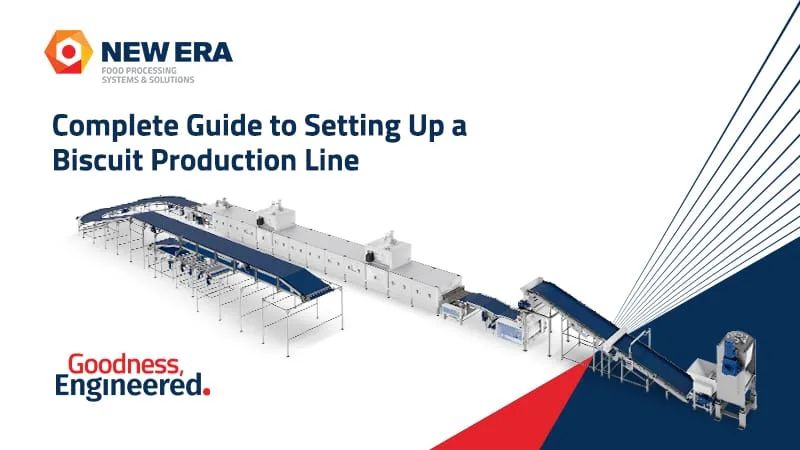
Complete Guide to Setting Up a Biscuit Production Line
Biscuits are one of the most widely consumed food products globally, ranging from tea-time classics to premium health-focused varieties. one of the most widely consumed food products globally, ranging from tea-time classics to premium health-focused varieties.
Setting up a biscuit manufacturing plant is not a matter of acquiring machines, it is about building a synchronized system where mixing, forming, baking, cooling, and packaging are seamlessly integrated.
This blog discusses every important stage of establishing a high-performing biscuit production line.
Understanding the Biscuit Production Line
A biscuit production line is a system of machines that is used together to process the raw materials into finished and packaged biscuits on a large scale. Be it baking soft biscuits, hard biscuits, cream biscuits, or any other special types like crackers, the line must be consistent, productive, and scalable.
The reason is that the global biscuits market was approximately USD 108.8 billion in the year 2024 and is expected to hit USD 206.2 billion in the year 2034, since the demand for biscuits is constant all over the world.
The global biscuit market was valued at approximately USD 108.8 billion in 2024 and is projected to reach USD 206.2 billion by 2034, reflecting steady worldwide demand.
Automation is also being integrated in modern factories manufacturing biscuits, in order to minimize human intervention and deliver uniform quality. An efficient Automatic Biscuit Making Machine system enables manufacturers to process large quantities, yet still ensure a very high degree of control over texture, thickness, and baking characteristics.
Planning the Biscuit Production Line
Manufacturers need to specify their production needs before they invest their money in machinery. This phase identifies the productivity and scalability of the entire facility.
Key Planning Factors:
- Type of Biscuits: Hard, soft, biscuits or both
- Required Output: Capacity per hour or shift
- Factory Space: Ceiling height and floor availability
- Energy Sources: Gas and electrical infrastructure
- Future Expansion: Ability to scale without replacing key equipment
Many manufacturers prefer modular production lines that can expand with demand rather than installing oversized systems from the start.
Core Stages of a Biscuit Production Line
1. Dough Mixing and Preparation
Preparation of the dough is the most crucial stage in the production of biscuits. Any minor inconsistencies at this stage may affect the texture, distribution, and appearance of the end product. That is why dough mixing is also known as the heart of your biscuit production line.
Industrial biscuit lines use heavy-duty horizontal dough mixers designed for:
- Uniform ingredient blending
- Controlled mixing speed
- Consistent batch quality
Proper mixing guarantees good gluten development in hard biscuits and the preferred softness in soft types of dough. Consistent production is also facilitated by the use of reliable dough mixers that ensure uniform dough characteristics throughout production.
2. Dough Forming and Shaping
After the dough is made, it proceeds to the forming phase. This step determines the shape, thickness, surface pattern, and weight of the biscuit.
Forming systems may include:
- Rotary moulders of soft dough biscuits
- Sheeting and cutting units of hard dough biscuits
Rotary moulders are used in creating detailed designs and embossed patterns, and are best suited to high-end and decorative biscuits. On the other hand, sheeting systems provide consistency in thickness and accuracy in cutting when producing in large volumes.
A complete Automatic Biscuit Making Machine system enables simple transfer of doughs, proper forming, and minimal handling, enhancing hygiene and minimizing product waste.
3. Baking System
Baking is regarded as the most technical process in the biscuit production line. The baking system determines the level of moisture, color, texture, and shelf life.
Industrial biscuit manufacturing is often associated with continuous tunnel ovens because they can process large quantities of materials with relative consistency. These ovens are designed with:
- Multiple temperature zones
- Adjustable conveyor speeds
- Controlled heat distribution
Accurate control of baking gives biscuits a uniform bake, neither burnt nor undercooked. The efficiency of energy and stability in temperature are the essential criteria, particularly in a long production run.
4. Cooling Conveyor
In baking biscuits, they should be allowed to cool very gradually and then they should be packed. Failure to provide proper cooling may result in cracking, condensation or loss of crispness.
Cooling conveyors are designed to:
- Lower the temperature of the biscuits uniformly
- Maintain product integrity
- Maximize space through multi-tier designs
Efficient cooling ensures that cookies will be in good condition once they are packed, as this improves the shelf life and appeal.
5. Packaging and Handling
The packaging systems depend on the product type and market needs. Common options include:
- Pillow pack machines
- Tray packing
- Cream sandwiching units with built-in wrapping
Properly packaged and processed biscuits minimize breakages and provide a clean transfer of cookies between cooling and final packing.
Automation, Efficiency, and Reliability in Biscuit Manufacturing
Automation is a key aspect in modern biscuit production in order to keep up with increasing demand in the market. Automation enhances speed, as well as consistency, safety, and operational control.
The main advantages of automated production lines of biscuits are:
- Stable Product Quality: Batches are mixed, shaped, and baked uniformly.
- High Production Volume: Operates continuously with minimal stoppages.
- Less Labor Dependency: Less manual intervention and error rates.
- Better Hygiene: Less physical contact with the product.
- Operational Reliability: Consistent performance over long production hours.
Automated control systems help manufacturers track key parameters and maintain consistent production standards, which is also needed to maintain brand uniformity.
Optimizing Layout, Performance, and Long-Term Value in a Biscuit Production Line
A biscuit production line is as important as the overall system design. In addition to individual machines, managerial concerns like plant layout, maintenance strategy, and long-term cost efficiency decisively influence productivity, uptime, and return on investment. Manufacturers who take into account these aspects in the planning phase are in a better position to attain operations that are stable and can be expanded.
Layout Optimization and Workflow Efficiency
Even the best machines can be restricted by a poorly planned layout. Efficient biscuit facilities are arranged in a linear or U-shaped structure that reduces material movement and cross-contamination.
The major principles of layout are:
- Complete division of raw and finished areas
- Smooth material flow
- Maintenance accessibility
- Supervision points and the safety of the operator
The layout of many high-capacity biscuit plants is based on industrial production lines that combine automation with ergonomic design.
Maintenance and Long-Term Performance
Preventive maintenance protects your investment. Modern lines often include:
- Easy-access panels
- Modular components
- Predictive maintenance warnings
Frequent check-ups of mixers, ovens, conveyors, and drives assure continuous production and quality.
Cost vs. Value: Thinking Beyond Initial Investment
Initial cost is important, but the long-term value is more important. Ovens with high energy efficiency, automatic controls, and strong construction reduce operating expenses greatly in the long run.
Scalable biscuit production line enables manufacturers to increase capacity without changing the core machinery: this strategy is followed by numerous growing biscuit brands in the world.
Conclusion
Establishing a biscuit production line is a strategic investment that needs a profound knowledge of the flow of production, integration of machines, and long-term objectives in operations. From dough mixing to baking and cooling, every stage must be designed for efficiency, consistency, and scalability.
Manufacturers that prioritize adequate planning, automation, and sound machinery are better placed to fulfill the demands in the market whilst managing the costs and quality.
New Era Machines, your ultimate biscuit production line manufacturer has been able to assist businesses in developing reliable, scalable, and efficient biscuit manufacturing lines through its experience in designing and supplying solutions with regard to industrial biscuit manufacturing.
| Want to set up an efficient biscuit production line? |
FAQs
- What is the best capacity of a biscuit production line?
The highest capacity is established based on the market demand, product range, and future expansion plans. Most manufacturers start with scalable lines which can be expanded to capacity.
- What is the significance of automation in making biscuits?
Automation improves uniformity, less labor reliance, wastage, and food safety policies.
- How long will it take to be installed with a biscuit production line?
The installation schedule will be based on the complexity of the line; the average automated line can take weeks of testing and commissioning.
- Is it possible to have more than one biscuit production line to produce different types of biscuits?
Yes, modular forming units and adjustable ovens mean that a single line can give several variants of biscuits with minimum changeover time.