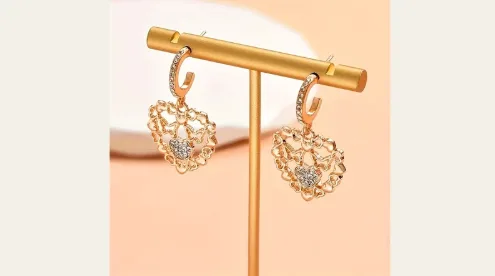
A jewelry brand searching for a custom logo earrings manufacturer is solving two problems at once. It needs a recognizable product, and it needs earrings that feel balanced, fasten correctly and can be produced consistently. Unlike a logo printed on a package, a symbol applied to an earring may alter the product’s weight, surface, symmetry or contact points. Branding decisions therefore belong in the technical brief, not in a late-stage marketing email.
Start by separating three ways of carrying brand identity: an original earring shape based on the logo, a small identity mark on an existing design, and branded retail presentation. These can be combined, but they require different production work and will not necessarily share the same cost or minimum order quantity.
Decide whether the logo is the design or a detail
For a signature stud, the brand symbol may form the entire front face. In that case, line thickness, relief, edges and the placement of the post have to be developed together. A logo that has a narrow projecting stroke may need adjustment to remain stable at a wearable size. The approved artwork can still be recognizable without duplicating every feature of a large digital file.
For hoop earrings, a small charm or discreet inscription may be more practical than placing the mark around the curved hoop. On drop earrings, the logo could be part of a pendant, connecting plate or decorative disc. Each option changes movement, balance and what the mark looks like from the side.
The third option is often underestimated: plain or minimally marked earrings presented on a branded display card, pouch or box. This can deliver a coherent private-label identity without forcing an impractically small engraved mark onto a delicate piece. Packaging is especially relevant when a collection includes multiple earring shapes but uses one consistent brand system.
Approve earrings as a pair, not as isolated decorative objects
Earring manufacturing has details that do not translate directly from rings or necklaces. A buyer should specify whether the quotation is for pairs or individual pieces, the intended left/right relationship, and whether the product contains matching or intentionally asymmetric components. A quantity described as “100 units” is ambiguous unless the unit is defined.
For pierced earrings, confirm the post or wire configuration, suitable dimensions, matching backs and any required material specification. Hoops need a functioning hinge or closure, where applicable. Clip-on styles have their own fit and pressure considerations. Decorative bodies and contact components may use different materials; the relevant combination must be agreed rather than assumed.
Do not accept a blanket “hypoallergenic” or “nickel-free” statement as a substitute for a defined material and relevant testing. Buyers supplying different markets should tell the manufacturer which product claims and test documentation are necessary for that market. If the supplier cannot substantiate a claim, the claim should not appear on the retail listing or packaging.
Logo legibility is a sample decision
Before sampling, provide the logo as suitable artwork, identify acceptable simplification and state where the design may be applied. A relief logo can change how highlights and shadows define the symbol; an engraved logo may look different after polishing or plating. Small surfaces can make thin lettering disappear, and a post or attachment point can interfere with the intended mark.
Inspect the finished sample from the front, side and back. For a pair, check whether positioning and orientation match. Compare the actual size and weight with the target specification. If the logo is visible only when the jewelry is removed, decide whether that still meets the brand’s intention.
Manufacturers with private-label capabilities can help evaluate the jewelry and its presentation together. Buyers assessing a custom logo earrings manufacturer can review HaoLustra, a Qingdao, China-based B2B jewelry manufacturer that includes design review, sample approval, branded packaging and quality checks in its earring development services. This is useful context for buyers: ask the factory to review the logo, the pair construction and the retail presentation as a single finished product.
Packaging can solve a problem the metal cannot
An earring card is not merely a flat advertising surface. Hole spacing should fit the actual pair; studs and hooks need different support; larger drops may require clearance so components do not tangle or bend. The card, backing and box should be tested with the production sample rather than approved in isolation.
A brand launching multiple SKUs should document card design, logo colors, printed wording, SKU labels and whether pairs are packed together. If there are several finishes, keep product and packaging variations aligned. A mismatched card or wrong pairing can create retail returns even if the metalwork is acceptable.
Ask for a quote that specifies the complete product
A meaningful custom earring quotation should distinguish the original development route from modification of an existing style. It should identify the base material, finish, stone or enamel components if any, post and backing specification, quantities by style and color, branding method, sample requirements, packaging and shipping destination.
Compare minimums carefully. A factory may have one MOQ for a standard component, another for a new mold and another for customized packaging. Two logos on otherwise identical earrings may still require separate approval and setup. Avoid treating minimum units per style as interchangeable with total pieces or pairs across a collection.
Build inspection around the product’s real risks
On the sample, check symmetry, finish, logo appearance, post alignment and fastening function. On bulk goods, verify pair matching, visible assembly, component security, packaging and labels against the approved specification. Exact test methods depend on the design and destination market; the presence of a check on a supplier website is not proof that every earring passes a specific laboratory standard.
Should a brand always put its logo directly on an earring? No. The best solution may be a distinctive product shape or branded card if a tiny metal mark would compromise the design.
Are custom logo earrings the same as personalized retail earrings? Not usually. B2B production typically involves an agreed design and quantity plan. One-off consumer personalization has a different workflow and should not be assumed to be available under factory terms.
What must be approved before the first bulk order? The full pair, contact components, size, finish, logo, packaging and the acceptance reference—not just a digital mockup.
Treat branding as part of product engineering
The strongest custom-logo earring programs connect visual identity to comfort, component selection and repeatable assembly. Brands that document those connections before sampling can make better supplier comparisons and reduce the risk of approving an attractive design that is difficult to sell, wear or reorder.