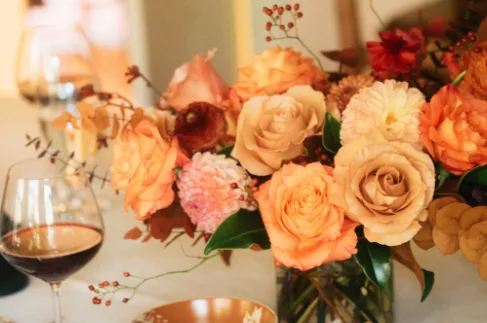
A loft on a Tuesday afternoon is a strange place to plan a wedding. There’s nothing in it. Brick on three sides, a row of factory windows on the fourth, columns down the middle, and a ceiling full of pipes that somebody once painted black and then gave up on. The couple stands in the middle of a converted factory floor in Greenpoint and asks me the question I get in every one of these rooms, which is some version of, okay, where do the flowers go? If you’ve been calling around for a wedding florist NYC couples recommend and getting a lot of enthusiasm about “the possibilities,” I’d slow that down a bit. A loft isn’t a blank canvas. It has very strong opinions. They’re just quieter than a ballroom’s.
Here’s how I think about it, more or less in the order I think about it.
Look at the brick before you pick a single flower
Exposed brick is warm and textured and photographs beautifully, and it will fight you on color the entire night. Anything in the red, rust, coral, or terracotta family just disappears into the wall. I’ve watched a bride’s coral peonies go up in front of a brick wall in Williamsburg and read, in every photo, as slightly rounder brick. So the ceremony flowers in a loft usually don’t need to be a backdrop at all. The wall is the backdrop. What the flowers need to do is contrast with it. Whites, creams, pale greens, a lot of foliage, soft rounded shapes against all those hard horizontal lines.
The thing I almost always end up suggesting is a low, wide meadow of garden roses and ranunculus right at floor level, instead of anything tall. A tall structure in front of brick ends up competing with it. A meadow sits in front of it and lets the wall do its thing. Ground, not sky, if that makes sense.
The columns are doing the arch’s job already
Most of these buildings have cast-iron columns running in a line down the room, and couples tend to see them as an obstacle. They’re not. They’re the ceremony frame, already installed, already paid for. Pick the pair nearest the windows, put the couple between them, let the guests fill the floor, and build the flowers up from the base of each column in uneven clusters, heavier on one side and reaching toward the light. Don’t wrap every column in the room. One pair. Anything more and it starts looking like a department store at Christmas.
I had a couple at a Long Island City loft last spring who were set on bringing in a rented arch, and I talked them out of it in about four minutes by walking them over to the columns and having them stand there. The photographer thanked me later.
Then figure out what the windows are doing at your ceremony hour
Those big factory windows are the loft’s one source of real light, and during a daytime ceremony they are the brightest thing in the building by a mile. Which means they backlight whatever is standing in front of them. Faces go dark, flowers go to silhouette, and the photographer spends the whole ceremony fighting it. Turn the setup so the windows are off to one side. Now the light comes across the arrangements instead of through them, and you can actually see the texture in everything.
After dark, the same windows go black and turn into mirrors. Anything near them shows up twice. That’s where I put the tables with the most candles. You get the glow and the reflection of the glow, and you paid for one.
The ceiling is where a loft earns its keep
Exposed ducts, sprinkler lines, timber joists, rigging points every few feet. This is the one thing a loft gives you that a hotel ballroom in Midtown never will, and if there’s room in the budget, this is where I’d put it. A long greenery cloud over the head table. A single line of suspended bud vases following the aisle. Amaranthus hanging over the dance floor so it moves when people do. One hanging piece, placed well, does the work of a dozen tall centerpieces and fills the space over everyone’s heads, which nothing on a table can reach.
Three boring but important things first. Confirm the weight limits with the building. Get the rigging policy in writing, because some lofts in DUMBO allow it, some charge a fee, and some flatly say no, and that answer changes the whole design. And light the piece from below, or it just disappears into the pipes.
Centerpieces look different under a twenty-foot ceiling
A standard centerpiece in a loft doesn’t look small on the table. It looks small under all that air. You have two real choices. Go low and dense, compotes spilling over, bud vases in clusters, candles everywhere, and let the hanging piece carry the height. Or go tall, and understand that tall in a loft means thirty inches of bare stem before you hit the first bloom, times twenty tables. Most couples I work with in Brooklyn land on low-and-dense plus one overhead installation, and honestly the photos back them up.
The welcome sign, the seating chart, and the elevator problem
Lofts almost never have a lobby. Guests come off a freight elevator and they’re in the reception. So the welcome sign and seating chart have nowhere to live except right there, on easels just past the elevator doors, angled toward whoever’s stepping out. I’ll put one floral cluster on a corner of each and leave the rest alone. Acrylic and mirror look right against concrete. Wood looks right against brick. Match the sign to the nearest wall, not to the invitation.
And about that elevator. Everything comes up in it. My flowers, my vessels, the hanging piece in sections, the caterer’s racks, the band’s drums. One slow freight car shared with three other vendors can quietly eat an hour of setup. I ask the building manager which hour is mine before I ask anything else.
Don’t soften the whole room
The loft weddings that look wrong are the ones where someone tried to cover everything. Drape on every wall, flowers on every surface, the brick basically apologized for. The room stops being a loft and starts looking like a tent that got lost indoors. I keep three things raw on purpose: one bare wall, one run of bare windows, one stretch of bare ceiling. The flowers are supposed to be the contrast. Concrete and ranunculus. Steel and sweet pea.
Anyway. Whether it’s DUMBO, Long Island City, or one of the old printing floors in Tribeca or Chelsea, the bones are the same, and so are the answers. A wedding florist in Brooklyn or Manhattan who has worked these buildings walks in, looks up, and already knows where things go.