Data Shows Gap Between Lebanon War Coverage and Public Needs
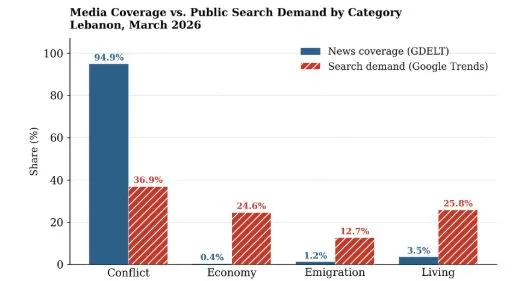
A new data analysis by Mohamed Soufan, Computational Researcher, reveals a striking gap between Lebanon news coverage and what people inside the country were actually searching for during the March 2026 conflict.
When rockets fall and ceasefires collapse, news organizations focus on war. That is expected. But the data suggests that while Lebanon conflict coverage was almost entirely centered on military events, public attention was directed elsewhere — toward the economy, daily survival, and the possibility of leaving the country.
The findings are based on 11,623 English-language news articles collected from the GDELT database between March 1 and March 31, 2026, filtered down to 1,894 relevant articles. These were compared with Google Trends data capturing search behavior from within Lebanon over the same period.
Lebanon News Coverage vs Public Search Demand: The Gap
Nearly all coverage was about conflict. Most searches were not.
Of the classified articles, 1,798 — or 94.9% — focused on conflict, including military operations, airstrikes, Hezbollah activity, and ceasefire developments. The remaining 5.1% was divided across economy, living conditions, and emigration.
Search behavior told a different story. Conflict-related searches accounted for 36.9% of total public demand, while the majority — 63.1% — focused on economic conditions, daily life, and emigration.
The imbalance becomes more pronounced at the category level.
- Economy: 24.6% of search demand vs 0.4% of coverage
- Living conditions: 25.8% vs 3.5%
- Emigration: 12.7% vs 1.2%
In practical terms, economic concerns alone accounted for nearly a quarter of all searches, yet appeared in just 7 out of 1,894 articles.
What People in Lebanon Searched During the Conflict
To measure public search demand, the analysis used Google Trends Topics, capturing multilingual search activity across Arabic, English, and French — a critical feature in Lebanon’s information environment.
Four proxy topics were used:
- Hezbollah (conflict)
- Lebanese lira (economy)
- Rent (living conditions)
- Passport (emigration)
Search patterns showed that interest in economic conditions remained consistently elevated throughout the month, with a notable spike around March 23, unrelated to any single major military escalation. Living condition searches were highest early in the month, while emigration-related searches remained steady but consistently above their share of media coverage.
These patterns suggest that public information demand was not simply reacting to headlines. Instead, concerns about currency, housing, and leaving the country persisted independently of the news cycle.
Who Covers Lebanon: Media Sources and Conflict Focus
The composition of sources helps explain the imbalance.
Israeli outlets accounted for 10.3% of coverage, while Lebanese outlets represented just 6.9%. International sources made up 22.2%, with the remainder distributed across other global publishers.
This reflects a broader dynamic in Lebanon war news analysis: much of the English-language coverage is produced by outlets whose primary lens is regional security. As a result, military developments dominate, while economic and civilian realities receive limited attention.
Lebanon Conflict Coverage Gap Persists Beyond Peak Escalation
A key question is whether the findings were driven by the intense escalation in early March.
To test this, the analysis was repeated excluding March 1–5, the period with the highest volume of conflict reporting. The results did not change. Conflict coverage remained at 94.9%, and the gap across economy, living conditions, and emigration persisted.
This indicates that the imbalance was not limited to peak escalation. It was consistent throughout the month.
What the Lebanon Media Coverage Gap Means for Public Needs
The findings do not suggest that conflict coverage is misplaced. Military developments are inherently newsworthy during war. What the data reveals is a narrowness in coverage relative to public needs.
While media coverage centered almost entirely on conflict, people living through the crisis were actively seeking information about:
- Economic survival
- Daily living conditions
- The possibility of leaving
“The data shows a clear gap between what is covered and what people are actively seeking,” said Soufan.
In other words, the information environment during the Lebanon conflict was split between what the media emphasized and what people needed to know.
Methodology: Comparing News Coverage and Search Data
This analysis compares 1,894 classified English-language news articles from the GDELT database (March 1–31, 2026) with Google Trends topic data for searches conducted within Lebanon over the same period. Articles were filtered for relevance using a two-stage keyword filter and classified into four categories: conflict, economy, living conditions, and emigration. Classification was performed using GPT-4o and validated through a stratified sample of 100 headlines independently labeled by two human annotators, achieving 100% agreement.
The full dataset and analysis code are publicly available on GitHub.
About the Researcher
Mohamed Soufan is a Lebanese computational researcher and software engineer. His work focuses on data analysis, data science, and software development, with an emphasis on understanding real-world systems through large-scale data.
He conducts independent research and publishes scientific papers examining information dynamics, public behavior, and data-driven patterns during periods of crisis and change. His work often combines multiple data sources, including news datasets such as GDELT and public search data from Google Trends, to produce empirical, reproducible findings.
His research is centered on developing structured, data-driven insights that are both methodologically rigorous and relevant to real-world contexts.