DeFi News: How Decentralized Finance Is Reshaping the Future of Banking
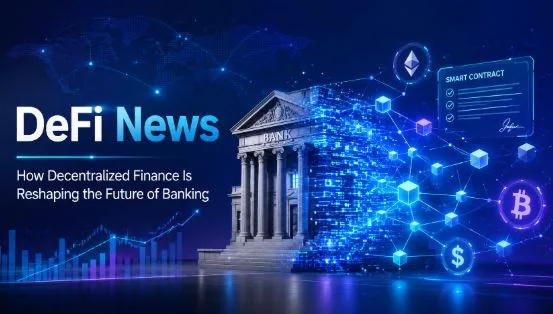
The New Financial Shift No Bank Can Ignore
Banking has always been built around trust. For centuries, people have trusted institutions to hold money, process payments, approve loans, protect savings, and manage access to financial products. That model still works for millions of people, but it also carries delays, fees, paperwork, restrictions, and barriers that leave many users looking for better alternatives.
Decentralized finance, better known as DeFi, is one of the most important changes happening in the financial world today. It uses blockchain technology to create financial services that do not depend on traditional banks or central authorities. Instead of asking a bank to approve a transfer, loan, or investment, users can interact with digital protocols that run automatically through smart contracts.
This is why interest in DeFi News, Latest DeFi News continues to grow among investors, developers, businesses, and everyday users. People want to understand how these tools work, why they matter, and whether they can become part of the future banking system.
DeFi is not just a passing trend. It is a major conversation about control, access, transparency, and the future of money.
What Makes DeFi Different From Traditional Banking?
Traditional banking depends on centralized institutions. A bank controls accounts, verifies transactions, manages lending, and decides who qualifies for financial services. Customers usually have limited visibility into how decisions are made.
DeFi works differently. It is built on public blockchain networks where transactions can be verified openly. Smart contracts handle many activities automatically, including lending, borrowing, trading, staking, and payments.
The biggest difference is access. In many DeFi systems, users only need an internet connection and a digital wallet. They do not always need a credit score, local bank account, or approval from a financial officer. This creates opportunities for people who are underserved by traditional banks.
Key features that make DeFi stand out include:
- Open access to financial tools
- Faster digital transactions
- Reduced dependence on middlemen
- Transparent blockchain records
- User control over digital assets
- Programmable financial products
This does not mean DeFi is perfect. It has risks, technical barriers, and security concerns. Still, its structure challenges old assumptions about how banking must work.
How DeFi Is Changing Payments
Payments are one of the clearest areas where decentralized finance is making an impact. Traditional cross-border payments can take days and may involve several intermediaries. Each intermediary can add fees, delays, and exchange-rate costs.
DeFi-based payments can move value across borders more quickly. Stablecoins, which are digital assets designed to maintain a steady value, are commonly used for this purpose. They allow users to send funds without relying on slow banking rails.
For freelancers, remote workers, online businesses, and international families, this can be meaningful. A person in one country can send money to another person almost instantly, often with fewer barriers than a conventional bank transfer.
This speed and flexibility are among the reasons DeFi News is watched closely by people who care about global finance. Payment innovation is not only about convenience. It is also about making financial movement more efficient in a connected world.
Lending and Borrowing Without a Bank
One of the most powerful DeFi use cases is lending and borrowing. In traditional banking, borrowers apply for loans, submit documents, wait for approval, and depend on institutional judgment. The process can be slow, especially for small businesses or people without strong credit histories.
DeFi lending platforms offer a different model. Users can deposit digital assets into liquidity pools, while borrowers can access funds by providing collateral. Smart contracts manage the terms, interest, and repayment rules.
This creates a more automated lending environment. Depositors may earn yield, while borrowers gain access to liquidity without going through a bank branch.
However, DeFi lending has its own challenges. Collateral requirements can be high, asset prices can be volatile, and users must understand how liquidation works. A sharp market move can quickly affect a borrower’s position.
Still, the model is important because it proves that lending does not always need to be controlled by a central institution. Code can manage parts of the process that banks traditionally handled manually.
The Rise of Decentralized Exchanges
Trading is another area where DeFi has changed expectations. Centralized exchanges require users to deposit funds into a company-controlled platform. Decentralized exchanges allow users to trade directly from their wallets.
This gives users more control over their assets. Instead of handing custody to a third party, they can connect a wallet, complete a trade, and keep control of their funds.
Decentralized exchanges also use liquidity pools rather than traditional order books in many cases. Users provide assets to these pools and may earn fees when trades happen.
This system has opened new possibilities for digital markets. Smaller projects can gain liquidity more easily, and users can access a broader range of assets. At the same time, it increases the need for caution. Not every token is reliable, and not every project is built with long-term value in mind.
People following Latest DeFi News often pay attention to decentralized exchange activity because it reflects user demand, market confidence, and innovation across blockchain ecosystems.
Why Transparency Matters
One of the biggest criticisms of traditional finance is that many processes are hidden. Customers often do not know how fees are calculated, how risk is managed, or how institutions use funds behind the scenes.
DeFi introduces a higher level of transparency. Public blockchains allow transactions and smart contract activity to be viewed openly. Anyone can inspect wallet movements, liquidity levels, and protocol activity.
This openness can build trust, but it also requires users to learn how to interpret data. Transparency only helps when people understand what they are looking at.
For analysts and market watchers, this creates a new kind of financial visibility. Instead of waiting for quarterly reports or institutional statements, they can observe activity directly on-chain.
This is one reason DeFi is reshaping financial research. It gives users and businesses access to real-time signals that were not available in older systems.
The Role of Smart Contracts in Modern Finance
Smart contracts are the engine behind DeFi. They are self-executing programs stored on a blockchain. Once conditions are met, the contract performs the action automatically.
For example, a smart contract can release collateral, process a trade, calculate interest, or distribute rewards. This reduces the need for manual approval and lowers dependence on intermediaries.
Smart contracts make finance programmable. Developers can build products that operate continuously, without office hours or geographic limits.
But smart contracts also carry risk. If the code has a bug, attackers may exploit it. If users interact with an unsafe protocol, they may lose funds. This is why audits, security reviews, and careful protocol design are essential.
In the future, banks may not ignore smart contracts. Instead, many may adopt similar automation within regulated environments. The result could be a blended financial system where traditional institutions borrow ideas from DeFi.
Benefits for Users and Businesses
DeFi offers several potential benefits for individuals and companies. These benefits explain why the sector continues to attract attention even during uncertain market cycles.
For users, DeFi can provide more control over assets, access to alternative financial products, and faster movement of funds. For businesses, it can support new payment models, treasury strategies, and financial infrastructure.
Some practical benefits include:
- Lower barriers to financial participation
- Faster settlement for digital transactions
- More flexible lending and borrowing options
- Direct access to global liquidity
- Greater control over asset custody
- New tools for financial innovation
These advantages are especially relevant in markets where banking access is limited or expensive. DeFi does not solve every problem, but it gives users another option.
The Risks That Cannot Be Ignored
A balanced view of DeFi must include risk. While the technology is promising, it is still developing. Users must understand that decentralized systems can be complex and unforgiving.
There may be no customer support number to call after a mistake. If someone sends funds to the wrong address, loses a private key, or interacts with a harmful contract, recovery may be difficult or impossible.
Common DeFi risks include:
- Smart contract vulnerabilities
- Market volatility
- Scams and fake projects
- Poor user experience
- Regulatory uncertainty
- Liquidity problems
This is why education matters. Readers should not treat DeFi as easy money or a guaranteed path to profit. It is a powerful financial movement, but it requires careful research and responsible use.
How Banks Are Responding
Traditional banks are not standing still. Many financial institutions are studying blockchain, digital assets, tokenization, and automated settlement systems. Some are exploring partnerships, while others are building internal blockchain-based tools.
Banks understand that customer expectations are changing. People want faster transfers, lower fees, mobile-first access, and more transparent services. DeFi has raised the standard for what digital finance can look like.
The future may not be a simple battle between banks and DeFi. Instead, the financial system may become more hybrid. Banks may adopt blockchain infrastructure, while DeFi platforms may face stronger compliance standards.
This combination could lead to safer and more efficient financial products. The institutions that adapt early may be better prepared for the next generation of banking.
Why DeFi News Matters for Financial Decisions
In a fast-changing industry, information matters. Protocol updates, security incidents, regulatory changes, market trends, and new product launches can all affect how users and businesses approach DeFi.
Following DeFi News helps readers understand where the market is going. Following Latest DeFi News helps them stay aware of recent developments that may influence risk, opportunity, and adoption.
This is especially important because DeFi moves quickly. A platform that looks strong today may face new competition tomorrow. A regulation in one country may affect global market sentiment. A security breach can change trust in an entire category.
Good financial awareness is not only about chasing trends. It is about understanding patterns, asking better questions, and making informed choices.
What the Future of Banking Could Look Like
The future of banking may become more open, automated, and user-controlled. DeFi has already shown that financial services can run through code, operate globally, and serve users without traditional gatekeepers.
Banks will likely remain important, especially for regulated services, consumer protection, and large-scale financial relationships. But their role may change. Instead of controlling every layer of finance, banks may become part of a wider digital ecosystem.
Users may hold assets in personal wallets, access lending through decentralized platforms, receive payments through stablecoins, and still use banks for certain regulated needs. This mixed model could give people more choice than ever before.
The most important shift is not only technological. It is philosophical. DeFi asks who should control financial access, how trust should be created, and what modern banking should offer in a digital world.
A Smarter Path Toward Financial Freedom
DeFi is reshaping banking by proving that finance can be more open, transparent, and programmable. It gives users new ways to send money, borrow, lend, trade, and manage assets without depending entirely on traditional institutions.
At the same time, responsible participation is essential. DeFi rewards knowledge, patience, and caution. It is not a replacement for financial judgment. It is a new environment where users must understand both opportunity and risk.
For readers, businesses, and financial observers, the message is clear: decentralized finance is no longer a niche experiment. It is becoming part of the broader conversation about how money will move, how services will be delivered, and how banking will evolve in the years ahead.