Dingchengzun Expands Global Footprint with Aluminum Facade Project in Luanda, Angola
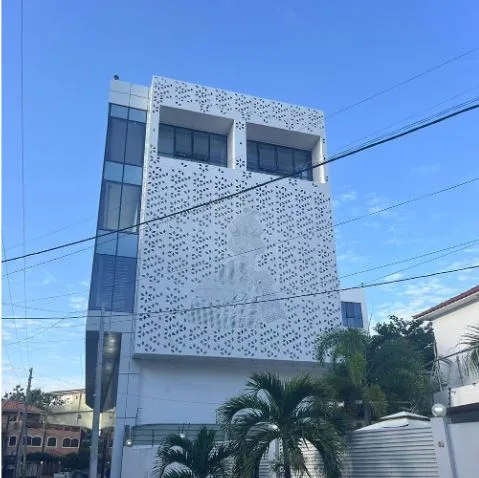
Guangzhou Dingchengzun Building Materials Co., Ltd. has completed a customized aluminum facade and interior ceiling solution for a large-scale supermarket development in Luanda, Angola, adding to the Chinese manufacturer’s growing list of installations across Sub-Saharan Africa and Central Asia.
A Commercial Sector Still Expanding, Despite a Mixed 2025
Angola’s broader construction industry had an uneven 2025: national permit data showed approved building permits fell sharply year-on-year, with family housing accounting for the large majority of approvals and commercial buildings a smaller share. Yet industry forecasters see the sector turning a corner. Analysts at GlobalData project Angola’s construction industry to grow by roughly 4.9% in real terms in 2026, picking up to an average annual rate near 5.7% between 2027 and 2030, driven in part by government infrastructure spending and a multi-billion-dollar tourism corridor investment approved earlier this year. Commercial construction specifically had already shown strong momentum in the years prior, registering double-digit compound annual growth between 2017 and 2021 according to sector data.
It’s against this backdrop — a market recovering unevenly but with commercial and retail development still attracting investment — that international material suppliers are securing a foothold in Luanda.
A Facade Rooted in Local Identity
For the Luanda supermarket project, the manufacturer supplied a complete exterior-and-interior aluminum system rather than a single product line. On the building’s exterior, the company developed a customized perforated aluminum veneer pattern inspired by Queen Nzinga, one of Angola’s most recognized historical figures — giving the building a distinct local identity rather than a generic commercial facade.
The perforation pattern also serves a functional purpose. Perforated aluminum panels allow for passive airflow and reduce solar heat gain on the building envelope, a relevant consideration in Luanda’s hot, humid coastal climate, where cooling costs and material degradation from humidity are recurring concerns for commercial property owners.
For the interior, the manufacturer installed aluminum baffle ceilings, including curved baffle sections, to manage the supermarket’s large interior spans while maintaining a clean, modern retail environment.
“Every international project comes with its own climate and cultural considerations, and Luanda was no exception,” said a Dingchengzun spokesperson. “We don’t treat overseas projects as a standard catalog order. The perforation pattern, the panel finish, even the curve radius on the ceiling baffles were all adjusted specifically for this building and this client.”
Engineering for a Coastal, High-Humidity Climate
Luanda’s climate — consistently hot and humid for most of the year, with a pronounced coastal salt-air exposure — places real demands on exterior building materials. Painted steel and many composite cladding products are prone to corrosion, chalking, or color fade within a few years in this type of environment, which drives up long-term maintenance costs for property owners.
Aluminum’s natural resistance to oxidation, combined with surface treatments such as powder coating or PVDF finishing, allows facade panels to hold their appearance and structural integrity over a longer service life with minimal upkeep. For commercial property owners weighing upfront material cost against years of repainting, sealing, or panel replacement, that difference in lifecycle cost is often the deciding factor — particularly in a market where, as construction permit data shows, commercial development still represents a meaningful but resource-constrained share of overall building activity.
Part of a Broader International Track Record
The Luanda installation adds to a growing list of cross-border projects for Dingchengzun, which has also supplied aluminum ceiling systems for Almaty International Airport in Kazakhstan and an aluminum facade and ceiling package for a luxury residential development in Dushanbe, Tajikistan. Together, the three projects span three distinct regions — Central Asia, the Caucasus-adjacent corridor, and Sub-Saharan Africa — illustrating how Chinese aluminum manufacturers are increasingly competing for large commercial and infrastructure contracts in markets where Western suppliers have historically had less presence.
Outlook
As Angola’s construction sector moves through its current adjustment period and toward the steadier growth projected for the back half of the decade, the commercial and retail segment is expected to remain one of the more active categories of development, alongside continued government investment in tourism and transport infrastructure. For material suppliers, that points to sustained — if uneven — demand for facade and ceiling systems built to perform in coastal, tropical conditions, an area where manufacturers offering both engineering customization and production scale are likely to keep winning specification on large commercial projects.
Guangzhou Dingchengzun Building Materials Co., Ltd. is a manufacturer of aluminum ceiling and facade systems serving commercial, public, and residential developments worldwide. The company’s product range includes aluminum veneer panels, curtain wall systems, and baffle, grid, clip-in, lay-in, and strip ceiling products, supported by in-house design, engineering, and project coordination services and a daily production capacity of up to 50,000 square meters.