Distracted Driving | A Nationwide Crises That Isn’t Letting Up
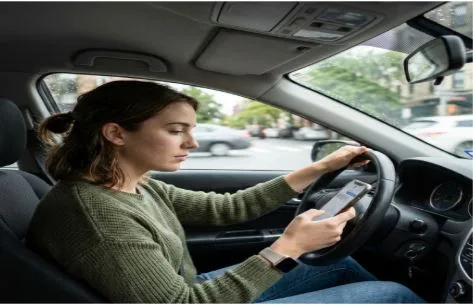
Distracted driving continues to be one of the most persistent roadway hazards in the United States, and new 2026 findings from Levine And Wiss show just how deeply the problem has become embedded in everyday driving behavior. Despite fluctuations in overall traffic fatalities, distraction‑related deaths have remained above 3,000 annually since 2020, underscoring a crisis that has not eased with time . In 2024 alone, distraction contributed to 2,955 fatal crashes—8 percent of all fatal collisions nationwide.
The economic toll is equally staggering. The total cost of distracted driving now approaches $100 billion annually, a figure that reflects medical expenses, lost productivity, and long‑term societal impacts .
How Distraction Has Evolved: Smartphones Take Center Stage
While eating, drinking, and talking with passengers have long been recognized as distractions, the rise of smartphones has reshaped the risk landscape. According to the study, handheld cellphone use—texting, scrolling, and app interaction—rose from 3.0 percent to 4.5 percent between 2023 and 2024 . Meanwhile, drivers holding phones to their ears declined slightly, suggesting that traditional phone calls are being replaced by more visually demanding behaviors.
Observed Driver Phone Use (2023–2024)
| Behavior | 2023 | 2024 | Trend |
| Phone to ear | 2.1% | 1.9% | Decreasing |
| Headset use | 0.5% | 0.5% | No change |
| Handheld manipulation | 3.0% | 4.5% | Increasing sharply |
The shift toward handheld manipulation is particularly concerning because it requires visual, manual, and cognitive attention simultaneously.
When and Where Drivers Are Most Distracted
The study highlights clear patterns tied to time of day and location. Weekday rush hour remains the most dangerous period for distraction‑related behavior. During these hours:
- 2.3 percent of drivers were observed holding phones to their ears—the highest rate of any time period .
- 4.6 percent were seen manipulating handheld devices, also the highest rate recorded .
Urban drivers were more than twice as likely to text and drive compared to rural drivers, with rates of 5.6 percent and 2.2 percent respectively .
Gender Differences in Distracted Driving
Women continue to report slightly higher cellphone‑related distraction rates than men. In 2024:
- 5.1 percent of female drivers were seen manipulating handheld devices
- 4.1 percent of male drivers were observed doing the same
Both groups showed small declines in phone‑to‑ear behavior, but handheld manipulation remains a growing concern.
The Human Toll: Fatalities and Injuries
The study reinforces that distracted driving affects far more than drivers themselves. In 2024, distraction‑related crashes killed:
- 75 pedalcyclists
- 525 pedestrians
- 654 passengers
- Additional victims across other categories
Injuries exceed 300,000 annually, a number that has remained consistently high despite public awareness campaigns and legislative efforts .
Which Age Groups Are Most Distracted? The Data Defies Assumptions
Contrary to popular belief, teenagers are not the most distracted drivers. Adults between 25 and 44 years old account for the majority of distraction‑related collisions.
Cellphone‑Related Fatal Crashes by Age (2024)
| Age Group | Fatal Crashes |
| 25–34 | 108 |
| 35–44 | 83 |
| 21–24 | 61 |
Drivers ages 21–24 represent 15 percent of all cellphone‑distracted drivers in fatal crashes, despite making up a smaller share of total drivers involved in fatal collisions nationwide .
Teens: High Risk, Different Causes
Teen drivers face unique developmental challenges. At age 16, the prefrontal cortex—responsible for impulse control and attention—is still developing, making multitasking and high‑pressure situations more dangerous . Studies show teens scan the roadway less frequently and have reaction times up to two seconds slower than experienced drivers.
Peer passengers are a major factor. Research cited in the study found:
- Distraction contributed to 58 percent of teen crashes
- 94 percent of teens witnessed distracting passenger behavior
- 45 percent saw passengers urging drivers to speed
Middle‑Aged Adults: The “Availability Pressure” Problem
Adults ages 18 to 44 face a different set of pressures. Work demands, parenting responsibilities, and constant digital communication create a sense of urgency that follows them into the driver’s seat. According to the study:
- 18–34 and 35–44‑year‑olds were tied at 54 percent for the highest rate of work‑related communication while driving
- 38 percent felt they always needed to be available
- 37 percent feared missing something important at work
This group has fully developed cognitive abilities, yet the volume of digital communication overwhelms those advantages.
Seniors: Low Phone Use, High Tech Overload
Drivers over 70 had the lowest smartphone usage rate at just 1.2 percent. However, modern vehicles introduce new challenges. Touchscreens, digital dashboards, and infotainment systems can create cognitive overload for older adults, who may struggle with rapid information processing or unfamiliar interfaces.
Passengers: Sometimes a Hazard, Sometimes a Help
Passenger behavior plays a measurable role in distraction‑related crashes. A meta‑analysis found that passenger interaction accounts for 3.55 percent of all road crashes, often due to slower reaction times and increased injury severity .
However, adult passengers—particularly among drivers ages 45 to 65—can reduce crash risk by assisting with navigation and maintaining driver awareness .
Where Distracted Driving Is Deadliest
Highest Distracted‑Driving Fatality Rates
| Rank | State | Deaths per 100,000 |
| 1 | New Mexico | 6.6 |
| 2 | Louisiana | 4.52 |
| 3 | Kentucky | 2.93 |
| 4 | Kansas | 2.58 |
| 5 | Hawaii | 2.57 |
Lowest Rates
| Rank | State | Deaths per 100,000 |
| 1 | Rhode Island | 0.18 |
| 2 | North Carolina | 0.19 |
| 3 | Connecticut | 0.25 |
| 4 | Nevada | 0.25 |
| 5 | Pennsylvania | 0.26 |
Even in states with strict cellphone laws, fatality rates remain high, suggesting that enforcement alone cannot solve the problem .
New York: Strict Laws, Rising Numbers
New York has some of the toughest distracted‑driving laws in the country, yet cellphone‑related crashes and citations continue to rise. In 2024:
- 100 distracted‑driving fatalities were recorded
- Texting‑related tickets rose from 58,737 in 2020 to 76,281 in 2024
- Drivers ages 21–29 accounted for 32 percent of cellphone‑related crash involvement
- Male drivers accounted for 60 percent of involvement and 69 percent of tickets
Automakers Step In—But With Mixed Results
Manufacturers are introducing driver‑monitoring systems to detect distraction, but experts warn that automation can create overreliance and complacency. Research from MIT AgeLab shows that hands‑free systems may reduce attention rather than improve it
The Bottom Line
The findings from Levine And Wiss paint a clear picture: distracted driving is not a teen problem, a tech problem, or a generational problem. It is a national crisis affecting every age group, every region, and every type of roadway. With fatalities remaining above 3,000 annually and injuries exceeding 300,000, the need for awareness and behavioral change has never been more urgent.