Does Red Light Therapy Help Muscle Recovery? What the Research Says
Recovery has become its own category of consumer health technology. Ice baths, compression boots, percussion massagers, and wearable sleep trackers have all moved from professional locker rooms into ordinary homes. The latest arrival is the red light therapy panel: an LED array emitting red and near-infrared light that users stand or lie in front of after training. The question that matters is whether the research behind the trend supports the recovery claims, and the answer is a qualified, cautiously positive one.
For readers who want the device-level picture straight away, a review of the best red light panels for muscle recovery and joint pain works through the hardware question in depth, and an evidence-minded guide to red light therapy for sleep covers the second pillar of recovery that this article returns to below. First, the science.
The Proposed Mechanism
Red light therapy, known in the scientific literature as photobiomodulation, rests on a specific biological hypothesis. Certain wavelengths of red and near-infrared light are absorbed by cytochrome c oxidase, an enzyme in the mitochondria, the structures that produce the cell’s energy currency, adenosine triphosphate. The leading theory holds that this absorption may support energy production and modulate inflammatory signaling in tissue under stress, which is precisely the state of muscle after hard exercise. That is a plausible mechanism, supported by laboratory data, though the translation to consistent human outcomes is still being mapped.
What the Studies Show
Two peer-reviewed findings are worth knowing. A randomized controlled trial published in Lasers in Medical Science (PubMed ID 31144070) applied photobiomodulation at approximately 808 nanometers alongside an exercise program in people with knee osteoarthritis. The group receiving light plus exercise showed greater reductions in pain and improvements in strength than the placebo group. The design reflects how researchers increasingly frame light therapy: as an addition to training and rehabilitation, not a substitute for it.
A second study (PubMed ID 24338090) examined photobiomodulation in fibromyalgia, a condition defined by widespread deep-muscle pain, and reported reduced pain among participants. Fibromyalgia is not post-workout soreness, but the finding matters for a mechanical reason: it suggests the light can reach and influence deeper tissue layers, which is the entire premise of using it on worked muscle.
The caveats are real. Many trials in this field are small, protocols vary widely in wavelength and dose, and positive findings still need replication at scale. What the evidence supports today is plausibility with early clinical signal, not settled certainty.
The Wavelengths That Matter for Muscle and Joints
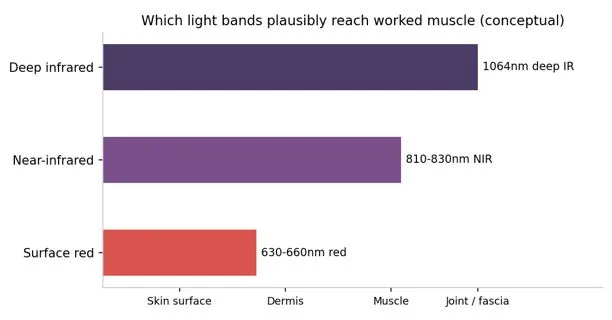
Not all red light reaches muscle. Wavelengths around 630 to 660 nanometers are largely absorbed at the skin. The bands relevant to recovery sit deeper: 810 and 830 nanometer near-infrared, which penetrate into muscle bellies and connective tissue, and 1064 nanometer deep infrared, the band studied for the deepest structures such as joints and fascia. A panel built for recovery should carry meaningful output in those longer wavelengths, not just the surface reds, and the device review linked above works through exactly that question panel by panel.
How People Actually Use It
Typical protocols in the literature and in practice run 10 to 20 minutes per muscle group, several times per week, at distances of about six to twelve inches from the panel. Some users prefer sessions shortly after training, others the following morning when soreness peaks. Consistency over weeks appears to matter more than the timing of any single session. There is also a second-order recovery angle: sleep. Because evening light exposure shapes the wind-down process, some users fold their panel time into a pre-bed routine, the use case the sleep guide linked earlier covers in detail.
The Bottom Line
Red light therapy for muscle recovery sits in the same place many recovery technologies do: a credible mechanism, early clinical support, and a research base that is growing but not yet definitive. It may help blunt soreness and support tissue recovery when used consistently alongside training, sleep, and nutrition. It will not replace any of those, and anyone with a diagnosed musculoskeletal condition should involve a clinician before adding it.
Frequently Asked Questions
How long before users typically notice anything?
Reports and study protocols generally point to two to six weeks of consistent use rather than immediate effects. Single sessions are unlikely to produce a measurable change.
Is more light better?
Not necessarily. Photobiomodulation research describes a biphasic dose response: too little light may do nothing, while excessive exposure may blunt the same processes moderate doses appear to support. Following device guidance on session length is the sensible default.
Does it replace stretching, sleep, or deload weeks?
No. In the trials showing benefit, light therapy was an addition to exercise and standard care. The fundamentals still carry the recovery load.
This article is general wellness information, not medical advice. Speak with a qualified healthcare provider before starting any new therapy.