Face Biometric Machine: Complete Guide to AI Attendance, Features, Benefits & Price in India (2026)
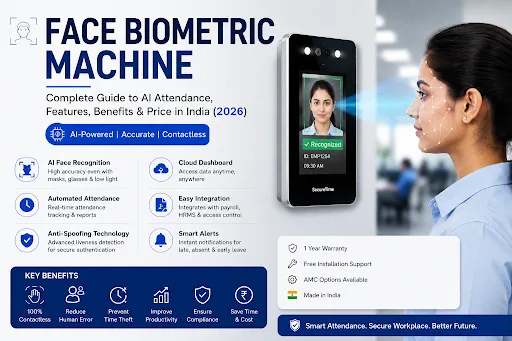
Face Biometric Machine
A Face Biometric Machine is an AI-powered attendance and access control system that identifies individuals using facial recognition technology instead of fingerprints, RFID cards, or passwords. It provides fast, contactless, and secure authentication, making it ideal for offices, schools, factories, hospitals, government organizations, and commercial buildings.
Modern face biometric machines use Artificial Intelligence (AI), deep learning, cloud connectivity, and real-time analytics to improve attendance accuracy, workplace security, and operational efficiency. In 2026, these systems have become one of the most reliable solutions for workforce management and campus security.
What is a Face Biometric Machine?
A Face Biometric Machine is an electronic device that verifies or identifies a person’s identity by analyzing unique facial features. Unlike traditional attendance systems that require fingerprints or ID cards, face recognition technology enables employees or students to mark attendance simply by looking at the device.
Every human face contains unique biometric characteristics, such as:
- Distance between the eyes
- Shape of the nose
- Jawline structure
- Facial contours
- Eye positioning
- Forehead dimensions
The system converts these facial features into an encrypted digital template and compares them with stored records. If a match is found, attendance is marked instantly.
Because there is no physical contact, face biometric systems have become increasingly popular in workplaces, educational institutions, healthcare facilities, and high-security environments.
Why Are Face Biometric Machines Becoming Popular?
Organizations are replacing manual registers and fingerprint attendance systems because they need faster, safer, and more intelligent attendance management.
Some major reasons include:
- Contactless attendance
- AI-powered identification
- Better hygiene
- Higher accuracy
- Reduced buddy punching
- Faster employee verification
- Improved security
- Cloud-based reporting
- Remote attendance monitoring
As businesses continue adopting digital transformation strategies, AI-based attendance systems have become an essential part of workforce management.
How Does a Face Biometric Machine Work?
Understanding the working process helps organizations choose the right attendance solution.
Face Enrollment
The user’s face is captured from multiple angles during registration.
The system creates an encrypted biometric template instead of storing a simple photograph.
AI Face Detection
When a person stands in front of the device, AI detects the face automatically.
Advanced algorithms identify:
- Eyes
- Nose
- Mouth
- Facial landmarks
- Head position
Face Recognition
The captured face is compared with stored biometric templates.
Deep learning algorithms calculate similarity scores within milliseconds.
Identity Verification
If the similarity score matches the predefined threshold, the person’s identity is verified.
Attendance is recorded automatically.
Attendance Sync
Attendance data can be synchronized with:
- HRMS
- Payroll software
- ERP systems
- Cloud attendance software
- Mobile applications
Managers can monitor attendance remotely through dashboards and reports.
Artificial Intelligence in Face Biometric Machines
Artificial Intelligence has transformed traditional attendance systems into intelligent workforce management platforms.
Instead of matching images pixel by pixel, AI analyzes hundreds of facial characteristics using deep neural networks.
Modern AI attendance systems can recognize faces even when users are:
- Wearing spectacles
- Growing a beard
- Aging naturally
- Wearing uniforms
- Standing at different angles
- In different lighting conditions
Many advanced devices also include:
- Liveness Detection
- Anti-spoof Technology
- Mask Detection
- Infrared Face Recognition
- Deep Learning Algorithms
These capabilities significantly improve accuracy and reduce false attendance entries.
Face Recognition Technology Explained
Face recognition technology combines computer vision, artificial intelligence, and biometric authentication.
The process generally involves:
Face Detection
The camera locates a human face.
Feature Extraction
Unique facial characteristics are identified.
Template Creation
The extracted information is converted into a mathematical biometric template.
Matching
The template is compared against stored user records.
Authentication
If matched successfully, access or attendance is granted.
Unlike passwords, facial features cannot be easily forgotten or shared, making biometric authentication more secure.
Key Features of Modern Face Biometric Machines
When purchasing a face biometric machine, organizations should evaluate the available features carefully.
| Feature | Benefit |
| AI Face Recognition | Fast and accurate identification |
| Contactless Attendance | Hygienic attendance process |
| Cloud Connectivity | Remote monitoring |
| Mobile App Support | Attendance from anywhere |
| Real-Time Reports | Better decision making |
| Multi-Factor Authentication | Higher security |
| Face + RFID + Password | Flexible authentication |
| Access Control Integration | Secure entry management |
| Employee Self-Service | Easy attendance tracking |
| Payroll Integration | Automated salary processing |
Benefits of Using a Face Biometric Machine
1. Contactless Attendance
Face recognition eliminates the need to touch fingerprint scanners or attendance registers.
This improves hygiene and reduces device wear and tear.
2. High Accuracy
Modern AI algorithms achieve extremely high recognition accuracy under normal operating conditions, minimizing incorrect attendance records.
3. Eliminates Buddy Punching
Employees cannot mark attendance for someone else because authentication is based on unique facial features.
This improves attendance integrity and payroll accuracy.
4. Faster Attendance
Face recognition takes only a few moments.
Large organizations can reduce queues during shift changes and office entry.
5. Better Workforce Management
Managers receive:
- Daily attendance reports
- Late arrival alerts
- Overtime reports
- Shift management data
- Leave summaries
These insights help optimize workforce planning.
6. Improved Security
A face biometric machine is not only an attendance device but also an access control solution.
Organizations can restrict access to:
- Server rooms
- Laboratories
- Warehouses
- Data centers
- Executive offices
- Manufacturing units
Only authorized personnel can enter designated areas.
7. Cloud-Based Attendance Management
Cloud integration allows HR teams to monitor attendance from any location.
Key advantages include:
- Real-time dashboards
- Automatic data backup
- Multi-location management
- Mobile attendance tracking
- Easy software updates
8. Cost Savings
Although the initial investment may be higher than manual attendance systems, organizations save money over time through:
- Reduced payroll errors
- Lower administrative effort
- Improved productivity
- Less time theft
- Minimal paper usage
Where Are Face Biometric Machines Used?
Face recognition attendance systems are now used across many industries.
Offices
Track employee attendance, manage shifts, and integrate with payroll systems.
Schools and Colleges
Record student attendance automatically while enhancing campus safety.
Manufacturing Units
Manage multiple shifts and control access to production areas.
Hospitals
Authenticate doctors, nurses, and staff while maintaining hygiene.
Government Offices
Improve transparency, accountability, and attendance compliance.
1. What is a Face Biometric Machine?
A Face Biometric Machine is an AI-powered attendance and access control device that identifies individuals using facial recognition technology. It verifies a person’s identity without requiring fingerprints, ID cards, or passwords, making attendance faster, more secure, and contactless.
2. How does a Face Biometric Machine work?
A face biometric machine captures a person’s facial features through a camera, converts them into an encrypted biometric template, and compares them with stored records. If a match is found, attendance is marked or access is granted within seconds.
3. Is a Face Biometric Machine more accurate than a fingerprint attendance system?
Yes. Modern AI-powered face biometric machines offer very high recognition accuracy under normal conditions. They also work without physical contact and reduce issues caused by dirty, wet, or damaged fingerprints.
- Can a Face Biometric Machine recognize people wearing masks or glasses?
Many advanced face biometric machines use AI, infrared sensors, and liveness detection to recognize users wearing glasses, masks (depending on the model), or with changes such as a beard or hairstyle.
5. Where can a Face Biometric Machine be used?
Face biometric machines are widely used in:
- Offices and corporate workplaces
- Schools and colleges
- Factories and warehouses
- Hospitals and healthcare facilities
- Government organizations
- Retail stores and shopping malls
- Residential societies
6. Does a Face Biometric Machine support cloud attendance?
Yes. Most modern face biometric machines support cloud-based attendance systems, allowing HR teams and administrators to monitor attendance, generate reports, and manage employees remotely through web portals or mobile apps.
7. Can a Face Biometric Machine integrate with payroll and HR software?
Yes. Many face biometric machines integrate with HRMS, payroll software, ERP systems, and employee management platforms. This helps automate salary calculations, leave management, and attendance reporting.
8. Is a Face Biometric Machine secure?
Yes. Advanced devices use encrypted biometric templates, AI-based facial recognition, and anti-spoofing technology to prevent unauthorized access and fake attendance attempts.
9. What is the price of a Face Biometric Machine in India?
The price depends on features such as AI face recognition, user capacity, cloud connectivity, access control support, and software integration. Basic models are generally more affordable, while enterprise-grade solutions with advanced features cost more.
10. How do I choose the best Face Biometric Machine?
When selecting a face biometric machine, consider:
- AI face recognition accuracy
- User and face storage capacity
- Cloud attendance support
- Access control integration
- HRMS and payroll compatibility
- Reporting and analytics
- Warranty and after-sales support
- Scalability for future business growth