Failed Payment Recovery for Gyms: What to Do When Membership Dues Do Not Go Through
Disclosure: This article was published as part of a paid partnership with Zil Money. The author is an independent contributor.
Failed payment recovery for gyms starts with recognizing that a declined membership payment does not always mean a member intended to cancel.
A payment can fail because of an expired card, insufficient funds, changed account information, or another payment issue.
For a gym that collects recurring dues, the goal should be to identify the failure, communicate clearly with the member, and provide a reasonable way to update the payment method.
Detect the Failure Quickly
A failed payment becomes harder to manage when staff discover it weeks later.
Membership billing software should make failed transactions visible to the team responsible for collections.
The record should show the member, payment amount, scheduled date, and current status.
That gives staff a clear starting point instead of relying on spreadsheets or manual account checks.
Use Retries Carefully
Recurring-billing systems often provide retry tools.
Stripe, for example, currently lists Smart Retries as part of its revenue-recovery features, along with reminder emails and expired-card updates.
That does not mean every payment should be retried indefinitely.
A gym should understand how its own billing system handles retry timing, limits, authorization, and failed-payment status.
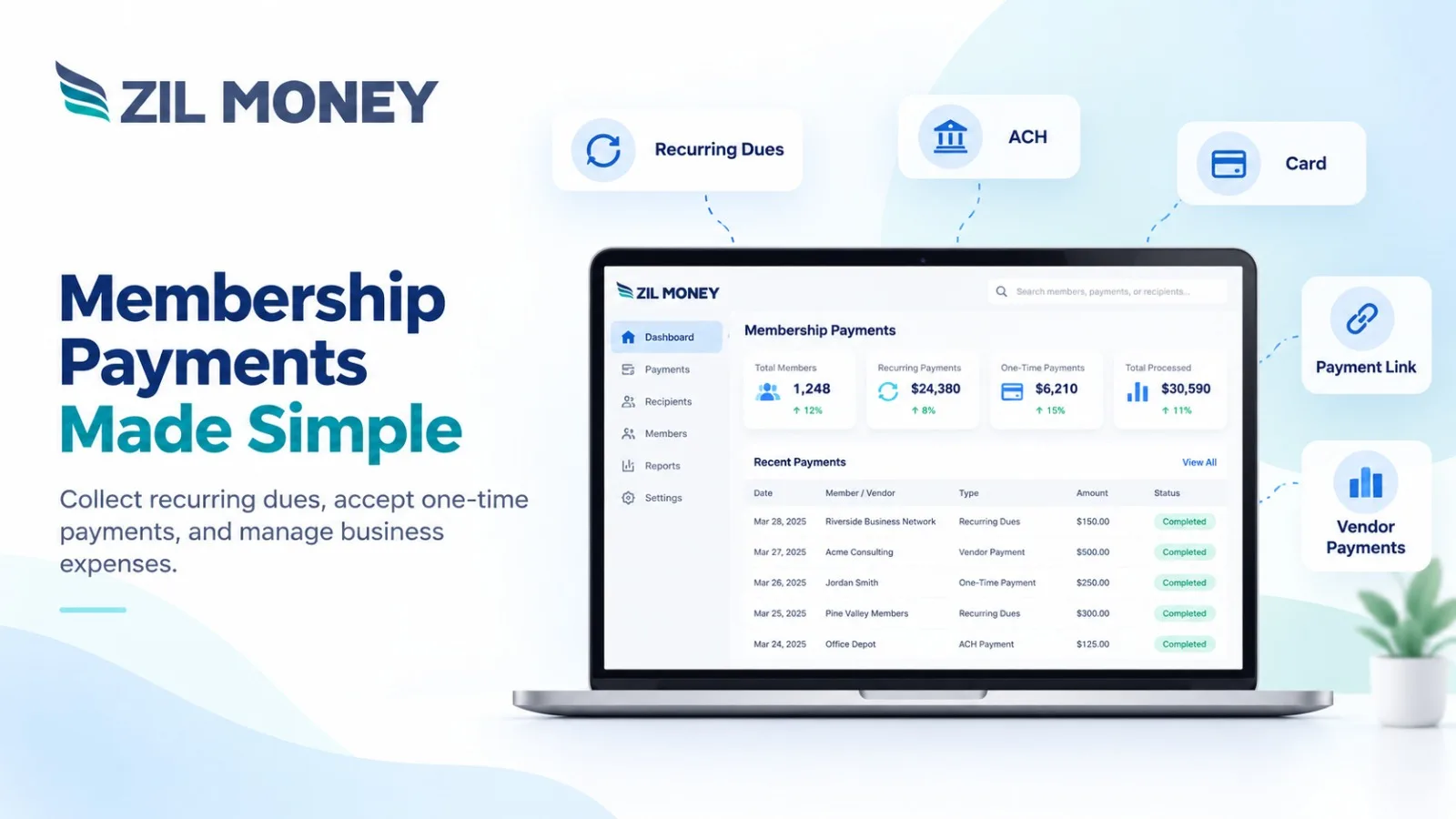
Zil Money’s current Membership Club Payments page describes recurring dues collection, failed-payment retries, and member notifications. Businesses should verify the current configuration and available settings before building their collection process around those features.
Tell the Member What Happened
A failed payment notice should be easy to understand.
The member should know that the payment did not go through, what membership charge was affected, and what action is needed.
Avoid language that sounds threatening when the problem may simply be an expired card.
A clear update link or instructions can reduce unnecessary calls to the front desk.
Stripe’s current billing documentation includes failed-payment reminders and hosted recovery tools as examples of this type of workflow.
Give Members More Than One Payment Option
A gym may accept cards, ACH, or another supported payment method depending on its payment setup.
Zil Money’s current membership page describes recurring dues collection using ACH or credit card options.
Offering an alternative can help when the member’s usual method no longer works.
ACH recurring debits have their own authorization requirements. Nacha explains that businesses originating recurring ACH debits need appropriate authorization and must follow rules for future recurring entries.
Keep Recovery Separate From Cancellation
Do not automatically treat one failed charge as proof that a member wants to end the relationship.
The gym should have a documented policy covering retry attempts, notifications, account status, access rules, and when manual follow-up begins.
That policy should also respect the member’s cancellation rights and any applicable contract terms.
Measure the Process Without Inventing Results
Track how many scheduled payments fail, how many are later resolved, how long resolution takes, and which reasons appear most often.
Do not assume a universal recovery percentage.
Results will depend on the gym’s members, billing method, communication process, processor, and retry rules.
Zil Money can be evaluated as part of a membership-payment workflow because its current page covers recurring dues, failed-payment handling, and payment collection.
The goal of failed payment recovery for gyms should be practical: detect the problem, contact the member, make payment updating clear, keep accurate records, and avoid turning a temporary payment issue into unnecessary membership loss.
Zil Money, is a financial technology company, not a bank. Banking and money movement services are provided through partner financial institutions and licensed service providers. FDIC insurance coverage applies only to eligible deposit products and accounts, and is subject to applicable terms, conditions, limitations, and requirements. Additional information regarding partner institutions, products, and services is available in the applicable terms and agreements.