A baker in Cobble Hill once stopped me, hand up, halfway to her cake with a bunch of ranunculus. “Those have been where?” she asked. The honest answer was a cooler, a bucket, the back of my van, and before that a farm I’d never seen. She didn’t let me touch the cake. She was right, and that was the day I started thinking about cake flowers as a food question before a design question. If you’ve been shortlisting every wedding floral designer NYC couples recommend, ask each one who puts the flowers on the cake and how. The answer tells you a lot, and it isn’t always the florist.
Let me explain.
It’s food first
Flowers aren’t clean. Most of what comes through the wholesale market in the city has been sprayed with something, and a lot of it is imported, and none of it was grown with the idea that somebody would press it into buttercream. So the first rule, before any of the pretty stuff, is that nothing touches the cake directly. Stems get wrapped or wired and taped. The flower sits on a small barrier, a bit of food-safe wrap or a dot of fondant, and the baker, not me, usually has the final say on what goes where.
Some flowers shouldn’t go near a cake at all. Lily of the valley, foxglove, hydrangea, oleander, a few others. Lovely in a bouquet, a problem in a kitchen. A good baker knows the list, and a good florist knows it too, and the two of them talk before anybody orders anything. That conversation, between the person making the cake and the person growing the flowers, is the whole job. The rest is arranging.
Who does it, and when
Here’s what actually happens at most weddings I work. The cake arrives from the bakery around four, sometimes in pieces, and gets assembled on the cake table by the baker or an assistant. The flowers for it are set aside in a small labeled bucket, already wired, already wrapped, with a note on what goes where. Then one of two things happens. The baker places them, or I do, and we’ve agreed in advance which.
I prefer the baker does it, honestly. They know where the structure is, where the dowels run, where the cake will hold a stem and where it’ll crack. I’ve seen a florist push a rose into a tier and watch the side slump. But if the baker’s gone by the time the cake’s set, I’m the one standing there, so I want to know the cake before I walk up to it. How many tiers, what’s it covered in, whether it’s been in a fridge or a hot kitchen. Fondant holds a stem. Buttercream in a warm room in July in Gramercy does not.
Not every flower survives a cake
The cake sits out for hours with no water. So whatever goes on it has to hold up dry, in a room that gets warmer as the night goes on, under lights. Roses do fine. Spray roses, better. Ranunculus is good for about four hours and then starts to look sleepy. Orchids and anthurium will outlast the party. Anything soft and thin, sweet pea, cosmos, the delicate things everyone loves in a bouquet, is going to fold over by the first dance.
What I’ll do is pull one or two of the tough flowers out of the centerpieces, something that’s already in the room, and use those. The cake matches without matching too hard. Same family, smaller, a little sturdier. And I keep a couple of spare stems in the bucket, because somebody always bumps the cake table.
Where they go on the cake
Less than you want. Couples see cakes online covered top to bottom in flowers, and those cakes are either fake, sugar-flower, or photographed and thrown out. A real cake that gets cut and served needs to be mostly cake. I like a cluster on one side of the top tier, a few stems trailing down one edge, and a small group at the base where the cake meets the stand. One side heavier than the other. A diagonal, not a ring.
And nothing on the tier that gets cut. The couple cuts from the bottom or the second tier, usually, and if there’s a wired rose in the way, the photo is a rose coming out and a crumb falling off. Talk to the planner about which tier, then leave that one clean.
The cake table matters more than the cake
This is the part that gets skipped. The cake lives on a table, and the table lives in a corner of the room, and the corner is where the cutting photos happen. If the table’s bare and the wall behind it is a fire exit, that’s the picture. So the cake table gets flowers of its own, low, spilling toward the front, the same vessels and the same stems as the rest of the room. A couple of candles if the venue allows. A length of garland if it’s that kind of wedding.
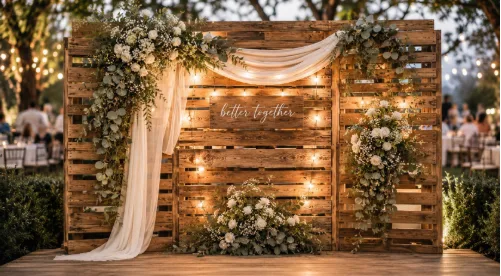
What’s behind the cake is the real question. I’ve moved a ceremony backdrop to the cake table more than once, and if there’s a plain wall in a hall in Flatiron or a loft in Bushwick, a small hanging piece or a simple drape fixes it. Whatever it is, it should be there before the cake arrives, because once the cake’s on the table nobody’s moving anything.
Sugar flowers, and when to let the baker win
Sometimes the right flowers on the cake aren’t flowers. A baker who does sugar work can make peonies that look better than peonies and never wilt, and if the couple wants a fully covered cake that still gets served, that’s the answer. I don’t fight it. I’ll send over the palette and a few real stems so the sugar ones match the room, and I’ll do the cake table and leave the cake alone. A wedding florist in Brooklyn I work with often says that the best thing she ever did for a cake was not touch it. Fair.
Anyway. From Cobble Hill to Hoboken to the big venues up in Westchester, the wedding floral designer in NYC worth hiring will treat the cake like what it is. Food, with flowers on it. Not the other way around.