From Raw Materials to Roofing: Inside APP Waterproofing Membrane Manufacturing
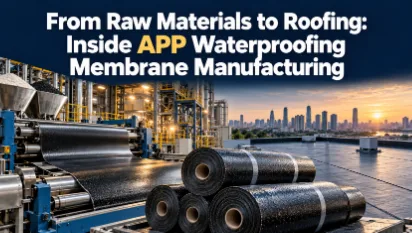
A waterproofing membrane looks straightforward when delivered to a building site: a tightly wound roll ready to cover a roof. Its performance, however, begins long before installation. Raw material selection, polymer blending, reinforcement, coating, and testing all influence how the finished sheet behaves under demanding conditions.
Understanding this manufacturing journey helps buyers evaluate products beyond appearance or price. It also explains why membranes with similar dimensions can deliver different results. From the first batch of bitumen to the final packaging label, dependable production relies on consistency, traceability, and careful control.
Understanding the Role of APP
APP stands for atactic polypropylene, a polymer used to modify bitumen. Bitumen provides the waterproofing compound, while the polymer changes its behavior, particularly its response to heat. The finished material combines this modified compound with reinforcement and suitable surface finishes.
APP membranes belong to the plastomeric family of modified bitumen products. Their properties differ from those of membranes modified with SBS, or styrene butadiene styrene, which introduces elastomeric characteristics. Neither designation alone establishes quality; the complete formulation and verified product performance matter.
For buyers researching an APP waterproofing membrane manufacturer, understanding these distinctions provides a useful starting point. Product selection should follow project requirements, rather than assumptions that every modified bitumen roll serves the same purpose.
Selecting and Checking Raw Materials
Manufacturing starts with incoming materials that meet defined purchasing specifications. Bitumen must be compatible with the intended polymer system. Polymer quality, reinforcement consistency, fillers, and surface materials also influence processing and finished membrane characteristics.
Mineral fillers can adjust compound behavior, but their amount must suit the formulation. Adding more filler does not automatically improve quality. Manufacturers need a balanced recipe that supports coating consistency, handling, and the declared performance of the product.
Incoming checks may include supplier documentation, material identification, moisture assessment, and laboratory evaluation. Retained samples and batch records help investigate problems later. When a material changes, even slightly, production teams should assess its effect before assuming the existing process will produce identical results.
Traceability is especially useful when several deliveries arrive during a large project. If installers report an unusual surface or handling issue, batch identification allows the supplier to review production records and retained samples. This creates a practical link between site observations and factory decisions. Without that link, identifying whether a problem arose during manufacturing, transport, storage, or application becomes considerably harder for everyone involved in the investigation.
Blending Bitumen Into a Controlled Compound
The selected bitumen is heated until it can be processed and blended. APP and other formulation ingredients are introduced under controlled conditions. Mixing must distribute the polymer effectively throughout the compound while maintaining a workable consistency.
Temperature, mixing intensity, and processing time require coordination. Insufficient blending can produce uneven material, while unnecessary heat exposure can damage the compound. There is no single processing temperature appropriate for every factory or formulation.
Laboratory and production checks help establish when a batch is ready for coating. Depending on the quality plan, these may examine viscosity, softening behavior, or other indicators. The goal is repeatability: each approved batch should remain within the established manufacturing limits for that specific product.
Building Strength With Reinforcement
The reinforcement forms the internal framework of the membrane. Common options include polyester, glass fiber, and composite carriers. Their characteristics affect tensile behavior, elongation, dimensional stability, and resistance to handling stresses.
Polyester reinforcement is often selected where movement accommodation and mechanical performance are important. Glass fiber can support dimensional stability. Composite carriers combine materials to achieve a particular balance, but their suitability still depends on the finished membrane specification.
During production, the carrier moves through the line under controlled tension. Wrinkles, misalignment, or inconsistent feeding can create defects that coating alone cannot correct. Careful handling keeps the reinforcement positioned properly and helps maintain a uniform sheet across the full production width.
Applying the Waterproofing Layers
The reinforcement passes through equipment that impregnates and coats it with the modified bitumen compound. The objective is effective integration between the carrier and surrounding material, with suitable coverage on both sides.
Coating controls regulate the sheet profile and target thickness. Production speed must match compound flow, reinforcement behavior, and cooling capacity. Increasing output without adjusting these relationships can undermine consistency.
Thickness deserves particular attention because nominal measurements do not tell the entire story. Surface granules, films, and reinforcement can influence readings. Buyers should understand the stated measurement method and permitted tolerances. A heavier roll is not automatically a better membrane, especially when differences arise from filler content rather than a more suitable formulation.
Adding Surface Finishes and Cooling
Surface treatments depend on the membrane’s intended position within the roofing assembly. Mineral granules can provide exposed surfacing, while sand, mineral powder, or films may support handling and prevent unwanted sticking in the roll.
Some torch applied products include a heat fusible film underneath. Surface design must also accommodate reliable overlaps, since seam areas need appropriate preparation and bonding. Buyers should check whether a product is intended as an exposed cap sheet, a protected layer, or another specified component.
After surfacing, the membrane cools before winding. Controlled cooling helps stabilize the sheet and prevent deformation. Winding tension also matters: excessively loose or tight rolls can create storage and handling problems before installation begins.
Testing the Finished Membrane
A credible quality program checks finished products against declared specifications and applicable test methods. Visual inspection can identify surface defects, but laboratory testing provides evidence that appearance cannot supply.
Useful performance checks may address:
- Thickness, dimensions, and mass consistency.
- Tensile strength and elongation.
- Flexibility at specified low temperatures.
- Resistance to flow at elevated temperatures.
- Watertightness and dimensional stability.
The exact test package depends on the product, market, and intended application. Results should identify relevant methods and conditions, rather than present unexplained numbers. Buyers comparing suppliers should also distinguish routine factory checks from independent certification. Neither a polished brochure nor an isolated laboratory result demonstrates consistent performance across every production batch.
Comparing APP and SBS Production Choices
An SBS waterproofing membrane manufacturer follows a broadly similar sequence of blending, reinforcement coating, surfacing, and winding. However, polymer chemistry changes processing requirements and influences the performance profile that the formulation seeks to achieve.
An SBS modified bitumen waterproofing membrane is commonly associated with elastic recovery and flexibility, while APP formulations are commonly selected for their plastomeric behavior and heat performance. These are general tendencies, not substitutes for technical evaluation.
Climate, substrate movement, installation method, and the complete roof assembly should guide comparisons. Manufacturers offering both categories should provide separate technical data and application instructions, enabling buyers to compare tested products instead of relying on simplified labels.
Consider a warehouse roof where procurement teams receive two apparently comparable offers. One supplier provides only roll dimensions and a price; the other supplies documented performance, clear application limitations, and batch identification. The second offer gives the project team a stronger basis for evaluation, although the material must still match the design. This approach replaces guesswork with evidence and makes purchasing discussions more useful for all parties.
Following Quality From Factory to Roof
Manufacturing quality must survive transport, storage, and installation. Clear labels should connect each roll to its product designation and production batch. Packaging should protect the membrane, while storage instructions should explain positioning, weather protection, and handling requirements.
Before ordering, ask for current technical data, relevant test evidence, installation guidance, and traceable batch information. Confirm compatibility with the proposed substrate, insulation, and other roofing components.
Finally, remember that a well manufactured membrane still depends on sound roof design and competent workmanship. Drainage, detailing, overlaps, and installation conditions all affect the completed system. Understanding the factory process gives buyers better questions to ask and helps turn a simple roll of material into a carefully specified waterproofing solution.