CardPrice Brings Card Scanning and Collection Tracking Together for TCG Collectors
Card identification and collection records in one workflow
Collectors who manage Pokémon cards often switch among several tools: one to identify a card, another to check prices, and a spreadsheet or notes app to remember what they own. CardPrice brings those jobs together through its online card database and companion iPhone app. The platform is designed to help users identify trading cards, review estimated market values, and save their cards to a collection they can revisit. The key idea is straightforward: a lookup is more useful when it also becomes an accurate record.
A mobile-first way to process physical cards
The CardPrice app uses a phone camera to identify cards and offers continuous scanning for people working through stacks or binder pages. According to its App Store listing, confident matches can be saved as the user keeps scanning, while uncertain identifications can be confirmed manually. This makes scanning practical for a collector who wants to catalog a box of cards without typing every name and number. Users should still confirm variant details, since similar artwork can appear across multiple printings and price categories.
From individual estimates to a collection picture
CardPrice’s website provides Pokémon card pricing information and historical charts. The platform also includes graded-card values and population information that can be helpful when researching specific cards. Within the app, saved cards form a tracked collection with an estimated value over time. Additional features described in the listing include purchase-cost tracking, alerts, and tools for monitoring notable changes in the cards a user owns. The figures are informational estimates, not a promise of a sale price or a recommendation to buy a particular collectible.
When an app value meets a real transaction
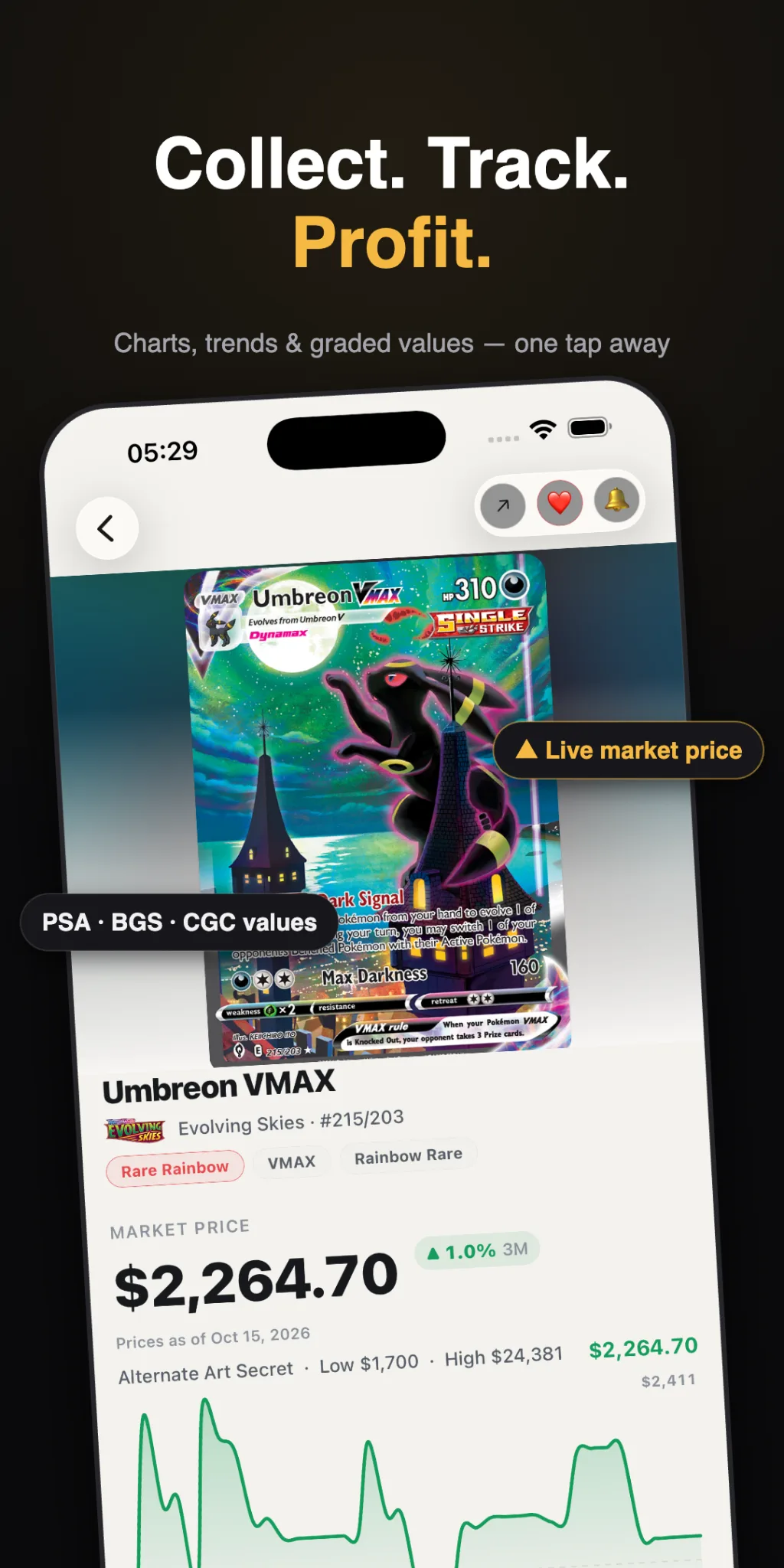
The Evolving Skies Umbreon VMAX #215/203 shows the difference between a valuation screen and a real market. A near-mint transaction appeared at $2,455 on October 12, 2026 in PriceCharting’s tracked TCGplayer records. On October 10, an eBay transaction was $2,289.15. That is not a contradiction: marketplaces, buyer confidence, condition and the exact listing affect what people pay. A responsible portfolio tracker gives owners a practical starting point, while the decision to sell or insure still calls for a look at comparable completed sales.
Market evidence: Completed-sale record 1
The practical lesson is to identify a printing before making a decision. For a closer look at the catalog and pricing tools, explore CardPrice.com. To scan cards and save them while sorting a collection, the CardPrice iPhone app provides the mobile workflow.
Why accuracy matters
Two cards that share a character or illustration may have different values because of their set, finish, language, or edition. A collector who selects the wrong printing can end up with a misleading portfolio total. For that reason, CardPrice’s confirmation step is as important as its speed. The company advises that market figures can be delayed and may differ from realized sales. Independent condition checks and recent completed-sale comparisons remain important for expensive cards or purchases where a small difference in condition matters.
A collector’s research session, from one card to the whole collection
Imagine a collector finds an Umbreon VMAX #215/203 in a binder and wants to decide whether to keep, sell or grade it. First, they confirm the printing and inspect its condition. Next, they review the CardPrice card-detail screen and its historical chart, remembering that the figure is an estimate rather than an offer. Then they save the exact card in their collection so it appears in the portfolio view. If they would rather buy a different card later, they can put that exact printing on a wish list. These are three separate decisions—identification, recordkeeping and purchasing—and they deserve to stay separate.
Available through the website and App Store
People can search the platform on the web at https://cardprice.com and access the iPhone app through https://apps.apple.com/us/app/cardprice-tcg-card-scanner/id6814949740. CardPrice describes collection synchronization between the website and the mobile app, allowing collectors to scan near their physical cards and review their holdings elsewhere. The App Store listing includes a free tier with a monthly identification limit and an optional paid subscription. Pricing and available features should be checked in the current listing before subscribing.
An everyday use case
Figure: Actual CardPrice app screen provided by CardPrice. Prices displayed in the interface are screenshots, not live quotes.
Imagine finding a binder that has not been opened in several years. Before making decisions about selling or grading, the owner needs to know what is in it. With a scan-and-save workflow, cards can be identified and organized progressively. The collector can then review the estimated collection value, flag unusual variants for closer inspection, and track new additions as they arrive. The benefit is not a guaranteed increase in value. It is a clearer, more usable inventory that saves time during future searches and trades.
For collectors at different stages
Someone opening their first few packs may mainly need a quick way to identify what they pulled. A longtime collector may have hundreds of cards that need sorting. A graded-card enthusiast may pay closer attention to population data and differences between grades. Those are distinct needs, but they can all benefit from accurate card records. The most useful starting point is often a small test: scan a few cards, verify their details, and save them. From there, decide which advanced features matter rather than assuming every collector needs the same workflow.
Looking beyond the headline number
A collection total can be a helpful summary, but it is only as accurate as the cards entered and the estimates available for them. Missing entries, incorrect quantities, and mismatched versions can all distort a figure. Owners should periodically audit a few entries against the cards themselves, especially if an estimated value changes sharply. For anyone preparing to sell, inventory accuracy comes first and realized prices come later. A digital tracker is a useful organizational starting point, not an appraisal certificate or a guaranteed cash offer.
The wider context
More collectors are managing mixtures of modern releases, vintage printings, and graded products. Keeping those categories straight requires more than a single static list. CardPrice’s combination of scanning, search, and collection tracking offers one approach to that challenge. As with any pricing service, users are best served by confirming card details and treating valuations as estimates. For hobbyists who want an organized starting point, a connected scanner and digital collection can make maintaining their cards significantly simpler.
What a connected collection record changes
Consider how easily a collecting session can fragment into separate tasks. Someone photographs a card to ask friends about it, searches several websites for a price, writes the result on a note and later forgets where that note went. Each tool may have done its job, but the information never became a usable inventory. A connected workflow reduces that friction by moving from identification to research to saving the card in one sitting.
That matters for new collectors and experienced ones in different ways. A beginner gets help distinguishing the correct version of a card from lookalikes. A long-time collector can work through storage boxes, track duplicates and keep a clearer picture of how an assortment of sets contributes to overall collection value. CardPrice’s iPhone scanning app and website offer two entry points into that process: one centered on the physical card, the other on searching and reviewing market data.
The caveat is the same one collectors have always faced. A digitally identified card is not a guarantee of condition, authenticity or resale price. Valuable pieces should be inspected carefully, and sellers should verify completed transactions rather than rely solely on optimistic listings. Used responsibly, the technology helps people spend less time sorting scattered notes and more time enjoying the history, artwork and stories that made them collect in the first place.
What to check before acting on a number
When evaluating a portfolio total, remember that a market estimate is not guaranteed liquidation proceeds. Selling fees, grading labels, condition, shipping and the time needed to find buyers can all change the amount a collector actually receives.
For collectors who want to follow up rather than rely on a single price screenshot, these tools help keep research and ownership organized. For a closer look at the catalog and pricing tools, explore CardPrice.com. To scan cards and save them while sorting a collection, the CardPrice iPhone app provides the mobile workflow.