Furnace Won’t Turn On in Brooklyn? 7 Reasons Your Furnace Is Not Starting and What to Check First
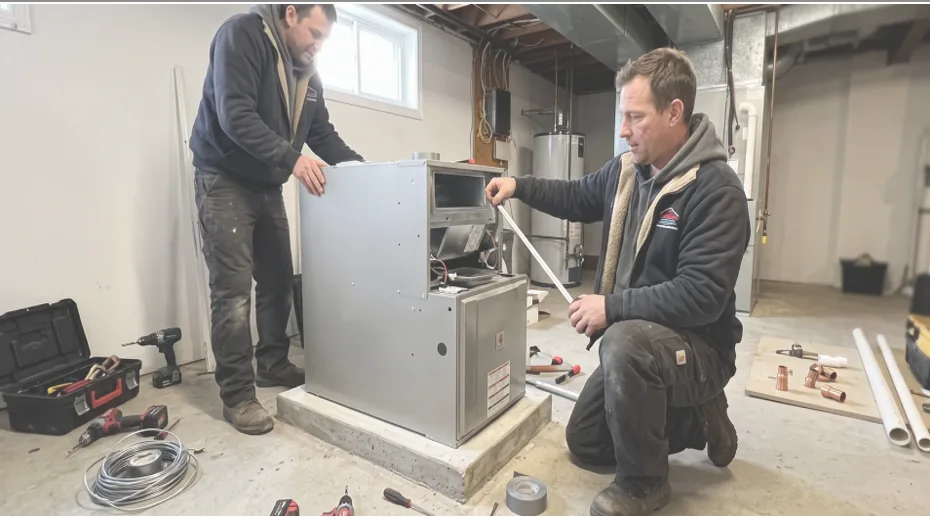
The thermostat is set to 70, the house reads 61, and the furnace in the basement sits silent. No blower, no click, no burner. A furnace that will not turn on at all is a different problem from one that runs cold, and it is the most common furnace repair Brooklyn homeowners search for on the first freezing night of the year. About half the time the fix involves no parts. Here is what to check, in order.
Thermostat Settings, Batteries, and Wiring
Set the thermostat to Heat and raise the setpoint five degrees above room temperature. Listen for a click at the thermostat and a relay click at the furnace a few seconds later. No click means the call for heat is not reaching the furnace. Replace the batteries in a battery-powered thermostat. A smart thermostat that lost its C-wire power shows a blank screen and calls for nothing. Loose low-voltage wires at the thermostat base, chewed by a mouse in a Midwood basement wall or pulled during a paint job, break the circuit. The R and W terminals jumped with a short wire at the furnace board will start a working furnace, which is how a technician separates a thermostat problem from a furnace problem in thirty seconds.
Power Switch, Breaker, and Furnace Door
Every furnace has a service switch that looks like a light switch, mounted on the unit or the wall next to it. Someone bumps it off, a painter flips it, a kid finds it. Check it. Check the breaker panel for a tripped 15-amp or 20-amp breaker labeled furnace, and reset it once. A breaker that trips again points at a shorted blower motor or a failed inducer. The blower compartment door has a safety switch that cuts power when the door is off or not seated. A filter change that left the door a half inch ajar is a classic no-start, and Bensonhurst basements with a filter slot right at the door produce that call every November.
Furnace Control Board Fault Codes
A furnace with power and a call for heat that still does nothing usually has a fault stored on the control board. An LED on the board flashes a code, visible through the sight glass in the blower door. The legend is on the inside of the door panel. Two flashes might be a pressure switch stuck open, three a limit switch, four an ignition failure, depending on the brand. Carrier, Goodman, Lennox, and Rheem each use their own codes. Cycling power at the service switch for 30 seconds clears a soft lockout. The code that returns after the reset is the one to chase.
Pressure Switch, Inducer Motor, and Blocked Vents
The ignition sequence starts with the inducer motor, the small fan that pulls combustion air through the heat exchanger and pushes exhaust out the flue. It runs first. If it does not start, the board stops the sequence and nothing else happens. Inducers fail from worn bearings and seize, and a humming inducer that never spins is done. If the inducer runs but the pressure switch cannot prove draft, the board also stops. Causes are a blocked flue or intake, a cracked pressure switch hose, a clogged condensate trap on a high-efficiency furnace, and ice or a bird nest in the PVC on the outside wall. Brooklyn row houses with a flue that terminates near a neighbor’s wall collect snow and leaves in the pipe every winter.
Ignition Failure: Igniter, Pilot, and Flame Sensor
If the inducer runs, the pressure switch closes, and the igniter should glow. A hot surface igniter that stays dark is cracked or has lost its connection. Igniters fail every five to seven years on a furnace that runs hard. A standing pilot furnace from before 1995 needs the pilot lit, and a thermocouple that cannot hold the pilot open leaves the furnace dead. A furnace that lights for a few seconds and shuts down has a dirty flame sensor, and the board locks out after three tries. The gas valve itself fails rarely, but a valve that gets 24 volts from the board and does not open is a gas valve replacement. Listen for the click of the valve opening when the igniter is at full glow.
Limit Switches and Rollout Switches
A high limit switch that tripped and failed open stops the furnace from lighting at all. A rollout switch, which trips when flames leave the burner compartment, usually has a manual reset button. A tripped rollout means something pushed flame backward: a cracked heat exchanger, a blocked flue, or a dirty burner. Resetting it without finding the cause is the kind of thing that puts carbon monoxide in a house. Any tripped rollout earns a technician visit and a combustion check before the furnace runs again.
Gas Supply and the National Grid Meter
Check that the gas valve on the supply line is open, handle parallel to the pipe. A National Grid meter locked after a gas leak report or a missed Local Law 152 inspection on a larger building leaves every gas appliance dead. Low gas pressure during a cold snap in some older Brooklyn mains shows up as a furnace that lights weakly or drops out, and that one is a utility call.
Picture a Dyker Heights homeowner with a silent furnace on a 20-degree morning. The thermostat is fine. The service switch is on. The board shows a pressure switch code. The technician finds the exhaust PVC packed with snow blown in from the neighbor’s shoveling. Ten minutes with a shop vac and the furnace lights. A screened termination kit goes on the pipe so the next storm stays out.
Brooklyn HVAC Company | AC & Furnace Repair
5305 13th Ave, Brooklyn, NY 11219
(929) 833-7835