Gas Cost Calculator: Estimate Your Fuel Costs Instantly (2026)
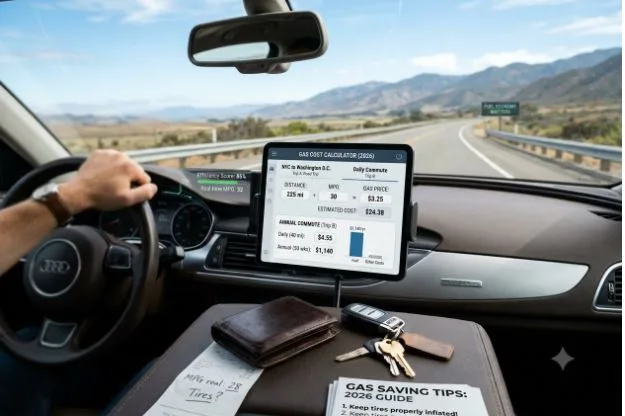
A gas cost calculator works out how much you’ll spend on fuel using three numbers: your trip distance, your car’s miles per gallon, and the current price of gas. Divide distance by mpg to get gallons needed, then multiply by the price per gallon. That’s the whole formula everything else is just context around it.
Most people run this math once before a road trip and forget about it. But if you commute daily, gas adds up in ways that surprise people when they actually sit down and calculate the annual total. Below is the formula broken down step by step, two worked examples, and the factors that actually move your number up or down.
How to Calculate Gas Cost (The Formula Explained)
The math itself is simple:
Trip Cost = (Distance ÷ MPG) × Price per Gallon
That’s it. Three inputs, one calculation.
Step-by-Step Manual Calculation
- Find your trip distance in miles (round trip or one-way decide which you’re calculating)
- Check your car’s mpg rating (or your own average from past fill-ups)
- Divide distance by mpg this gives you gallons needed
- Multiply gallons by the current price per gallon in your area
- That number is your estimated fuel cost
The only tricky part is getting an accurate mpg figure. The number on your car’s window sticker is a manufacturer estimate under ideal conditions. Your actual mileage especially in city traffic or hilly terrain is usually a bit lower.
Real-World Examples
Numbers make more sense with actual scenarios attached to them, so here are two common ones.
Road Trip Example
Say you’re driving from New York City to Washington D.C. about 225 miles in a car that averages 30 mpg, with gas running $3.25 a gallon.
- 225 miles ÷ 30 mpg = 7.5 gallons
- 7.5 gallons × $3.25 = $24.38 one way
Double that for the round trip if gas prices stay roughly the same along the route: about $48.75 total. If you’re crossing state lines where prices differ noticeably, it’s worth calculating each leg separately rather than assuming one flat rate for the whole trip.
Daily Commute Example
Commuting costs sneak up on people because nobody calculates them until they’re already annoyed about a gas bill.
Let’s say you live 20 miles from work, so your daily round trip is 40 miles. You drive a Honda Civic that gets about 36 mpg, and gas costs $4.10 a gallon where you live.
- 40 miles ÷ 36 mpg = 1.11 gallons
- 1.11 gallons × $4.10 = $4.55 per day
Over a typical work year (five days a week, 50 weeks), that’s roughly $1,140 annually just for getting to and from work. For a lot of households, that lands right in the middle of transportation being the second-biggest budget category after housing.
What Affects Your Gas Cost the Most?
Two variables move the needle more than anything else: your mpg and the price at the pump. But there’s more going on underneath both.
MPG (Fuel Efficiency)
A car getting 20 mpg burns 50% more fuel than one getting 30 mpg over the same distance. That gap alone can be the difference between a $30 tank and a $45 tank on the same trip. City driving, cargo weight, a roof box, and short stop-and-go trips all drag real-world mpg below the rated number.
Gas Price Fluctuations (Crude Oil, OPEC, Seasonal Demand)
Gas prices aren’t random they mostly track the price of crude oil, which typically makes up more than half of what you pay at the pump. When OPEC (the group of major oil-producing nations) adjusts production, or when geopolitical events disrupt supply, prices respond fairly quickly. Seasonal demand plays a role too prices often climb heading into summer travel season and ease off in the fall.
None of this changes your calculation day-to-day, but it explains why the number you get in January might look different by July.
Driving Style & Conditions
Aggressive acceleration, high speeds, excessive idling, and underinflated tires all quietly reduce your mpg. None of these show up in a manufacturer’s rating, which is part of why your real-world number rarely matches the sticker.
How to Reduce Your Gas Costs (Practical Tips)
A few habits make a measurable difference over time:
- Keep tires properly inflated: underinflated tires increase rolling resistance and fuel use
- Use cruise control on highways: steady speeds burn less fuel than constant acceleration and braking
- Avoid unnecessary idling: modern engines don’t need a long warm-up
- Combine errands into one trip instead of several short drives
- Remove excess weight and roof racks: when you’re not using them
- Compare gas station prices nearby:a few cents per gallon adds up over a year of fill-ups
None of these are dramatic changes, but stacked together they can shave a meaningful percentage off your annual fuel spend.
Frequently Asked Questions
What’s the formula for calculating gas cost?
Divide your trip distance by your car’s mpg to get gallons needed, then multiply by the price per gallon. Distance ÷ MPG × Price = Cost.
Should I calculate round trip or one-way?
Either works just be consistent. If you’re budgeting for a full trip, use the round-trip distance. If you’re comparing route options, one-way numbers are easier to compare directly.
How accurate is a gas cost calculator?
It’s an estimate, not an exact figure. Real mpg varies with driving conditions, and gas prices can differ between towns along your route, so treat the result as a solid ballpark rather than a precise total.
How do I split gas costs with passengers?
Calculate the total trip cost using the formula above, then divide it evenly by the number of people sharing the ride or split proportionally if some passengers are getting out partway through the trip.
Does highway driving use less gas than city driving?
Generally yes. Highway driving involves steadier speeds and less stop-and-go, which tends to produce better mpg than city traffic with frequent braking and idling.
Final Thoughts
The math behind a gas cost calculator isn’t complicated it’s the same three-number formula whether you’re planning a cross-country drive or just trying to understand what your commute actually costs over a year. The real value is in checking your assumptions: a slightly lower real-world mpg or a price jump at the pump can shift your total more than people expect. Run the numbers before your next trip, and you’ll have a much clearer picture of what you’re actually spending on gas.