Pregnancy Calculator: Find Your Due Date & Track Every Week (2026 Guide)
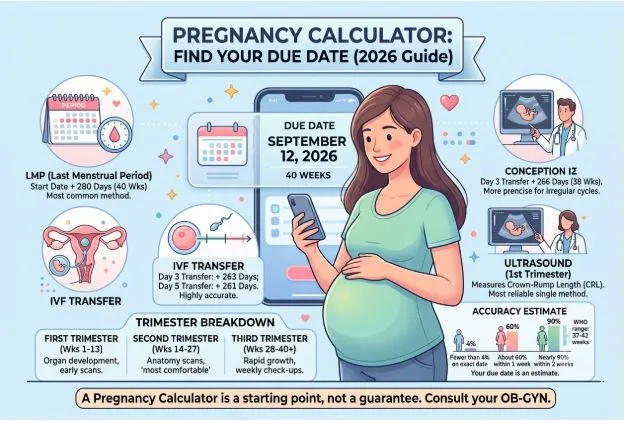
A pregnancy calculator estimates your due date by adding a set number of days to a known reference point your last period, conception date, IVF transfer date, or an ultrasound scan. Most calculators use 280 days from your last menstrual period, though the exact method changes depending on what information you have available.
Whether you just found out you’re expecting or you’re already deep into your second trimester, a pregnancy calculator is usually the first tool people reach for. But not all methods give you the same level of accuracy and understanding why your due date is really just an educated estimate can save you a lot of unnecessary stress later on.
How Does a Pregnancy Calculator Work?
Every pregnancy calculator works in a simple way. It takes a date that you know. Adds a certain number of days. This is because most pregnancies last around 280 days or 40 weeks from the start of the menstrual cycle. The way you figure out your date with a pregnancy calculator depends on what you already know about your pregnancy. You use the information you have to calculate when your baby is expected to arrive. Pregnancy calculators are all based on the idea of pregnancy lasting, around 280 days or 40 weeks.
LMP (Last Menstrual Period) Method
This is the most widely used method, and it’s the one most home calculators default to.
- Take the first day of your last menstrual period
- Add 280 days (40 weeks), or 9 months and 7 days
This method assumes a textbook 28-day cycle with ovulation happening around day 14. If your cycles run shorter or longer than that, your actual due date can shift by several days in either direction which is one of the biggest reasons LMP-based estimates aren’t perfectly precise for everyone.
Conception Date Method
If you’ve been tracking ovulation through basal body temperature, ovulation predictor kits, or simply because you know when conception likely happened this method tends to be more reliable than LMP alone.
- Take your known or estimated conception date
- Add 266 days (about 38 weeks)
This works well for people with irregular cycles, since it skips the assumption that ovulation happens on day 14.
IVF Transfer Date Method
For pregnancies conceived through IVF, this is by far the most precise method available, because the exact age of the embryo at transfer is already known.
- Day-3 embryo transfer: add 263 days from the transfer date
- Day-5 embryo transfer: add 261 days from the transfer date
Because there’s no guesswork involved in timing, IVF-based due dates are considered highly accurate.
Ultrasound-Based Method
When a woman is pregnant doctors like to do an ultrasound. This usually happens in the trimester. The ultrasound measures how big the fetus is. This helps doctors figure out how far, along the pregnancy is. They do this by measuring the fetus from the top of its head to its bottom.This is really helpful when the woman is not sure when her last period was. It is also helpful if her periods are not regular.
Doing an ultrasound in the trimester is a way to find out when the baby is due. Doctors think this is a way to do it. So they often use it to make sure the due date they thought was right is actually correct. They get this date by asking when the womans last period was. Then they use the ultrasound to confirm it.
Comparison Table : Which Method Is Most Accurate for You?
| Method | Best For | Days Added | Accuracy |
| LMP | Regular 28-day cycles | 280 days | Good baseline, less accurate with irregular cycles |
| Conception Date | Tracked ovulation | 266 days | More precise than LMP alone |
| IVF Transfer | IVF pregnancies | 261–263 days | Very high exact timing known |
| Ultrasound (1st trimester) | Unknown LMP or irregular cycles | Based on fetal measurement | Considered the most reliable single method |
If you’re not sure which method applies to you, a first-trimester ultrasound is generally the most dependable way to confirm your due date, regardless of what a calculator tells you initially.
How Accurate Is Your Estimated Due Date?
Here’s the part most calculators don’t explain clearly: your due date is a statistical estimate, not a prediction of the exact day you’ll give birth.
- Fewer than 4% of babies are born on their exact calculated due date
- About 60% of babies arrive within a week of the estimated date
- Nearly 90% arrive within two weeks of the estimated date
- The World Health Organization defines a full-term pregnancy as anywhere between 37 and 42 weeks
In other words, your due date is better thought of as the midpoint of a range rather than a fixed deadline. Factors like the mother’s age, whether it’s a first pregnancy, and individual variation in pregnancy length all play a role in how far the actual birth date can drift from the estimate.
What Happens After You Calculate — Trimester Breakdown
Once you have an estimated due date, it helps to understand where that places you in your pregnancy journey:
- First trimester (Weeks 1–13): Major organ development begins; this is when early ultrasounds are most useful for confirming your due date
- Second trimester (Weeks 14–27): Often called the most comfortable stage; anatomy scans typically happen around week 20
- Third trimester (Weeks 28–40): Rapid weight gain and final development; weekly check-ups usually begin in this stage
Knowing your trimester helps you plan prenatal appointments, screenings, and milestones without having to recalculate every time you get new information.
Can Your Due Date Change? Factors That Affect It
Yes and it’s more common than people expect. Your due date can be adjusted if:
- An early ultrasound suggests a different gestational age than your LMP calculation
- Your cycle length is significantly shorter or longer than 28 days
- You conceived through IVF and your due date is later reconciled with an ultrasound
- New measurements during prenatal visits suggest the baby is developing on a different timeline
Doctors generally trust early ultrasound dating over LMP when the two disagree by more than about a week, since fetal measurement tends to be more precise in the first trimester.
Frequently Asked Questions
How is my due date calculated?
Most calculators add 280 days to the first day of your last menstrual period, assuming a 28-day cycle. If you know your conception date or had an early ultrasound, those methods tend to be more accurate.
What if I don’t remember my last period date?
An early ultrasound can estimate gestational age from fetal measurements, giving a reliable due date even without an LMP reference.
Is a pregnancy calculator accurate for irregular cycles?
LMP-based calculators are less reliable with irregular cycles. In that case, the conception date method or an ultrasound will give you a more accurate estimate.
Can I use a pregnancy calculator for twins or multiples?
Standard calculators still use the same LMP or conception-based formulas, but pregnancies with multiples often deliver earlier than the standard 40-week estimate, so your doctor may adjust expectations accordingly.
How many weeks pregnant am I today?
Pregnancy is counted in gestational weeks starting from the first day of your last period not the day of conception which is why you’re technically considered a couple of weeks pregnant before conception actually occurs.
Final Thoughts
A pregnancy calculator is a genuinely useful starting point, but it works best when you understand which method fits your situation and treat the result as an estimate rather than a guarantee. If your due date is uncertain, irregular, or based on incomplete information, an early ultrasound remains the most reliable way to confirm it. As always, your OB-GYN or midwife should be your final source of truth as your pregnancy progresses.