Google Veo 4 and Gemini Omni: The New Frontier of Conversational AI Video Generation
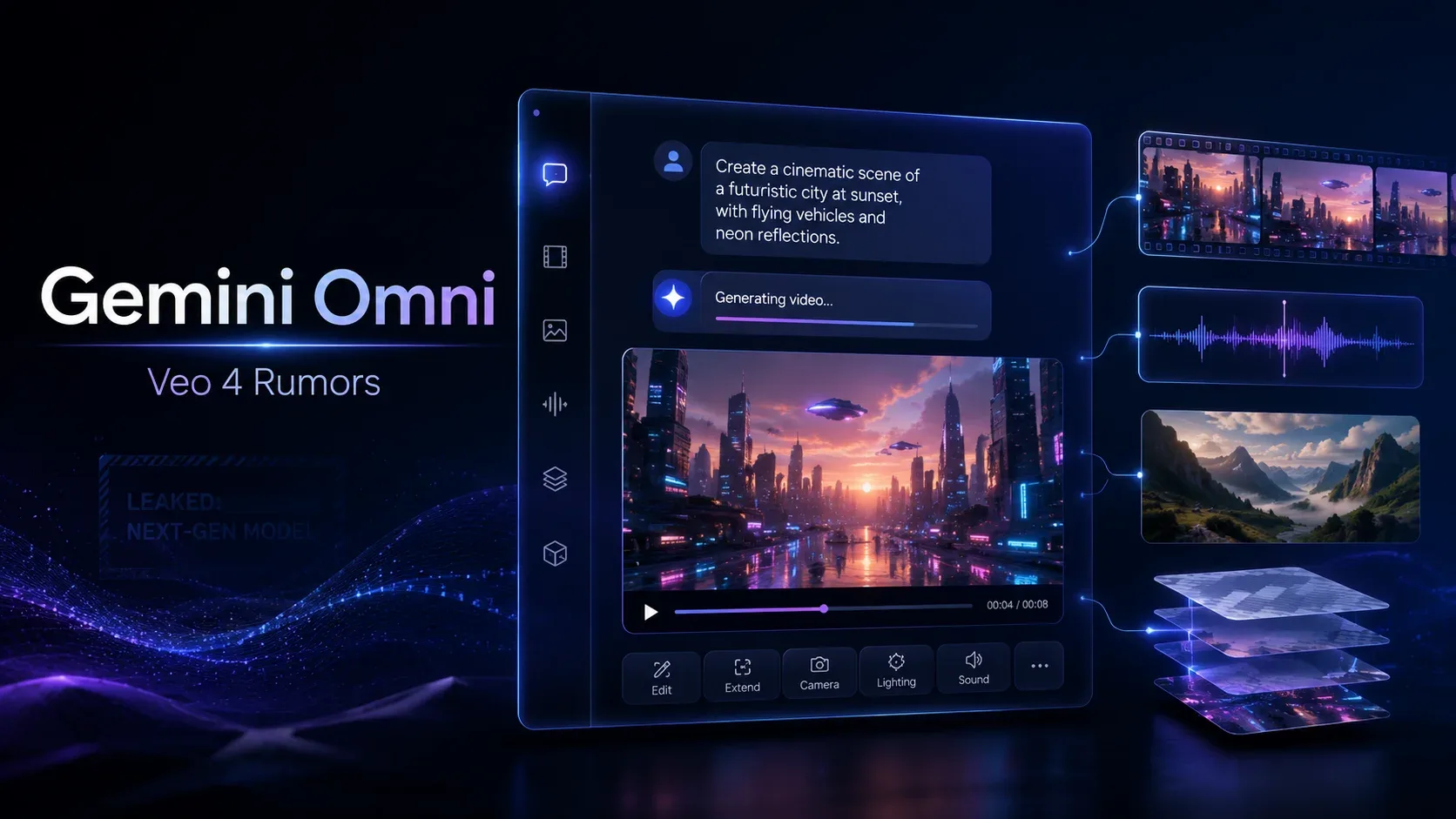
The generative artificial intelligence landscape is currently locked in a high-stakes arms race, specifically within the realm of video synthesis. As industry leaders like OpenAI and ByteDance push the boundaries of realism with Sora 2 and Seedance 2.0, all eyes have shifted toward Mountain View. While Google’s official documentation still champions Veo 3.1 as its state-of-the-art video foundation model, a series of high-profile leaks have surfaced just days before the highly anticipated Google I/O 2026 conference.
The center of this storm is a rumored model dubbed Gemini Omni. Emerging reports suggest that this isn’t just a minor iteration of previous technology, but a fundamental redesign of how humans interact with video AI. Whether Gemini Omni is the internal codename for what the public expects to be Google Veo 4, or a new conversational layer built atop it, the implications for creators and developers are profound.
The Anatomy of the Gemini Omni Leak
The buzz began when prominent tech publications, including 9to5Google, Android Authority, and Gadgets 360, reported that a select group of Google AI Pro subscribers briefly saw a new interface option: “Create with Gemini Omni.” The UI was accompanied by a bold promise: “Meet our new video generation model. Remix your videos, edit directly in chat, try a template, and more.”
This leak reveals a strategic pivot for Google. Most current AI video tools operate on a “prompt-and-pray” basis—you input a text string and hope the black box outputs something usable. If you want a change, you usually have to start over. Gemini Omni appears to introduce a conversational editing workflow. By allowing users to “edit directly in chat,” Google is moving toward a world where the AI acts more like a junior film editor than a static generator.
As the digital community prepares for this shift, early-access portals and information hubs such as Gemini Omni have emerged to help creators track the latest API documentation and deployment schedules for these next-generation tools.
Is Gemini Omni Actually Veo 4?
To understand the technological significance, we must look at the “Veo” lineage. Google Veo 3.1 was a milestone, introducing native audio synchronization and high-fidelity 4K upscaling. However, metadata discovered in recent web leaks—specifically the tag VEO_MODE_OMNI—suggests that “Omni” is the bridge between the raw power of the Veo architecture and the intuitive interface of Gemini.
In technical terms, industry insiders speculate that Veo 4 (operating under the Omni branding) might be Google’s first truly native multimodal video model. Unlike current systems that might use a language model to interpret a prompt and then hand it off to a separate diffusion model to generate pixels, a native multimodal model processes text, image, and video data within the same neural network space. This “omni-channel” processing reduces the loss of intent that often happens during hand-offs between disparate models, leading to video that more accurately reflects complex, multi-layered prompts.
Analyzing the Leaked Demos: Realism vs. Physical Consistency
Two specific video demos have been circulating within developer circles, providing a glimpse into the model’s capabilities and its remaining hurdles.
The “Mathematical Proof” Demo
In this clip, a professor is seen writing a complex trigonometric identity proof on a traditional green chalkboard. For the AI video world, this is a “stress test.” It requires:
- Temporal Consistency: The chalk must stay in the hand.
- Text Rendering: The equations must remain legible and mathematically correct as they are written.
- Human Motion: Hand and arm movements must look natural, not jittery.
Early observers noted that the text rendering was surprisingly crisp—a feat that has eluded many current-generation models. This suggests that Google has integrated a much stronger understanding of symbolic logic into the video generation process.
The “Spaghetti Dinner” Demo
The second demo features two men dining at a seaside restaurant. This clip focuses on fluid dynamics and object interaction. Eating is notoriously difficult for AI because it involves the interaction of soft bodies (food), rigid bodies (forks), and complex human anatomy (mouths and lips).
While the lighting and textures were described as “cinematic” and “indistinguishable from reality,” minor “hallucinations” were still present—spaghetti strands occasionally clipping through the fork or appearing out of thin air. For professional creators, these demos suggest that while Gemini Omni is a massive leap forward, we are still in the era of “assisted creation” rather than “perfect automation.”
The Economic Reality: Compute Costs and Usage Limits
One of the most revealing aspects of the leak wasn’t the video quality, but the usage meter. A leaked screenshot showed that generating just two high-quality Omni videos consumed roughly 86% of a user’s daily Google AI Pro quota.
This highlights the staggering computational cost of next-generation video synthesis. For the solo developer or SaaS entrepreneur, this is a critical data point. It suggests that while the creative ceiling is rising, the “cost per generation” remains a significant barrier to mass-market commercialization. Platforms like Gemini Omni are expected to play a vital role in providing a more accessible entry point for those looking to test these high-compute models without the restrictive overhead of enterprise-level contracts.
If Google maintains this high cost-of-entry, it may signify that Gemini Omni/Veo 4 will initially be positioned as a premium tool for professional studios and high-end marketing agencies, rather than a casual tool for the average social media user.
Strategic Market Positioning: Challenging Sora and Seedance
Google’s timing is not accidental. By teasing Gemini Omni just before Google I/O 2026, the company is attempting to reclaim the narrative from OpenAI’s Sora and ByteDance’s Seedance 2.0.
Where Sora has focused on “world simulation” and long-duration clips, Google seems to be betting on integration and utility. By baking the video model directly into the Gemini ecosystem, Google leverages its existing user base of millions. If you are already using Gemini for coding, writing, or research, having a “video editor” button right there is a powerful incentive to stay within the Google Cloud ecosystem.
Furthermore, the “Remix” feature mentioned in the leak suggests a strong focus on content iteration. In a professional marketing workflow, you rarely get the perfect shot on the first try. The ability to tell the AI, “Keep the same background but change the actor’s shirt to blue,” or “Make the lighting more like a sunset,” is far more valuable to a product manager than a single, unchangeable 60-second clip.
Looking Ahead to Google I/O 2026
As we count down to the keynote on May 19, several questions remain unanswered:
- API Accessibility: Will Google release a “Vertex AI” version of Omni immediately, or will it remain a Gemini-exclusive feature for several months?
- Resolution and Framerate: Will the final version support native 4K at 60fps, or will it rely on upscaling?
- Safety and Watermarking: How will Google implement SynthID to ensure that these hyper-realistic videos aren’t used for misinformation?
What we do know is that the “Omni” era marks the end of the “siloed” AI experience. We are no longer just looking at a “video generator”; we are looking at a multimodal assistant that can see, hear, and create in a unified digital space.
Final Thoughts
The transition from Veo 3.1 to the rumored capabilities of Gemini Omni represents a turning point for the industry. While the name “Veo 4” may still be used for the underlying API, the “Gemini Omni” brand signals Google’s intent to make AI video a conversational, iterative, and accessible part of the creative process.
For developers and creators, the message is clear: the next generation of AI isn’t just about what the model can produce—it’s about how well it can collaborate. As we wait for the official curtains to rise at Google I/O, the leaks have already given us plenty to dream about. The future of video production isn’t just being rendered; it’s being discussed.