Heat Shrink Tubing: Sizes, Uses, and How to Apply It Properly
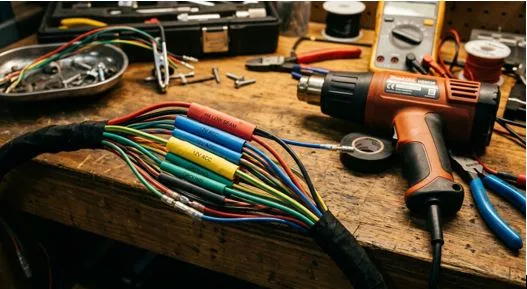
Heat shrink tubing looks like nothing more than a plastic sleeve that shrinks when you heat it. But getting the size right, choosing the right material, and applying it properly makes the difference between a connection that lasts years and one that fails in months.
How heat shrink works
Heat shrink tubing is a cross-linked polymer sleeve that contracts to a fraction of its original diameter when heated. It is one of those small, cheap components that can make or break an electrical installation. A good shrink fit seals a connection against moisture, provides insulation where the cable jacket has been stripped away, and adds mechanical support at the joint.
The tubing is extruded at a larger diameter, then irradiated to create cross-links between the polymer chains, then heated and stretched to its expanded size and cooled rapidly. The cross-links give the material elastic memory — when reheated above its activation temperature (~125 °C for standard polyolefin), it returns to its original diameter. Shrink ratios of 2:1, 3:1 or 4:1 are common, meaning the tubing can shrink to half, a third, or a quarter of its original diameter.
Choosing the right size
The expanded tubing must slide easily over the largest part of the connection, and the fully recovered diameter must be smaller than the wire insulation to form a proper seal. As a rough guide: for standard crimp terminals on 1.5 mm² cable, use 3 mm or 4 mm heat shrink. For 2.5 mm² cable, use 6 mm. For 4 mm² cable and heavy-duty terminals, use 8 mm or 10 mm.
Dual-wall or adhesive-lined heat shrink is worth the extra cost for any connection exposed to the elements. The inner adhesive layer melts and flows into the gaps around the wire and terminal, creating a waterproof seal that standard single-wall tubing cannot match.
Types of heat shrink material
The most common material for automotive work is polyolefin — flexible, excellent dielectric strength, and resistant to common automotive fluids like oil, petrol, and brake fluid. For high-temperature areas near exhaust manifolds or turbochargers, you need fluoropolymer (PTFE or FEP) withstanding 200°C continuous. PVC heat shrink is cheap but less durable and not recommended for engine bay use.
Other specialised types include neoprene (oil-resistant, good for marine applications) and PVDF (thin-wall, high abrasion resistance for aerospace and motorsport wiring).
How to apply heat shrink correctly
Slide the tubing onto the wire before you crimp or solder the connection. Cut it long enough to overlap the cable insulation on both sides by at least 10 mm — this gives the seal room to work. Apply heat evenly from the middle outward to push trapped air out of the ends. Use a proper heat gun set to around 250–300°C, not a cigarette lighter. A lighter creates an uneven flame that can burn the material, cause soot deposits, and prevent a proper seal.
When using adhesive-lined tubing, you will see a small ring of melted adhesive squeeze out at both ends when it is done correctly. That is your visual confirmation of a waterproof seal. Rotate the tubing while heating for even coverage.
When to use heat shrink versus electrical tape
Heat shrink is permanent. It cannot come loose over time, resists oil and fuel, and gives a professional finished look. Electrical tape has its place — it is removable, good for temporary repairs, and useful for bundling wires — but it degrades with heat, gets sticky residue everywhere, and can unravel in tight spaces. The only place tape beats shrink tubing is where you cannot slide a tube over the connection; in that case, use self-amalgamating silicone tape as a permanent alternative.
What not to do
Do not use expired tubing — it loses shrink performance over time. Do not use a drill to spin the wire when applying adhesive-lined tubing, as it twists the inner liner and ruins the seal. Do not assume bargain heat shrink meets the same specifications as recognised brands — cheap tubing often has uneven wall thickness, lower shrink ratios, and poor dielectric strength.
Grease Monkey Direct carries everything you need for professional wiring jobs:
- Heat Shrink Tubing — https://greasemonkeydirect.co.uk/collections/heat-shrink
- Heat Shrink Butt Connectors — https://greasemonkeydirect.co.uk/collections/heatshrink-terminals