How Business Leaders Can Navigate the Next Computing Paradigm
The global quantum computing market is projected to expand into a multi-billion-dollar economy over the next decade, with early corporate adopters poised to capture unprecedented competitive advantages. Yet, for the average executive, quantum technology remains shrouded in dense theoretical physics and abstract jargon. While technical teams grapple with qubits and entanglement, C-suite leaders face a different challenge: how to prepare an organization for a technology that fundamentally alters the mechanics of data processing, optimization, and cybersecurity.
Waiting until quantum hardware reaches complete fault tolerance is a strategic error. The real risk lies not in being late to own the hardware, but in being late to cultivate the internal expertise required to utilize it. Achieving true “quantum readiness” demands that business leaders build workforce literacy today, bridging the gap between high-level business strategy and deep technological execution.
1. Beyond the Hype: The Commercial Reality of Quantum Advantage
For decades, quantum computing was relegated to academic research centers and theoretical labs. Today, the conversation has shifted toward practical business applications across high-impact sectors like logistics, pharmaceuticals, finance, and material sciences.
Classical supercomputers process information sequentially using binary bits ($0$ or $1$). In contrast, quantum computers utilize quantum bits (qubits) that leverage superposition and entanglement to evaluate vast, multi-variable solution spaces simultaneously. For enterprise leaders, this translates directly to solving complex optimization problems that would take conventional computing clusters millennia to compute.
- Supply Chain & Logistics: Real-time route and inventory optimization across global networks with millions of dynamic variables.
- Financial Modeling: Unprecedented precision in portfolio risk analysis, fraud detection, and multi-asset algorithmic trading strategies.
- Chemical & Material Discovery: Simulating molecular interactions at the atomic level to accelerate drug discovery and develop novel battery chemistries.
The organizations already positioning themselves for these breakthroughs are not necessarily building their own quantum hardware; instead, they are investing in intellectual capital and algorithmic readiness.
2. Bridging the Technical Talent Gap in the C-Suite
The primary bottleneck facing the quantum transformation is not a lack of venture capital or cloud-accessible hardware—it is a severe shortage of skilled personnel. Traditional computer science curricula rarely cover quantum mechanics, leaving a distinct disconnect between executive strategic vision and engineering execution.
To mitigate this operational risk, forward-thinking organizations are prioritizing internal upskilling initiatives. Rather than competing in an hyper-expensive recruitment war for scarce PhD-level quantum physicists, enterprises are training their existing workforce—data scientists, software engineers, and domain specialists—to translate business problems into quantum frameworks.
The Power of Practical Educational Frameworks
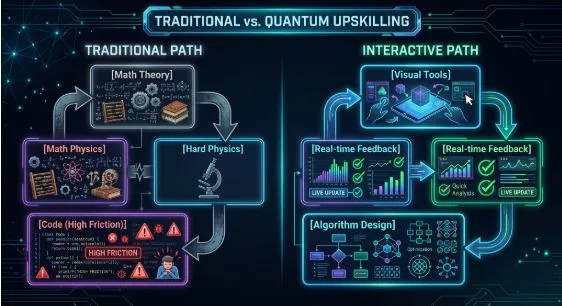
Transitioning classical software developers and business managers into quantum-literate teams requires moving past abstract mathematical equations. Effective upskilling relies on hands-on, intuitive learning models that demonstrate how quantum circuits manipulate data in real time.
When teams leverage specialized educational platforms—such as those that allow employees to learn quantum computing with interactive tools—the learning curve flattens significantly. Interactive visual simulations, real-time circuit feedback, and gamified modules enable technical staff to build intuition around complex concepts like state vector manipulation and quantum error suppression without requiring a doctorate in physics.
By democratizing access to quantum concepts through visual tools, business leadership can quickly evaluate where quantum algorithms yield an immediate ROI versus where classical systems remain sufficient.
3. Executive Blueprint: A 3-Step Strategy for Quantum Readiness
Preparing your business for the quantum era does not require a multi-million-dollar capital expenditure on day one. Instead, it calls for a structured, risk-mitigated approach focused on capability building and strategic alignment.
Step 1: Identify Quantum-Susceptible Use Cases
Audit your enterprise operations to discover where classical computing hits performance ceilings. Look specifically for non-linear optimization bottlenecks, complex simulation needs, or data analytics scenarios where adding more classical computing power yields diminishing returns.
Step 2: Establish Cross-Functional Task Forces
Form a dedicated quantum working group that pairs business domain leaders with internal software developers. This structure ensures that technical upskilling directly serves tangible business goals rather than remaining an isolated experiment.
Step 3: Implement Scalable Enterprise Education
Deploy structured, self-paced learning platforms across your technical and management teams. Setting baseline metrics for quantum literacy across department leaders enables better vendor evaluation, faster identification of third-party integration opportunities, and seamless adoption of cloud quantum processing units (QPUs).
4. The First-Mover Advantage in the Quantum Economy
Disruptive technologies consistently follow a exponential adoption curve. Those who delay building operational capacity until quantum advantage is fully mainstream will find themselves playing catch-up against competitors who spent years sharpening their algorithmic tools and training their workforces.
Quantum computing is no longer a distant theoretical exercise—it is an emerging infrastructure layer. By proactively cultivating internal expertise and leveraging intuitive, interactive educational platforms today, executive leaders can ensure their organizations remain resilient, agile, and ahead of the curve as the next digital revolution unfolds.
What areas of your operational stack face computational bottlenecks that classical hardware struggles to solve? Share your thoughts and strategy in the comments below.