How Digital Traceability Is Changing the Global Food Supply Chain
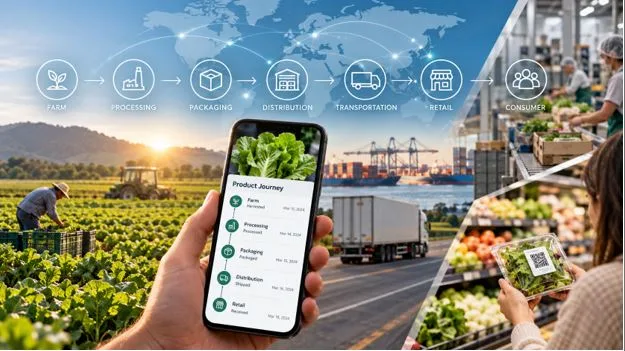
Food can travel thousands of miles and pass through farms, processors, packers, warehouses, distributors, and retailers before reaching the person who eventually consumes it.
The physical supply chain has become increasingly sophisticated. The information moving alongside food, however, has not always kept pace.
Important records may still be spread across spreadsheets, paper documents, supplier portals, ERP systems, emails, and databases that don’t communicate with one another. When something goes wrong, whether it is a contamination event, supplier issue, incorrect shipment, or documentation gap, businesses can find themselves reconstructing the product journey after the fact.
Digital traceability is beginning to change that.
Instead of treating traceability primarily as a record-keeping requirement, agricultural and food businesses are increasingly using connected data to understand where products originated, how they moved, what happened to them, and where they ultimately went.
That shift could make traceability an important part of building safer, more transparent, and more resilient food supply chains.
From fragmented records to connected supply chains
Traceability itself is not new.
Food businesses have long maintained records covering suppliers, purchases, production, inventory, shipments, and customers. The limitation has often been how those records are collected and connected.
Consider a food product moving through a relatively simple supply chain.
A crop is harvested on a farm. It is assigned to a lot, transported to a facility, processed or combined with other material, packaged, stored, and eventually shipped to one or more buyers.
Each stage generates information.
The farm may have records about the crop and harvest. A processor maintains production information. Warehouses record inventory movements. Logistics providers hold shipment information. Buyers maintain their own receiving records.
When these records remain disconnected, tracing a product backward or forward can require information to be collected manually from several parties.
Digital traceability aims to connect those events into a more continuous record.
A lot or batch can be associated with its origin, supplier, production events, transformations, inventory movements, shipments, and destination. Instead of traceability information existing as separate documents, businesses can create a digital chain of events around the product.
The idea is already expanding beyond food. Recent developments in digital product passports have similarly focused on connecting physical goods with digital records containing information such as origin, chain of custody, certification, and lifecycle history.
Why food traceability is becoming more important
Several forces are making better traceability increasingly valuable.
One is the complexity of global food trade.
Agricultural products frequently move through multiple organizations and jurisdictions before reaching their final market. The more participants involved, the harder it becomes to maintain a consistent view of what happened to a product.
At the same time, global food markets are highly interconnected. Disruptions caused by extreme weather, geopolitical events, transportation constraints, production shortages, and other shocks can affect agricultural supply chains far beyond their point of origin.
Traceability does not eliminate these disruptions. What it can do is improve visibility when businesses need to understand where affected products, suppliers, or shipments sit within their operations.
Food safety adds another dimension.
When a potential contamination or quality problem is discovered, organizations need to determine what is affected and where it went. Poorly connected records can make that investigation slower and potentially expand the scope of precautionary actions.
A stronger digital trail can help businesses identify relevant lots, suppliers, processing events, and customers more efficiently.
Finally, buyers, regulators, certification programs, and consumers increasingly expect companies to substantiate claims about where products came from and how they were produced.
That makes traceability data useful beyond the traditional recall scenario.
Traceability is becoming an operational data layer
One of the more significant changes is how businesses can use traceability information.
Historically, traceability could be approached primarily as something that needed to exist in case an auditor, regulator, or customer requested it.
Digital systems make the same information useful during normal operations.
For example, connected traceability records can help teams answer questions such as:
- Which suppliers contributed to a particular finished product?
- Which lots contain material from a specific farm or supplier?
- Where is a particular batch currently located?
- Which customers received products associated with a particular lot?
- Which records or certificates are associated with a shipment?
- What happened to a product between receiving and dispatch?
This changes the role of traceability.
Instead of being a separate compliance exercise, it can become an operational data layer connecting procurement, production, inventory, quality, logistics, and compliance workflows.
That broader digital transformation is already visible across agriculture. Technologies ranging from AI and data analytics to connected agricultural platforms are increasingly being applied across global agri-food supply chains to improve efficiency and resilience.
Technology is making farm-to-buyer visibility more practical
Several technologies are contributing to this shift.
Cloud-based platforms make it possible for information from geographically distributed operations to be stored and accessed centrally. Mobile applications allow information to be recorded closer to farms and field operations. QR codes and other identifiers can connect physical products or lots with their corresponding digital records.
APIs and integrations can connect traceability platforms with ERP, inventory, procurement, and other enterprise systems.
IoT devices can contribute additional information from farms, storage facilities, or transportation environments. Digital identities and product passports can provide another mechanism for connecting physical goods with their digital histories.
The objective is not necessarily to replace every existing system.
For many organizations, a more practical approach is to connect information already being generated across the supply chain and establish relationships between those records.
A farm record, purchase transaction, receiving event, processing batch, inventory movement, and customer shipment become considerably more useful when they can be connected to the same product journey.
Choosing technology for food traceability
As traceability becomes more digital, organizations also face a growing technology landscape.
The appropriate system depends heavily on the supply chain being managed.
A fresh produce exporter may have very different requirements from a grain processor, ingredient manufacturer, coffee exporter, or vertically integrated agricultural business.
When evaluating food traceability software, businesses should therefore look beyond whether a platform can simply assign lot numbers or generate QR codes.
The more important question is whether the system reflects how products actually move through the organization.
That may include the ability to manage farm and supplier records, purchasing, receiving, lot creation, transformations, inventory movements, processing, shipments, certificates, and supporting documentation.
Integration also matters.
If traceability information exists in another isolated system, teams may simply replace one data silo with another. Platforms that can exchange information with existing ERP, procurement, inventory, or reporting systems can make traceability part of established business processes rather than an additional administrative task.
Better traceability can improve recall readiness
One of the clearest applications of connected traceability is recall preparedness.
Suppose a processor discovers a quality issue associated with an incoming ingredient.
The immediate questions are operational:
- Which lots used that ingredient?
- Which finished products contain those lots?
- Are those products still in inventory?
- Which customers received them?
Answering those questions quickly requires relationships between incoming materials, transformations, finished products, inventory, and outbound shipments.
With fragmented records, teams may need to reconstruct those relationships manually.
Digital traceability can make those relationships searchable.
The objective is not simply to collect more data. It is to make the relevant data retrievable when a decision needs to be made.
Recent work around cocoa provides an example of this direction. New traceability initiatives are combining product authentication with digital records covering origin, quality, chain of custody, and compliance information, partly to improve responses to food recall and compliance investigations.
Traceability can support sustainability claims, but it is not proof by itself
Traceability is also becoming closely associated with sustainability.
Companies increasingly want information about where agricultural commodities originated, how they were produced, and whether suppliers meet particular sourcing requirements.
Traceability infrastructure can help organize the underlying records.
For example, a business may connect a shipment with farm information, supplier documentation, certifications, production records, or other evidence collected throughout the supply chain.
But digital traceability should not be confused with verification.
Recording a sustainability claim in a database does not automatically make that claim accurate. The reliability of the resulting information still depends on how data was collected, who supplied it, how it was validated, and whether appropriate controls exist.
This distinction becomes particularly important as businesses use supply-chain information for regulatory reporting, sustainability disclosures, certifications, and customer-facing claims.
The technology can establish a clearer chain of information. Governance determines how much confidence should be placed in it.
The challenge is increasingly interoperability, not data collection
Most agricultural businesses already generate large amounts of data.
The bigger challenge is often fragmentation.
Farm management systems may contain production information. ERP platforms hold commercial transactions. Warehouse systems track inventory. Laboratories maintain testing data. Certification documents may live elsewhere.
Adding another application does not automatically solve the problem.
The next stage of digital traceability will therefore depend heavily on interoperability.
Systems need ways to exchange identifiers, events, documents, and other relevant information while maintaining appropriate access controls.
This is particularly important across organizational boundaries.
A farmer, processor, exporter, distributor, and retailer are unlikely to use exactly the same technology stack. Effective traceability therefore depends less on forcing every participant onto one platform and more on ensuring that relevant information can move with the product.
From tracking products to understanding supply chains
The long-term value of digital traceability may extend beyond knowing where a product came from.
Once organizations have structured information connecting suppliers, products, locations, transformations, and shipments, they gain a clearer view of the supply chain itself.
That can make it easier to identify concentration risks, investigate quality problems, understand sourcing patterns, respond to buyer questions, and prepare documentation.
It can also make supply chains more adaptable when disruptions occur.
Recent discussions around food and critical supply chain resilience have highlighted the need for stronger visibility and preparedness as food systems face geopolitical, logistical, environmental, and economic disruptions.
Traceability is only one part of that challenge. Transportation capacity, supplier diversification, inventories, trade policy, infrastructure, and agricultural production all remain important.
But organizations cannot respond effectively to what they cannot see.
That is where digital traceability has the potential to make a lasting difference.
The transition is ultimately about moving from disconnected records toward a connected history of how food moves from farm to buyer.
For an increasingly complex global food system, that information is becoming more than a compliance record. It is becoming part of the infrastructure needed to understand and manage the supply chain itself.