
How Giti and YANGWANG Took an EV Speed Record Beyond the Test Track
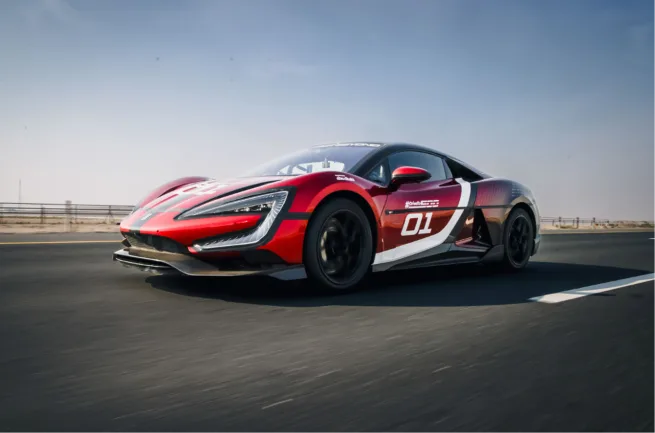
The YANGWANG U9 Xtreme reached 503.17 km/h on a closed highway in Abu Dhabi on November 1, 2026, taking its speed-record program beyond the German proving ground where it had set its previous benchmark. For tire partner Giti, the attempt brought more than three years of development into a new setting, with road preparation and overnight vehicle adjustments preceding the successful run.
Driven by Marc Basseng, the electric hypercar exceeded its previous German benchmark on a secured stretch of the E11 highway. The FIA recognized the achievement and reported Guinness World Records titles for production cars and electric production cars in a single-direction run. Giti announced a separate Guinness title for the highest speed achieved by electric vehicle tires, earned with its GitiSport e.GTR 2 Pro.
The preparation behind the number shows how tire development, suspension behavior and aerodynamics came together when the team changed venues.
A new setting for an established project
The U9 program had already made substantial progress before arriving in the United Arab Emirates. The FIA records a 309 km/h test by the original U9 in January 2024, followed by 391.94 km/h at ATP Papenburg that October. The U9 Xtreme subsequently reached 472.41 km/h in August 2025 and 496.22 km/h in September.
Those milestones established a development history; they did not eliminate the work required at a different location. BYD’s account describes a road used by ordinary traffic near the desert. Preparing it included sweeping and further checks for debris, down to wire particles that cleaning brushes could leave behind.
The route became part of the engineering assignment: an established car and tire combination still needed preparation for a different surface.
Putting the speed into perspective
At a constant 503.17 km/h, the car would cover approximately 140 meters each second. That conversion illustrates the scale of the peak speed; it is not the average speed over the course.
The increase over September 2025 was 6.95 km/h, or about 1.4 percent. A small percentage can cross a conspicuous threshold, but it does not tell us how difficult the gain was to achieve. That requires looking at the development and preparation behind the result.
Why the tire was developed for this car
Giti describes the e.GTR 2 Pro as the product of more than three years of collaboration with YANGWANG. Its construction includes aramid reinforcement and an Anti-Standing Wave Structure intended to manage deformation at extreme rotational speeds. According to Giti, the latter had already been tested indoors at 500 km/h before the Abu Dhabi result.
The company’s earlier account of the 2025 runs explains additional design priorities. It identifies compound development intended to improve tensile and tear strength, a racing profile intended to distribute pressure more evenly, and sidewall design intended to improve support. These details describe how Giti approached the tire’s development; they are manufacturer statements rather than independent comparisons with competing products.
Taken together, the design priorities explain why a tire cannot be understood only by its tread pattern. Rubber composition, internal reinforcement and geometry address different parts of the task. The visible surface is one element of a complete structure developed for a particular application.
Indoor testing gave Giti a controlled setting to develop the tire. The highway attempt brought that work into contact with the road surface, suspension response and aerodynamic loads of the complete car.
What changed before the successful run
BYD reports that the first day of running, October 31, produced a maximum of 490 km/h. The team then worked overnight on preparation and setup. Changes included battery and motor temperature preparation, the rear-wing angle, suspension software and tire pressures.
The suspension changes responded to subtle variations in the road surface, while the wing adjustment increased rear-axle downforce. Two more runs followed on November 1, with the second producing 503.17 km/h. This sequence makes the record an account of observation and revision, rather than simply an attempt to deploy the car’s available power.
Giti says its engineers refined the tires with input from YANGWANG and Basseng and supported the latest attempt. That work connected component development with the behavior of the complete vehicle. A driver’s feedback and the team’s adjustments could inform the next run, while the tire remained part of the same coordinated setup.
Where everyday EV tires enter the picture
The specialized demands of the U9 Xtreme sit within a much wider discussion about EV tires. Giti’s broader EV information emphasizes load support, rolling resistance and quiet comfort as well as grip and durability. Those priorities describe a different balance from chasing a maximum speed on a secured course.
The GitiControl P10 illustrates that distinction within the company’s own range. Giti positions this passenger car tire around comfort, noise reduction and control, and identifies it as EV-ready. It is a separate product from the e.GTR 2 Pro fitted to the record car.
The connection is a shared manufacturer working on different vehicle requirements, not evidence that the two tires deliver the same performance. The record provides a specific achievement for the bespoke tire and its vehicle. Everyday product claims still need evidence relevant to the model and conditions concerned.
About Giti and the next stage of its engineering story
Singapore-headquartered Giti traces its origins to bicycle tires and inner tubes produced in Indonesia in 1951. Its published history records the establishment of the Giti name in 1993 and subsequent international expansion. The YANGWANG collaboration adds a highly specialized electric-vehicle project to that longer manufacturing history.
The move to Abu Dhabi extended that history through a demanding change of venue. Earlier tests supplied the starting point; road preparation, driver feedback and overnight setup changes helped the team complete the next stage. The published account does not isolate how much speed any one adjustment contributed.
For Giti, the result places its tire engineering inside a documented development sequence: construction and indoor testing, successive vehicle benchmarks, then support for a run above 500 km/h on a secured highway. That sequence gives the record substance beyond the headline number and shows how a specialist tire program contributes to the performance of the complete vehicle.